Buck
The Call of the WildBuck is the central character of The Call of the Wild and the novel’s decisive study of transformation. Once a privileged companion at Judge Miller’s estate in the Santa Clara Valley, he is carried into the Northland as a working animal, where the club, the harness, the trail, and the fang strip away the assumptions of civilized life. He does not merely survive that world: he masters its codes, discovers capacities buried beneath domestication, and ultimately becomes the legendary leader of a wolf pack.
Identity and Early Life
Buck begins as a magnificent, one-hundred-and-forty-pound dog born to Elmo, a huge St. Bernard, and Shep, a Scotch shepherd dog. For four years he lives at Judge Miller’s expansive home in the Santa Clara Valley, a domain of stables, servants’ cottages, lawns, orchards, pastures, and berry patches. He is neither confined house dog nor obscure kennel dog. The whole estate is his realm, and he moves through it with the authority of a sovereign.
His privileged position is expressed through many forms of service and companionship. He swims in the tank, hunts with Judge Miller’s sons, escorts Mollie and Alice on their walks, rests before the library fire, and carries or guards the Judge’s grandsons. Among the terriers he stalks imperiously, while the household’s smaller dogs scarcely merit his attention. Humans as well as animals fall within the territory he rules, and his confidence is supported by both size and universal respect.
Yet Buck is not merely pampered. Outdoor exercise keeps him lean and muscular, while hunting and his love of water prevent him from becoming a soft house pet. He possesses the pride of a well-fed aristocrat, but the physical preparation that later enables him to endure the Northland is already present in his body. His civilized identity therefore contains an unrecognized reserve of strength: domestication has shaped him, but it has not exhausted what he is capable of becoming.
Abduction and Education in Violence
The Klondike Gold Rush changes Buck’s fate before he can know that the change is coming. Men rushing toward the Northland need heavy, muscular dogs with thick coats, and Buck becomes valuable precisely because his body suits the demands of frozen labor. Manuel, a gardener’s helper whose gambling has left him desperate for money, betrays him into captivity. Buck is removed from Judge Miller’s estate and made part of a commercial traffic in animals created by the search for gold.
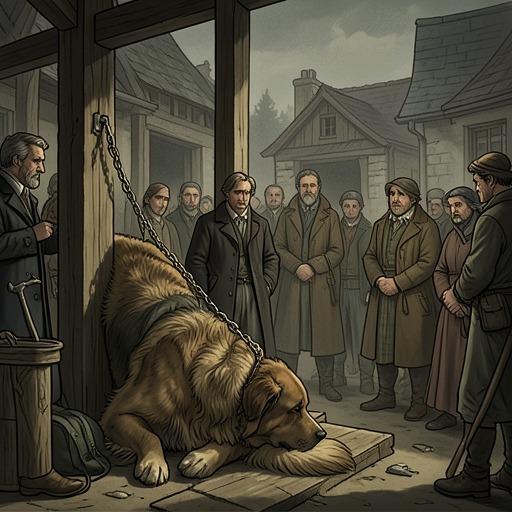
His first lesson in the new order comes from the Man in the Red Sweater, who beats him with a club. Buck resists until the weapon makes resistance impossible. He is beaten, but not broken; he learns that no dog can prevail against a man with a club, and that the club is the governing revelation of his new existence. This knowledge does not produce submission in any lasting moral sense. Instead, it awakens caution, calculation, and the latent cunning needed to live under the Law of Club and Fang.
In the Northland, there is no peace, rest, or dependable safety. Men and dogs are shaped by conditions in which every moment may threaten life or limb. Buck’s education becomes collective as well as personal when Curly approaches a husky and is attacked without warning. Thirty or forty huskies form a silent circle, waiting until Curly is thrown down; then they close over her and tear her apart. Francois and several men drive the dogs away with clubs, but Curly is already dead. Buck understands that there is no fair play in this world: once an animal falls, the end has come. The scene returns to him in sleep, and his hatred of Spitz begins when Spitz visibly laughs at it.
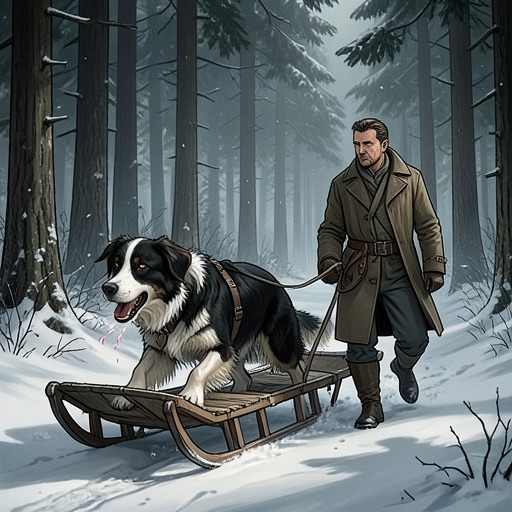
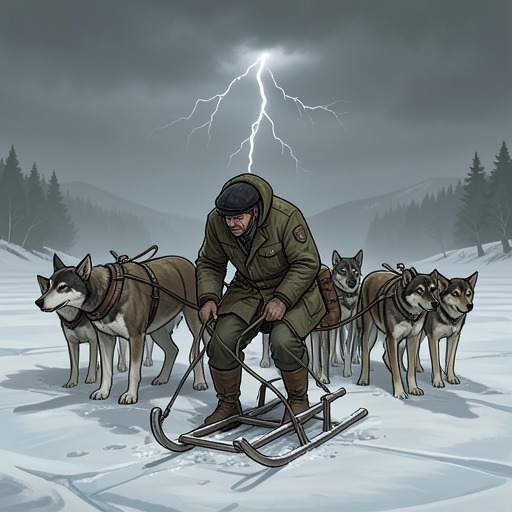
Soon afterward Buck is fitted with a harness and set to hauling a sled. The work initially wounds his dignity, but he is too intelligent to rebel against what the whip and the team demand. Positioned between Dave and Solleks, he learns through their corrective bites, Francois’s discipline, and the practical demands of the traces. He masters the work quickly. The team crosses the Canyon, Sheep Camp, the Scales, glaciers, deep snowdrifts, and the Chilkoot Divide before reaching the great camp at Lake Bennett. The route’s scale establishes that Buck’s transformation is forged through repeated labor, exposure, fatigue, and danger rather than through a single symbolic revelation.
Instinct, Rivalry, and Leadership
The life of the trail hardens Buck physically and sharpens every sense. His muscles become hard as iron; he grows resistant to ordinary pain and able to extract nourishment from almost any food. He learns to bite ice from between his toes, break the crust over a water hole with his forelegs, and forecast the wind by scent, finding shelter before the weather arrives. These are not ornamental talents. They are practical forms of knowledge that allow him to remain alive in an environment where ice, cold, hunger, and distance govern every movement.
At the same time, domesticated generations fall away from him. Ancient instincts return: the quick wolf snap, the slash and bite of pack fighting, the memory of ancestral dogs ranging through primeval forests and running down living meat. When Buck howls beneath the stars, the sound is presented as an ancestral voice passing through him. His development is therefore both progress and retrogression: he becomes more capable by moving away from the identity imposed by civilized ownership and toward the older life encoded in his breed.
That recovery first takes political form in his conflict with Spitz. Buck initially avoids open battle, but when he finds Spitz occupying his snow nest, the beast within him erupts. Their rivalry is interrupted by starving huskies who invade camp, overturn the grub-box, and fight through the men’s clubs for bread and bacon. The attack leaves the dogs wounded and the camp in chaos, but it also intensifies the struggle between the two rivals.
Buck begins to undermine Spitz’s authority deliberately. When Pike is buried beneath a snowfall in his nest, Buck intervenes as Spitz moves to punish him. Francois beats Buck repeatedly with the whip and its butt, yet Buck refuses to abandon the mutiny. Thereafter he continues to interfere craftily whenever Francois is absent, encouraging general insubordination and keeping the team in continual friction. The dogs eventually reach Dawson with the decisive contest still unresolved.
The contest comes after Buck leads the team in a chase after a snowshoe hare. Sixty dogs pursue the animal under the pale moonlight, and Buck experiences the chase as an intimate bloodlust: he wants to overtake living meat and kill it with his own teeth. The pursuit makes visible the distance between his former estate life and the older predatory energy now moving through him.
When Buck and Spitz finally fight, Buck is bleeding and exhausted while a silent circle of dogs waits to devour whichever combatant falls. Buck survives because instinct is joined to imagination. Instead of repeating a familiar shoulder maneuver, he sweeps low and breaks Spitz’s left foreleg, then his right. Spitz is left on three legs before the circle he once used against defeated dogs. Buck completes the attack, kills him, and stands as the successful champion and dominant primordial beast.
Leadership follows immediately. Buck takes the head of the team and proves superior to Spitz in judgment, quick thinking, and quick action. He also enforces discipline. Pike, who habitually loafs, is shaken until he pulls properly; Joe, whom Spitz had failed to subdue, is overwhelmed and beaten into submission; and new huskies are rapidly trained. Dave and Solleks accept the change because their concern is work, but the wider team regains its former solidarity under Buck. His authority is not merely ceremonial: he makes the dogs move together as one working body.
Love, Labor, and the Human Bond
Buck’s transformation does not consist solely of violence. After being rescued by John Thornton, he enters a different kind of relationship with humans. Skeet tends his wounds each morning, and Nig offers companionship without jealousy. Their friendliness, along with the games shared by the dogs and John Thornton, carries Buck through convalescence into a new existence.
John Thornton awakens in Buck a form of love he has never known. At Judge Miller’s estate, Buck’s relations had been affectionate but structured: partnership with the Judge’s sons, guardianship toward the grandsons, and a dignified friendship with Judge Miller. Thornton’s bond is more passionate and physically expressive. Thornton treats Buck’s welfare as he would a child’s, remembers kind greetings and encouraging words, and enjoys sitting with the dogs to talk. His rough embraces and affectionate insults become signs of love to Buck.
Buck answers in a corresponding language of his own. He takes Thornton’s hand in his mouth and bites hard enough to leave the impression of his teeth, a gesture Buck intends as a caress and Thornton understands as one. This relationship gives Buck a reason to remain connected to human life even as the wilderness grows stronger within him. It also complicates any simple opposition between civilization and nature: affection, trust, and mutual recognition can exist within human companionship, but only when authority is no longer based on exploitation or the club.
Final Transformation and Ending
Buck’s wild identity becomes unmistakable when he enters the forest. There he moves softly and cat-footedly, uses cover, crawls like a snake, and kills ptarmigans, rabbits, fish, and beavers for food. He prefers what he kills himself, and his occasional release of terrified squirrels shows that hunting has become both survival practice and a field for his own intelligence and play.
His appetite for greater quarry leads him to a bull moose more than six feet high, bearing fourteen-point antlers that span seven feet and an arrow lodged near the flank. Buck cuts the bull away from its herd by dancing just beyond the reach of antlers and splay hooves. The encounter places him within the full scale of the wild food chain: he is no longer merely enduring nature but acting as a skilled predator within it.
The last human tie is severed when the Yeehats attack the camp and John Thornton dies. Buck returns to find that the man who saved him is gone. As night comes, the call of the wolves approaches, and Buck recognizes it as more compelling than ever. Without Thornton, the claims of human life no longer bind him. The choice that follows is not a sudden conversion but the culmination of every earlier change: the club taught him the limits of human force, the harness taught him collective labor, Spitz taught him dominance, Thornton gave him love, and the forest restored his ancestral freedom.
A wolf pack enters Buck’s valley, and he faces it alone in the moonlit clearing. He kills the first attacker by breaking its neck, wounds three more, and holds the pack at bay for half an hour from a protected angle in a gravel bank. The wild brother he once followed approaches, and the two touch noses. An old wolf then begins the long howl; the pack joins him, and Buck answers. When the leaders move into the woods, Buck runs with the wolves, side by side with his wild brother.
The ending turns Buck into legend. The Yeehats speak of a Ghost Dog with brown markings, a white chest, cunning enough to rob traps, kill dogs, and defy hunters. Some hunters fail to return, and the tribe avoids the valley where the Evil Spirit is believed to dwell. Yet Buck still visits the abandoned human camp in summer, where he pauses beside the yellow stream flowing from rotted moose-hide sacks and howls mournfully before departing. In winter he runs at the head of the pack beneath moonlight or borealis, singing the pack’s song. He has not simply escaped civilization; he has become a figure through which memory, grief, predation, and the younger world of human legend continue to meet.