Buck's Decivilization
The Call of the WildBuck's Decivilization names the central state of transformation through which Buck passes from a respected domestic aristocrat into a disciplined sled dog, a calculating fighter, and finally a wolf-like leader of the wild. The process begins when human violence and the Northland's conditions strip away the protections of Judge Miller's estate. It produces hunger, stealth, bodily resilience, tactical intelligence, and a return of ancestral instincts; yet it does not erase Buck's capacity for passionate attachment, as his love for John Thornton coexists with his primitive lawlessness.
Definition and Southland Origin
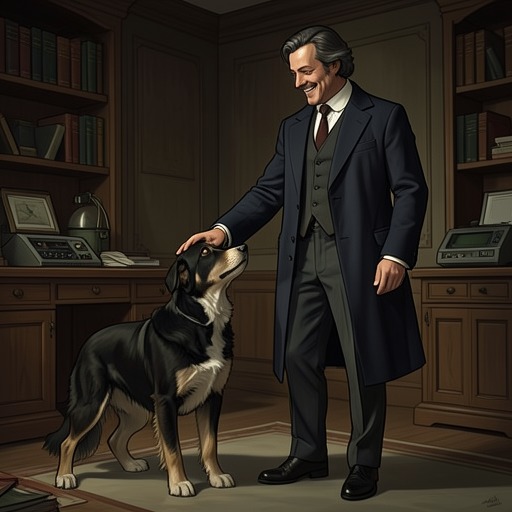
Buck's Decivilization is a loss of civilized conditioning and a recovery of older, more primitive capacities. In his first life, Buck ruled Judge Miller's great Santa Clara Valley estate rather than belonging merely to its house or kennels. He swam in the cement tank, hunted with the Judge's sons, escorted Mollie and Alice on rambles, carried the Judge's grandsons, and guarded them through the paddocks and berry patches. At one hundred and forty pounds, he possessed the dignity of good living and universal respect, while outdoor activity kept him muscular rather than pampered. His relationship to the estate was therefore one of authority, security, and social inclusion: he was treated as a kind of king among its humans and animals.
That identity is violently severed by Manuel's treachery. While the Judge is away at a meeting and the boys are occupied, Manuel leads Buck through the orchard to College Park, where a stranger pays him and binds a stout rope around Buck's neck. The sale converts a celebrated companion into merchandise and places him outside the protection of the household. The decisive lesson follows when the man in the red sweater beats him with a club. Buck repeatedly attacks, but each charge is smashed down; after the beating, he understands that he cannot prevail against a man with a club. He is beaten but not broken, and the club becomes a revelation: the first instrument of the primitive law that will govern his new existence.
Threshold into the Northland
The transition is also environmental and bodily. Aboard the Narwhal, Buck senses the weather growing colder and encounters snow for the first time when his feet sink into a white substance that bites his tongue like fire before disappearing. His puzzlement marks the beginning of an education in a world whose physical conditions demand immediate learning. Soon the dogs and men around him reveal that the Northland is governed not by the assumptions of town life but by the law of club and fang.
Curly's death gives Buck this law in its most unforgettable form. After a husky tears her face open, the watching dogs form a silent circle, waiting for her to fall. When she is thrown down, thirty or forty huskies close over her and tear her apart before Francois and the men can scatter them. Buck learns that there is no fair play and that once a dog goes down, the end is near. The scene returns to him in sleep, and it fixes both his fear of helplessness and his determination never to be the one who falls. It also turns his first hostility toward Spitz into a bitter, deathless hatred.
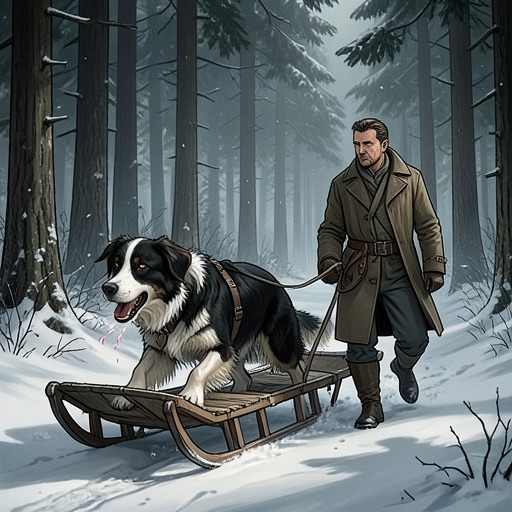
Harness work completes his social displacement. Francois straps Buck into a dog harness and makes him haul a sled to the forest and return with firewood. His dignity resists the degradation of becoming a draught animal, but he does not rebel; the whip demands obedience, Dave corrects his errors by nipping his hindquarters, and Spitz reinforces the discipline with sharp growls. Through labor, hunger, and repeated exposure to danger, Buck is not simply imprisoned in a new role. He is resocialized into the working order of the Northland, where competence is the condition of survival.
Adaptation, Theft, and the Primitive Body
Hunger accelerates Buck's decivilization. He works from before dawn until after dark, sleeps in the snow, and receives a pound and a half of dried salmon that never satisfies him. Because faster companions steal unfinished portions, he abandons the fastidious eating of his former life and learns to consume his ration quickly. He then observes Pike secretly stealing bacon and repeats the maneuver, taking an entire chunk while Perrault's back is turned. The theft succeeds, while Dub is punished because he is the obvious culprit.
The episode changes Buck's relation to property and moral restraint. In the Southland, private property and personal feeling had belonged to a functioning social order; in the Northland, observing such rules at the expense of one's survival would be foolish. Buck does not steal for pleasure or openly challenge authority. He steals because his stomach demands food, and he does it secretly because the club and fang have taught him that evasion is safer than moral confrontation. His decivilization is therefore practical before it is ideological: he unconsciously accommodates himself to a new system because doing so is easier than refusing it and more likely to keep him alive.
The change reaches into every part of his body. His muscles harden like iron, ordinary pain loses its power, and his digestion extracts nourishment from food that would once have seemed loathsome or indigestible. His sight, scent, and hearing sharpen; while asleep, he can distinguish a sound promising peace from one announcing peril. He bites ice from between his toes, breaks the crust over a water hole by striking it with stiff forelegs, and scents the wind well enough to forecast its direction a night ahead, digging his sleeping nest where the later wind will leave him sheltered. Adaptation becomes an embodied intelligence rather than a collection of learned commands.
Instinct, Violence, and Leadership
As Buck adjusts to the Northland, instincts that domestication had suppressed become active again. He learns the quick wolf snap and the cut-and-slash manner of fighting without the labor of discovery, as though the techniques had always belonged to him. His nighttime howling is presented as an ancestral recurrence: through Buck, the dead dogs of earlier generations seem to point their noses toward the stars and voice the cold, darkness, and stillness of the world. His primitive inheritance is thus both biological and imaginative, joining practical survival with a sense of memory deeper than individual experience.
Buck's conflict with Spitz demonstrates that decivilization also alters his place within a group. He openly threatens Spitz's leadership by intervening when the leader tries to punish Pike for hiding beneath the snow. Francois lashes Buck and strikes him with the whip's butt, but Buck refuses to withdraw. Thereafter he continues his interference covertly, provoking general insubordination and making the team increasingly disorderly. Buck is no longer merely adapting to the hierarchy imposed on him; he is testing and destabilizing it, preparing to replace its leader.
The eventual battle with Spitz makes his new intelligence unmistakable. In the moonlit snow, surrounded by a silent circle of sixty dogs, Buck recognizes that the encounter is a fight to the death and experiences the scene as something ancient and familiar. Spitz's experience and defensive skill initially keep Buck's fangs from the throat, and Buck is cut, exhausted, and bleeding. He then combines instinct with imagination, feinting with the old shoulder attack before sweeping low and biting Spitz's left foreleg. The breaking bone leaves Spitz on three legs; Buck repeats the maneuver against the right foreleg, defeating the leader through tactical invention rather than mere force. With the pack closing in, mercy has no place in the law Buck now obeys: the defeated must be mastered or destroyed.
Love, Contradiction, and the Wild Ending
Buck's decivilization never wholly extinguishes his capacity for attachment. After John Thornton rescues him from Hal's beating, Buck heals beside Thornton, Skeet, and Nig. Skeet cleans his wounds each morning, Nig offers unforced friendliness, and both dogs share Thornton's kindness rather than treating Buck as a rival. Their games draw Buck into a new existence, but Thornton awakens something more intense than the dignified companionship he once had with Judge Miller or the practical partnership he shared with the Judge's sons. For the first time, Buck experiences passionate love and adoration.
His devotion has a distinctive form. He watches Thornton's face and every change in his expression, sometimes from a distance, and their silent looks become a form of communion. He follows Thornton from tent to tent because earlier masters—Perrault, Francois, and the Scotch half-breed—had disappeared from his life, leaving him afraid that no master could remain. At night he wakes from dreams and listens at the tent flap to Thornton's breathing. This anxiety reveals that the wild transformation has not made him indifferent; it has made permanence precious and precarious.
At the same time, Buck's love exposes the complexity of his altered nature. He will not steal from Thornton, but he steals readily from other camps, using the cunning that allows him to escape detection. He remains devoted and wild, a creature who has come in from the wilderness to sit by a human fire rather than a soft Southland dog marked by generations of civilization. Even under Thornton's protection, Buck fights strange dogs with greater skill and no mercy, obeying the rule that one must master or be mastered, kill or be killed.
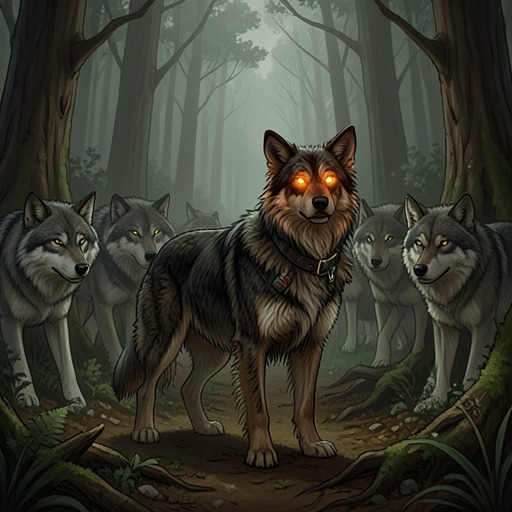
The final movement carries decivilization beyond the human world. When Thornton is killed, Buck attacks the Yeehats and then faces a wolf pack, defending himself from its assault until the wolves withdraw. He recognizes a wild brother, touches noses with him, and answers the old wolf's moonlit howl. When the pack runs into the woods, Buck runs beside his wild brother. Later, the Yeehats speak of a Ghost Dog with brown markings and a white chest, a cunning animal that steals from camps, robs traps, kills dogs, and defeats hunters. Buck's return to the wild is therefore not a retreat into anonymity. He becomes the legendary leader at the head of the pack, while the valley associated with his final violence becomes a place the Yeehats fear to enter. The state of decivilization ends as a new belonging: Buck has shed the last binding claims of domestic society and come fully into the ancestral life that the Northland awakened in him.