Buck's Kidnapping
The Call of the WildBuck's Kidnapping is the decisive rupture at the beginning of Buck's story: a trusted domestic world ends, and Buck is forced into a world where dogs are bought, sold, transported, disciplined, worked, starved, and killed according to the demands of money and the trail. The event is not merely a change of ownership. It is the first violent exposure of a powerful animal to an economic and physical order in which human authority can be enforced by rope, clubs, harnesses, and hunger.
Causes and Background
Buck had been raised in the Santa Clara Valley as the privileged companion of Judge Miller. His father, Elmo, was a huge St. Bernard and the Judge's inseparable companion; his mother, Shep, was a Scotch shepherd dog. Buck himself weighed one hundred and forty pounds and carried the dignity of good living and universal respect. For four years after puppyhood he had lived as a sated aristocrat, proud and somewhat egotistical, but outdoor hunting and his love of water had kept him muscular rather than merely pampered.
The wider crisis came with the Klondike strike in the fall of 1897, which drew men from across the world into the frozen North and created an exceptional demand for dogs. Buck knew nothing of newspapers, northern commerce, or the danger posed by Manuel, one of the gardener's helpers. Manuel had a wife and numerous children, wages that did not cover his needs, and a consuming passion for Chinese lottery. His faith in a gambling system required money he did not possess, and Buck became the means by which he sought it.
The abduction was therefore enabled by two forces operating together: Manuel's private desperation and the public demand generated by the Klondike Gold Rush. Dogs had become valuable transport animals. Later, the man in the red sweater could ask three hundred dollars for Buck, and Perrault recognized that such a price was justified by the extraordinary demand and by Buck's unusual quality. The transaction reveals the human market behind the adventure: Buck's life is treated as property before he has any opportunity to understand that his social status has changed.
Deception and Abduction
The Judge was away at a meeting of the Raisin Growers' Association, while the boys were organizing an athletic club. No one saw Manuel lead Buck through the orchard, and Buck believed that the walk was ordinary. At the little flag station called College Park, a solitary stranger met Manuel; money changed hands, making the purpose of the meeting unmistakable even though Buck could not interpret it.
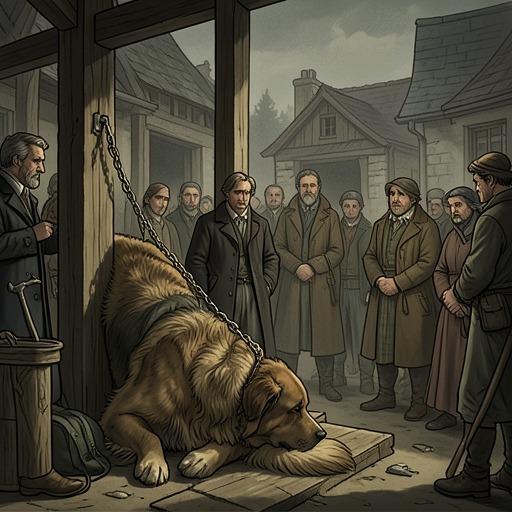
The stranger ordered Manuel to wrap up the goods before delivery. Manuel then doubled a piece of stout rope around Buck's neck beneath the collar and advised twisting it tightly enough to choke him. Buck accepted the rope with quiet dignity because he trusted familiar men and assumed that human wisdom exceeded his own. His first growl was meant as a command, a proud warning that he expected to be obeyed. Instead, the stranger tightened the rope and cut off his breath.
Buck attacked in sudden rage. He sprang at the stranger, but the man grappled him by the throat and threw him onto his back. The rope tightened mercilessly while Buck struggled, his tongue lolling and his great chest panting without effect. He had never been treated so vilely and had never been so angry, yet physical strength could not overcome the method used against him. His strength ebbed, his eyes glazed, and he lost consciousness before the train was flagged and the two men threw him into the baggage car.
The train completes the separation begun at College Park. Buck's former identity as a respected household animal has no protection once he is placed among freight. When he recovered partial awareness, he felt his injured tongue and the jolting of the conveyance, then recognized the hoarse locomotive whistle and understood that he was in a baggage car, a sensation familiar from earlier journeys with the Judge. The recognition makes the abduction more terrible: a familiar form of travel has been retained, but its meaning has been transformed from privileged companionship into captivity.
Sale and Northern Passage
Buck's first response after awakening was not submission but renewed resistance. The man sprang for his throat, and Buck's jaws closed on the man's hand. He held on until his own senses were choked out again. The captor then concealed the mangled hand from the baggage man by claiming that Buck had fits and was being taken to San Francisco for a boss and a dog doctor. The explanation is an intentional lie, and the story's withholding of the truth mirrors Buck's helpless ignorance: the human beings around him understand the transaction while he can only experience its violence.
The journey ends behind a saloon on the San Francisco waterfront, where the man speaks most eloquently for himself through what he does rather than through any trustworthy account. The abduction has moved Buck from the Judge's grounds to a concealed urban setting, from open land and social recognition to a place where a stolen animal can be hidden, restrained, and prepared for resale.
The next transfer is formalized when Perrault arrives and sees Buck. Perrault offers three hundred dollars and notes that the money is government money. The man in the red sweater accepts, and Buck is led away with Curly, a good-natured Newfoundland. The sale establishes Buck as a government-related transport asset, while Perrault's judgment identifies him as an exceptional dog rather than an ordinary purchase. From Buck's perspective, however, the transaction is experienced only as another unexplained removal.
Buck and Curly leave Seattle aboard the Narwhal, and the voyage marks the end of the warm Southland. Below deck, Perrault turns them over to Francois. Buck feels no affection for these new men, but he soon develops an honest respect for them because they are fair, calm, impartial, and too knowledgeable about dogs to be deceived. The contrast is crucial: the kidnapping begins with betrayal by a familiar human being, whereas the next stage introduces unfamiliar handlers whose competence and consistency allow a different, more disciplined relation to form.
From Captive to Working Dog
The abduction's consequences extend beyond the sale. Buck is placed between Dave and Solleks so that they can teach him the work of the team. He learns through correction from the other dogs and through Francois's whip, discovering that it is cheaper to mend his ways than to retaliate. When he becomes tangled in the traces and delays the start, Dave and Solleks administer a beating; the immediate result is an even worse tangle, but Buck thereafter takes care to keep the traces clear and soon masters his work. The stolen companion of the Judge is being converted into a skilled sled dog.
His new labor carries him across a geography utterly unlike the Santa Clara Valley. The team runs up the Canyon, through Sheep Camp, past the Scales and the timber line, across deep glaciers and snowdrifts, and over the Chilkoot Divide between salt water and the North. They descend through a chain of lakes formed in the craters of extinct volcanoes and reach the great camp at Lake Bennett, where thousands of gold-seekers are building boats for the spring breakup. Buck sleeps in a hole in the snow, is roused in the cold darkness, and is harnessed again before exhaustion has passed.
The route exposes the physical stakes of the new economy. One day the team makes forty miles on a packed trail; on following days it must break its own trail, work harder, and make poorer time. Perrault often travels ahead in webbed shoes to pack the snow, while his knowledge of thin fall ice protects both people and dogs. On the Thirty Mile River, open water and unstable ice require six days of exhausting travel. Perrault repeatedly breaks through ice bridges in temperatures of fifty degrees below zero, and once the sled breaks through with Dave and Buck, leaving them half frozen and nearly drowned before fire and forced movement save them.
The wider system treats even this extraordinary labor as replaceable. After Buck and his mates have covered twelve hundred miles with only two days of rest, official orders require fresh Hudson Bay dogs to replace those considered worthless for the trail. The exhausted animals are sold because dogs count for little against dollars. Buck's kidnapping thus inaugurates a recurring cycle: purchase creates an obligation to work, work produces exhaustion, and exhaustion reduces a living worker to a depreciated commodity.
Significance and Foreshadowing
The event also foreshadows the lesson Buck later learns from the man in the red sweater: human authority can be arbitrary, physical, and absolute. At the outset, Buck trusts the wisdom of men he knows and assumes that a growl can command. The rope teaches him that trust does not protect him from betrayal and that pride cannot overcome a weapon used by a stronger opponent. The later club scene makes the same principle explicit, but the kidnapping is its first practical demonstration.
The consequences reach far beyond Buck's immediate removal. His later work beside Dave and Solleks, his dangerous crossings of the Chilkoot Divide and Thirty Mile River, and his exposure to the exhaustion and disposability of sled dogs all originate in the sale at College Park. The same economic world eventually sends teams toward Skaguay, produces the deadly starvation under Hal, Charles, and Mercedes, and turns Buck's strength into a wager of one thousand dollars when John Thornton stakes it against Matthewson. In this sense, the kidnapping begins a transformation in which Buck's value is repeatedly measured by strangers: first as a stolen possession, then as government transport, later as labor power, and finally as a force capable of moving a thousand-pound sled load.
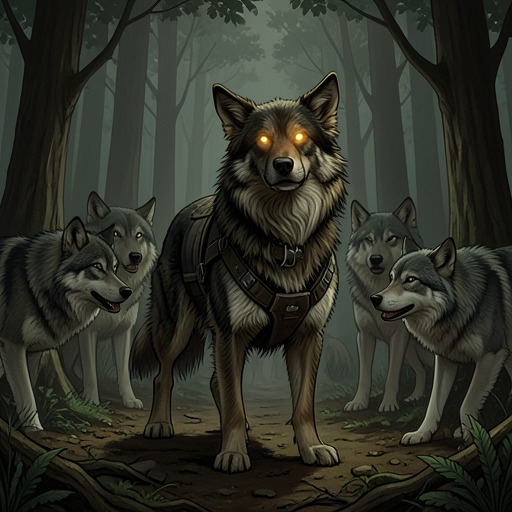
The event's deepest irony is that the act intended to monetize Buck releases capacities that his sheltered life had left unused. His aristocratic confidence is not erased, but it is forced into confrontation with ropes, clubs, snow, hunger, ice, and animal hierarchy. The kidnapped king does not simply lose civilization; he acquires knowledge of its violence and begins adapting to the law of the North. The first sale therefore functions as both dispossession and initiation, setting Buck on the path from Judge Miller's estate toward the wilderness where, after John Thornton's death, the call of the wolf pack can finally claim him.