Buck's Rescue by John Thornton
The Call of the WildBuck's Rescue by John Thornton is the turning point that carries Buck out of near death and into a new form of life. At White River, the starving dog refuses to pull a sled across ice he senses is about to collapse; John Thornton recognizes the danger, confronts Hal, cuts Buck free, and remains beside him as the expedition vanishes through the broken trail. The rescue changes not only Buck's immediate fate but also the emotional and moral direction of his story: coercion gives way to trust, and survival becomes the foundation of fellowship.
Causes and Background
The rescue grows out of a chain of hazards created by exhaustion, starvation, bad judgment, and violence. Earlier on the route, Perrault's team had endured the marauders' destruction of its supplies and harnesses, then struggled through the Thirty Mile River at the risk of drowning. Perrault repeatedly broke through ice bridges in temperatures registering fifty below zero, while Buck and Dave were once pulled from a collapse half-frozen and nearly drowned. Later, after the team reached better ice, Perrault drove the dogs hard to recover lost time. Buck's feet, softer than those of the huskies, became so painful that he limped all day, lay down like a dead dog at camp, and would not rise for his ration until Francois brought it to him. Francois rubbed his feet nightly and made four moccasins from the tops of his own, but Buck's temporary footgear only enabled him to continue an already punishing journey.
The team's condition deteriorated further under Charles, Hal, and Mercedes. They proudly assembled fourteen dogs without understanding that the sled could not carry sufficient food for so many animals. Their calculations reduced the expedition to pencil arithmetic: a ration per dog multiplied by the number of dogs and the number of days, without practical knowledge of the trail. The newcomers were hopeless, the old team had already covered twenty-five hundred miles, and Buck had covered the distance between Salt Water and Dawson four times. The travelers pitched camp without order, spent much of the morning breaking it, repeatedly stopped to rearrange badly loaded freight, sometimes covered fewer than ten miles, and never achieved more than half the distance assumed in their food calculation. The result was a team too depleted to meet the demands placed upon it.
John Thornton had already warned Hal that the ice was unsafe. Thornton stated that the bottom was likely to drop out at any moment and that only fools, aided by blind luck, could have reached White River; he would not risk his life on that ice for all the gold in Alaska. Hal answered with defiance and insisted on continuing to Dawson. His decision made Buck's refusal a conflict between practical knowledge and reckless authority: Buck's body, and perhaps his instinct, resisted a journey that Thornton had identified as mortal folly.
What Happens at White River
When the team fails to rise at Hal's command, the whip flashes across the exhausted dogs. Solleks, Teek, Joe, and Pike struggle painfully to their feet, but Buck makes no effort. This is not ordinary disobedience. It is the first time Buck has failed, yet he has decided not to get up because he feels an impending disaster on the ice ahead. The blows scarcely matter to him now: starvation and exhaustion have carried him toward numbness, until the club seems to strike a body already distant from him and the spark of life within him nearly goes out.
Hal exchanges the whip for the club and beats Buck more heavily, trying to force movement from a dog who can barely remain alive. Thornton watches, repeatedly seeming ready to speak, then walking irresolutely as moisture comes into his eyes. His hesitation ends when Buck's life is plainly at stake. Without warning, Thornton springs upon Hal and hurls him backward. He struggles to control a rage so intense that he can scarcely speak, then warns Hal that another blow will cost him his life.
Hal claims Buck as his property and threatens Thornton, declaring that he is going to Dawson. Thornton refuses to move. When Hal draws a long hunting knife, Mercedes descends into hysterical screaming, crying, and laughter while Charles watches without rising because of his stiffness. Thornton strikes Hal's knuckles with an axe-handle, knocks the knife down, strikes again when Hal tries to recover it, and then picks it up himself. With two strokes he cuts Buck's traces. The physical gesture is also a decisive reversal of ownership: the lines that have bound Buck to Hal's disastrous expedition are severed by the man who values Buck's life above the claim of property.
Buck is too near death to haul the sled, and Hal has little fight left while dealing with Mercedes. The remaining party departs with Pike leading, Solleks at the wheel, Joe and Teek between them, Mercedes riding the loaded sled, Hal guiding at the gee-pole, and Charles stumbling behind. Buck hears them go and raises his head to watch. The team is limping and staggering, but the full consequence of Thornton's warning becomes visible only moments later: the sled's rear drops as if into a rut, the gee-pole jerks upward with Hal clinging to it, Mercedes screams, and an entire section of ice gives way. Dogs and people disappear into the opening. The bottom has literally dropped out of the trail.
Immediate Consequences and Recovery
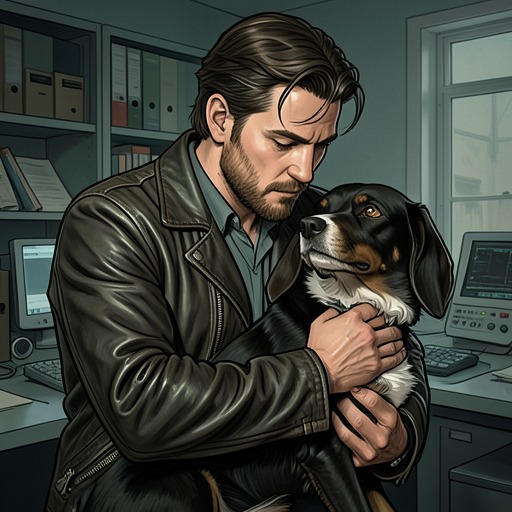
After cutting the traces, Thornton kneels beside Buck and searches him with rough but kindly hands for broken bones. He finds many bruises and a condition of terrible starvation, but no fracture. The rescue therefore has two dimensions: Thornton prevents the final beating, and he stays to assess the damage that violence and the trail have inflicted. The contrast with the departing expedition is stark. Hal's group treats Buck as a failing instrument of transport; Thornton treats him as a living creature whose injuries require attention.
Buck responds by licking Thornton's hand after Thornton calls him a poor devil. The gesture is small, but it establishes the emotional exchange that will define their relationship. Buck has known command, punishment, and the ownership implied by traces; here he encounters protective action followed by tenderness. His response is not merely gratitude for physical assistance. It marks the first visible movement toward the trust and fellowship through which he will recover.
Thornton's intervention also confirms the accuracy of the risk judgment that Hal dismissed. The warning about rotten ice is proved within minutes, while Hal's confidence collapses with the trail itself. Buck's refusal, previously treated as a failure demanding punishment, is retrospectively revealed as a life-preserving act. The event thus reverses the apparent hierarchy of knowledge: the exhausted dog perceives what the human driver refuses to accept, and the competent human rescuer understands the dog's refusal rather than destroying him for it.
Transformation of Buck's Life
The rescue opens the period in which Buck slowly regains his strength beside John Thornton. After Thornton had frozen his feet the previous December, his partners had left him to recover while they went upriver to Dawson; by the time he rescued Buck, his limp had nearly disappeared in the warm weather. Buck likewise lies by the river bank through the long spring days, watching running water and listening to birds and the hum of nature, while his strength returns. The setting contrasts with the compressed violence of White River. The broken trail, the club, and the frantic departure give way to rest, natural movement, and gradual restoration.
This recovery is not an isolated medical improvement. It prepares Buck for a different relation to work and action. Under Hal, hauling has become a mechanism of depletion: fourteen dogs are overburdened, food is miscalculated, discipline is chaotic, and blows replace judgment. Under Thornton, Buck's life is no longer measured solely by the force he can supply to a sled. The rescue creates the conditions in which his physical power, intelligence, and attachment can develop together rather than being consumed by an incompetent expedition.
The bond soon proves reciprocal in action. Later, while Hans, Pete, and Thornton guide a poling boat down dangerous rapids on Forty Mile Creek, Buck stays abreast of the boat on the bank, anxious and never taking his eyes off his master. When the boat overturns and Thornton is swept toward water in which no swimmer could live, Buck immediately enters the river, overtakes him after three hundred yards, and lets Thornton grasp his tail. Thornton eventually orders Buck to go when the current carries them toward the final destructive drop; Buck obeys only after a last look, then swims toward the bank and is dragged ashore by Pete and Hans. The White River rescue therefore begins a relationship in which protection moves in both directions: Thornton saves Buck from human violence, and Buck later risks himself to save Thornton from the river.
Narrative Significance
Buck's Rescue by John Thornton is an event of death narrowly averted and identity decisively changed. Its danger is environmental and human at once: rotten ice threatens the travelers, starvation weakens the dogs, and Hal's violence converts exhaustion into an immediate execution. Thornton's resistance interrupts that convergence. He does not simply offer a new owner; he rejects the assumption that ownership authorizes destruction and substitutes judgment, courage, and care.
The event also functions as a threshold between Buck's earlier imposed existence and the life that follows. He has been kidnapped, beaten with a club, introduced to snow, hardened by relentless trail work, exposed to madness in the team, and shaped by the fatal contest with Spitz. At White River, those experiences culminate in a body that refuses the command to proceed. Thornton's severing of the traces makes the threshold visible: Buck is separated from a failed human order just before that order is swallowed by the ice.
Its final irony gives the rescue its full force. The expedition that boasts of traveling in style with fourteen dogs cannot understand the basic conditions of Arctic travel, while the supposedly useless Buck survives because he refuses to obey a suicidal command. Thornton's intervention turns that refusal into life rather than punishment. From the moment Buck licks his rescuer's hand, the story's central relationship is no longer founded on service extracted by force, but on a fellowship whose later test will be Buck's own willing and dangerous devotion to John Thornton.