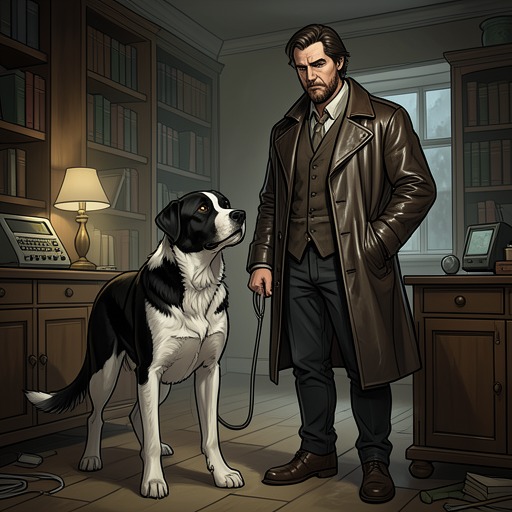
Buck–Francois relationship
The Call of the WildThe Buck–Francois relationship is the first sustained human partnership through which Buck learns the physical and social laws of sled work. Francois does not offer the domestic affection Buck once knew in the Southland, yet his calm authority, practical knowledge, and impartial treatment make him trustworthy within the violent world of the North. Under Francois’s direction, Buck acquires the skills, endurance, and pride that define his early life as a working sled dog.
Identity and First Impressions
Francois is a French Canadian half-breed, described as a black-faced giant and as twice as swarthy as Perrault. He and Perrault are unfamiliar kinds of men to Buck, representatives of the harsher northern world into which Buck has been sold. Buck develops no affection for either man, but he soon learns that both are fair, calm, and impartial in administering justice, and too knowledgeable about dogs to be deceived by them. That judgment establishes the basis of his relationship with Francois: respect comes before intimacy.
Francois’s fairness becomes concrete during Buck’s first meal aboard the Narwhal. A large white dog steals from Buck’s food while appearing friendly, and Buck springs forward to punish him. Francois’s whip reaches the culprit first, allowing Buck to recover his bone without being permitted to turn the incident into a reckless fight. Buck recognizes the intervention as fair, and the half-breed rises in his estimation. Francois therefore enters Buck’s life not simply as a captor or driver, but as a human whose force is governed by discernment.
Training Buck for the Traces
After Curly’s death, Francois fastens a harness of straps and buckles onto Buck and immediately sets him to hauling a sled to the forest and returning with firewood. The work wounds Buck’s dignity because it makes him a draught animal, but he is too intelligent to rebel blindly. Francois demands instant obedience and secures it through the whip; Buck’s training is coercive, but it is also systematic, intelligible, and directed toward a practical task.
Buck learns through a combination of human command and canine correction. Dave nips his hindquarters when he makes mistakes, while Spitz, the experienced lead dog, growls or throws his weight into the traces to jerk Buck into position. Francois’s whip backs up these lessons, making correction immediate and resistance costly. By the end of Buck’s first day, he can stop at “ho,” move ahead at “mush,” swing wide around bends, and keep clear of the wheeler when a loaded sled shoots downhill behind him. His body is being reorganized into the precise movements demanded by the team.
Francois quickly recognizes the result. He tells Perrault that Buck pulls exceptionally hard and learns with extraordinary speed. Perrault, eager to carry important Canadian Government dispatches with the best possible dogs, is especially pleased to possess him. Francois’s role is central to that assessment: he does not merely discover Buck’s strength; he makes the strength usable by teaching Buck the grammar of traces, speed, spacing, and obedience.
Discipline, Care, and Mutual Recognition
The relationship is not reducible to punishment. When Buck’s feet suffer under the long journey because they have not yet hardened like the huskies’ feet, Francois brings his ration of fish to him while Buck lies unable to move. Each night the driver rubs Buck’s feet for half an hour after supper, and he sacrifices the tops of his own moccasins to make four protective moccasins for Buck. The relief is so important that when Francois forgets the footgear one morning, Buck refuses to move until the moccasins are put on, lying on his back with all four feet raised appealingly. The episode reveals a working partnership in which Buck has learned to communicate a bodily need and Francois has learned to answer it.
Francois’s authority also helps Buck survive the team’s dangerous social order. Curly’s violent death has taught Buck that a fallen dog receives no mercy, and that lesson makes him wary of being overthrown. Francois does not erase this brutality, but he provides a human framework within it: commands are enforced, errors corrected, and useful effort recognized. Buck’s growing competence allows the traces to become less a humiliation than a field in which he can prove himself.
Buck’s transformation is visible when the full team leaves camp. Three more huskies bring the team to nine, and the dogs move toward the Yea Canyon. In harness, Dave and Solleks are utterly changed: their former passiveness disappears, replaced by alertness, activity, and fierce irritation at delay. Buck absorbs the same energy. The work becomes more than imposed labor; it becomes a source of purpose and pride. Francois’s training thus joins external discipline to an internalized “pride of trace and trail,” the powerful commitment that drives the dogs to keep working until their last strength is spent.
The Relationship within Buck’s Larger Development
Francois’s instruction helps prepare the conflict between Buck and Spitz. Francois predicts that Buck will one day attack Spitz, and from then onward the two dogs are at war. Spitz fears Buck because Buck is unusually strong, savage, cunning, and resilient, while Buck has learned from the man in the red sweater that rash blind courage is dangerous. His desire for leadership is patient and strategic rather than impulsive. Francois does not directly create Buck’s ambition, but his training gives that ambition a disciplined form.
The significance of the training is also shown by Buck’s endurance in the mail service. After the record run to Skaguay, Buck and the other dogs are transferred to a Scotch half-breed and sent back toward Dawson with the mail train. Buck dislikes the monotonous routine, yet he bears up well and takes pride in the work, ensuring that his teammates do their share. The later discipline of that labor rests on the foundation Francois established: commands have become habits, and the harness has become a structure in which Buck can exercise strength, judgment, and authority.
Separation and Lasting Significance
The bond ends because of official orders rather than personal betrayal. After the team completes a record run in which it averages forty miles a day for fourteen days, Francois and Perrault spend several days in Skaguay amid public admiration. Then the orders arrive. Francois calls Buck to him, throws his arms around him, and weeps; it is the last time Buck sees him. The farewell is brief but decisive, contrasting with the impersonal transfers that repeatedly remove people from Buck’s life.
Francois’s departure leaves no claim of ownership or romantic sentiment. Its force lies in what has been built and then abruptly severed: Francois has been the man who first harnessed Buck, corrected him, protected his feet, recognized his exceptional ability, and taught him to take pride in the work that would shape his future. The relationship demonstrates that control and care can coexist uneasily within a labor system that depends on animal bodies. Francois uses whip and command, but unlike later masters he also possesses knowledge, restraint, and responsibility. For Buck, that combination makes Francois the first northern human worthy of respect and the first trainer through whom his buried capacity becomes visible.