Buck–John Thornton relationship
The Call of the WildThe Buck–John Thornton relationship transforms both the meaning of human mastery and the direction of Buck’s life. John Thornton is the first human to care for Buck without reducing him to labor, profit, or obedience, while Buck answers that care with an intense devotion that is at once tender, possessive, watchful, and still unmistakably wild. Their bond reaches its fullest expression in Buck’s loyalty and protective violence, then becomes the emotional and structural cause of his final separation from humanity when John Thornton is killed.
Rescue and the Beginning of Trust
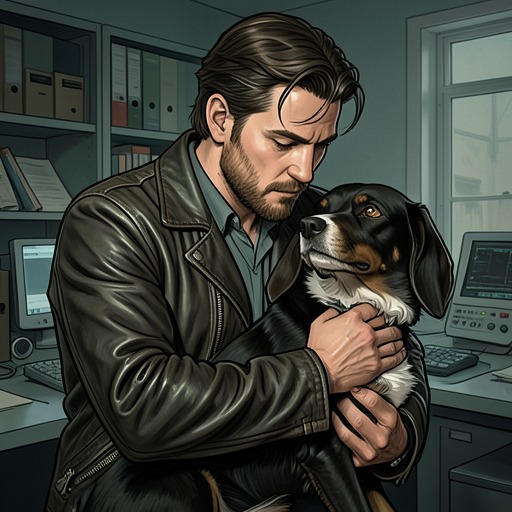
John Thornton enters the relationship at the moment when Buck has been reduced almost to bare life. After Hal’s repeated club blows, Buck is too exhausted and starved to rise; the beating has become distant to him, and the spark of life is nearly extinguished. John Thornton suddenly attacks Hal, hurling him backward and standing over Buck in uncontrollable rage. The rescue is therefore not a routine change of ownership. It is an interruption of violence: John Thornton places his own body between Buck and the man who is destroying him. John Thornton’s first care is practical but already personal. He searches Buck for broken bones, recognizes the terrible starvation beneath the bruises, and remains with him after Hal’s party leaves. As Buck watches the departing sled collapse through the rotten ice, John Thornton stays beside him; his pity is answered when Buck licks his hand. The gesture establishes a reciprocal recognition before Buck has recovered his strength. John Thornton does not merely acquire a damaged sled dog. He receives a living creature whose survival has been endangered by human power, and Buck begins to associate him with protection rather than coercion.
Care, Recovery, and a New Emotional Language
During the long spring days beside the river, Buck heals in the company of John Thornton, Skeet, and Nig. Skeet repeatedly cleanses his wounds, Nig welcomes him with an unjealous good nature, and John Thornton allows recovery to proceed through rest, companionship, and play. The dogs’ lack of jealousy reflects the largeness and kindness they share with John Thornton. Their games draw Buck into a new existence, while John Thornton’s participation makes care communal rather than merely supervisory. The emotional change in Buck is explicitly contrasted with his earlier life in the Santa Clara Valley. His relations with Judge Miller’s sons had been a working partnership, with the grandsons a kind of guardianship, and with Judge Miller a stately friendship. None of these bonds is dismissed as false, but none is the feverish, burning adoration John Thornton awakens. John Thornton’s importance lies not only in saving Buck’s body; he gives Buck an experience of passionate love for the first time. John Thornton cares for his dogs as if they were his own children, not from duty or business expediency but because kindness is inseparable from his character. He remembers a friendly greeting and a cheering word, and he delights in sitting with the dogs for long conversations, which he calls “gas.” His physical affection is rough and exuberant: he takes Buck’s head between his hands, rests his own head against it, shakes him back and forth, and calls him ill names that Buck understands as terms of love. Buck responds with a characteristic ambiguity, seizing John Thornton’s hand in his mouth and biting hard enough to leave the impression of his teeth. Each understands the other’s potentially aggressive gesture as affection. Buck’s devotion is usually quieter than Skeet’s or Nig’s. He does not constantly demand touch. Instead, he lies alert at John Thornton’s feet, studying every expression and movement, or watches him from a short distance. Their communication often becomes silent: Buck’s gaze draws John Thornton’s head around, and the man returns it with his heart visible in his eyes. This is a relationship in which attention itself becomes an exchange, and in which Buck’s animal presence is treated as communicative rather than mute.
Devotion Within a Still-Wild Nature
The bond with John Thornton does not restore Buck to the civilized dog he had been in the Santa Clara Valley. It makes his wildness more secure rather than removing it. Buck follows John Thornton whenever he leaves the tent because the transient masters of the Northland—Perrault, Francois, and the Scotch half-breed—have taught him that a master may disappear. Even at night, dreams awaken this fear; Buck creeps through the cold to the tent flap and listens for the sound of John Thornton’s breathing. His attachment therefore contains both adoration and anxiety, born from repeated separations and the uncertainty of human ownership. Yet the relationship also produces a moral distinction in Buck’s behavior. Because of his love for John Thornton, Buck cannot steal from him. From other men and other camps, however, he steals without hesitation, using enough cunning to avoid detection. John Thornton is thus not simply an object of generalized obedience. He is the exceptional human whom Buck voluntarily spares and serves, while Buck’s dealings with everyone else remain governed by the older calculations of the wild. That combination of tenderness and ferocity defines the relationship’s particular power. Buck’s body bears the teeth marks of many dogs, and he continues to fight as fiercely as before, but now he fights within a bond that recognizes his independent force. Earlier, his resistance to Spitz had become a covert mutiny: Buck intervened between Spitz and the dogs he wished to punish, endured Francois’s whip rather than abandon the intervention, and eventually defeated Spitz through tactical intelligence. Afterward, Buck imposed order as leader, shaking Pike for loafing, subduing Joe, restoring the team’s solidarity, and rapidly breaking in Teek and Koona. These experiences show that Buck’s capacity for leadership precedes John Thornton’s arrival; John Thornton’s significance is that he accepts and cherishes this powerful nature instead of trying to erase it.
Love Tested by Violence and Loss
John Thornton’s rescue changes Buck’s understanding of what a human relationship can be, but it does not prevent the world from making the bond vulnerable. Buck’s earlier history has taught him that ropes, harnesses, clubs, hunger, madness, and treacherous men can turn an apparently ordinary encounter into a struggle for life. Manuel’s sale of Buck for gambling money, the man in the red sweater’s repeated clubbing, Curly’s death beneath the huskies, Dolly’s madness, and the frozen trail all belong to the violent Northland order through which Buck has learned to survive. Against that background, John Thornton’s kindness appears not as a mild improvement but as an exception powerful enough to reorganize Buck’s emotional life. The exception is tested by mortality. When the Yeehats attack the camp, Buck returns after driving them away and finds Pete dead in his blankets and Skeet lying faithful to the last at the edge of the pool. John Thornton’s struggle is visible on the earth, and Buck follows its trace into the water, where no trace leads away. The hidden water contains John Thornton’s body; Buck understands that his master is dead. The discovery gives physical finality to the loss: the man whose breathing Buck once needed to hear at the tent flap has vanished without a surviving path back to the living. Buck’s grief is described as a great aching void akin to hunger, yet food cannot fill it. His mourning by the pool is not sentimental submission to civilization. It is the wound left by the one human relationship that had become indispensable. At the same time, Buck’s response to the Yeehats reveals the bond’s other side. He has killed men while obeying the law of club and fang, takes pride in having defeated the attackers, and recognizes that they are no match for him without their arrows, spears, and clubs. His violence is both revenge for John Thornton and a final demonstration that the man’s love has never domesticated the primitive power John Thornton protected.
The Last Tie and Buck’s Release
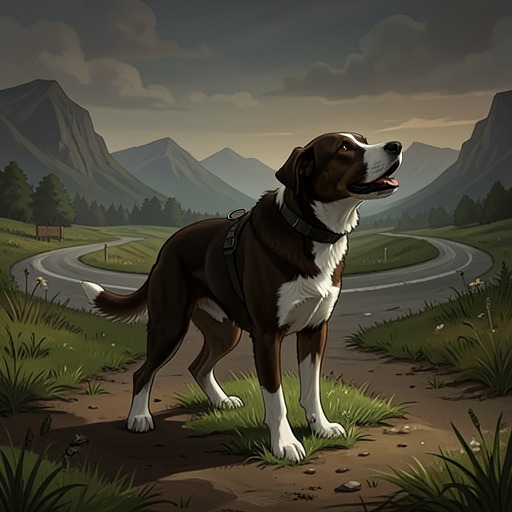
John Thornton’s death removes the last restraint binding Buck to human claims. That night, while Buck broods and mourns by the pool, he hears the many-noted call from the forest. He has heard it before, but now it is more compelling than ever, because John Thornton is dead and the final tie is broken. The narrative makes the causal connection unmistakable: Buck does not abandon John Thornton while he lives; only the irreversible loss of the beloved man opens the way to complete obedience to the forest. The arriving wolf pack first encounters Buck as a solitary power. He breaks the neck of the bold wolf that attacks him, wounds others, and holds the pack at bay for half an hour from an angle protected on three sides by a gravel bank. The scene repeats the structure of Buck’s earlier battles—an encircling group waiting to finish the defeated animal—but Buck now stands beyond the domestic hierarchy of the sled team. When a lean gray wolf approaches peacefully, Buck recognizes the wild brother with whom he once ran. An old, battle-scarred wolf then leads the pack in its long howl, and Buck answers. The exchange of howls functions as a passage from one belonging to another. Buck comes out from his defensive angle, allows the pack to crowd around him, and runs into the woods beside the wild brother. The movement is not a repudiation of John Thornton’s love. It is the consequence of that love’s destruction: John Thornton made Buck capable of an attachment deep enough to produce profound grief, and the grief releases the older life that had been waiting beneath the human bond.
Narrative and Thematic Significance
The Buck–John Thornton relationship is the novel’s clearest counterexample to ownership based on force. Buck has learned that commands can be enforced by the dog whip, that leadership can be established through fighting, and that the club can reduce an animal to helplessness. John Thornton’s authority works differently. He saves, touches, speaks to, watches, and trusts Buck; the relationship is sustained by mutual recognition rather than by the threat of punishment. The bond also preserves a productive contradiction at the center of Buck’s character. Love does not make him less capable of theft, combat, instinct, or leadership, and wildness does not make him incapable of loyalty, grief, or reciprocal affection. John Thornton is therefore neither a civilizing master who reforms Buck into a Southland pet nor merely a temporary owner on the northern trail. He is the human companion who allows Buck’s full nature to appear, including the part that ultimately cannot remain within human society. The ending converts personal bereavement into legend. After Buck joins the wolf pack, the Yeehats report changes in the timber-wolf breed, including brown markings on the head and muzzle and a white rift down the chest. They also tell of a Ghost Dog that leads the pack, steals from camps, robs traps, kills dogs, and defies hunters. The valley associated with this spirit becomes a place the Yeehats avoid. Buck’s continuing presence in their stories preserves John Thornton’s death as the founding wound of a new identity: the beloved human is gone, but the courage, intelligence, and fierce life awakened in Buck through their relationship survive in the Ghost Dog of the forest.