Buck–Judge Miller relationship
The Call of the WildThe Buck–Judge Miller relationship defines the protected world from which Buck is violently removed. At Judge Miller’s estate in the Santa Clara Valley, Buck is not merely housed or owned: he belongs to the entire social and physical order of the place, moving through it with authority, affection, and confidence. His later memories of that life measure the distance traveled by his body and instincts, even after the civilized bond has been broken by Manuel’s treachery and the demands of the northern dog trade.
Identity and Foundation
Buck lives at Judge Miller’s large country house, set back from the road behind trees, lawns, poplars, graveled drives, stables, cottages, orchards, pastures, grape arbors, and berry patches. The estate includes an artesian pumping plant and a cement swimming tank, making it not simply a home but a self-contained domain. Buck is born there and spends the first four years of his life there, growing within a stable hierarchy in which Judge Miller’s household is the center of his existence.
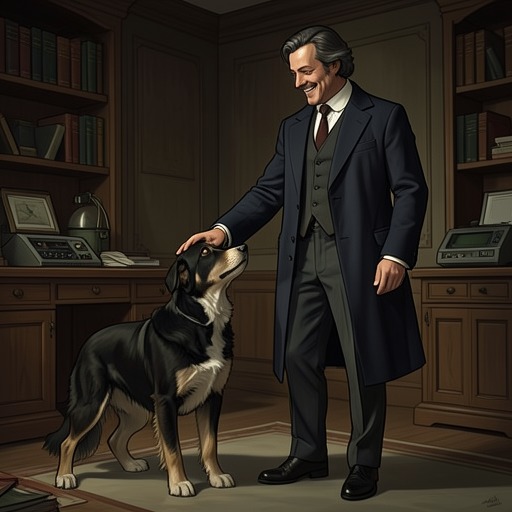
Buck occupies a distinct position among the estate’s many dogs. He is neither a house dog confined to indoor life nor a kennel dog reduced to one place; the whole realm is his. He swims in the tank, hunts with the Judge’s sons, escorts Mollie and Alice on their walks, rests at the Judge’s feet before the library fire, and carries or guards the Judge’s grandsons during their adventures. He moves among the terriers with imperious confidence and ignores Toots and Ysabel, behaving as the recognized king of the estate, humans included.
A Civilized Bond Without Pampering
The relationship rests on respect, familiarity, and a form of aristocratic belonging. Buck’s father, Elmo, a huge St. Bernard, had been Judge Miller’s inseparable companion, and Buck appears likely to inherit that role. Although Buck is smaller than his father, he weighs one hundred and forty pounds and carries the dignity produced by good living and universal respect. His life with Judge Miller gives him pride and even a touch of egotism, but it does not make him helpless.
Outdoor activity preserves Buck from becoming a merely pampered house animal. Hunting, swimming, and other pleasures harden his muscles and keep down his fat. The civilized life established by Judge Miller therefore contains both comfort and exercise: Buck is protected, yet he retains physical competence and an appetite for the outdoors. This combination helps explain why he can later endure the northern trail and respond to its demands, even though nothing in the estate prepares him for forced labor, violence, or commercial sale.
The Rupture Through Sale
The relationship ends not through a mutual decision but through betrayal within Judge Miller’s household. During the Klondike Gold Rush, the discovery of gold draws men northward and creates an enormous demand for strong, long-haired dogs capable of hauling loads and surviving frost. Manuel, one of the gardener’s helpers, needs money because of his gambling and his family obligations. While Judge Miller is away at a Raisin Growers’ Association meeting and the Judge’s sons are occupied with an athletic club, Manuel leads Buck away through the orchard under the pretense of an ordinary stroll.
At College Park, a solitary stranger pays Manuel and binds a stout rope around Buck’s neck. Buck does not understand that he is being delivered as merchandise until the rope tightens and choking replaces the familiar security of the estate. The transaction exposes the legal and economic vulnerability beneath his privileged life: the bond with Judge Miller may be intimate in practice, but Buck can still be removed as property when money and labor demand it.
The sale also reveals the historical scale of the forces overwhelming the relationship. Perrault pays three hundred dollars for Buck, with the man in the red sweater describing him as a valuable animal and noting that the money belongs to the Canadian Government. Perrault recognizes Buck as an exceptional dog, while the government’s interest is practical: the dog must help dispatches travel without delay. Buck’s worth is therefore translated into price, strength, and transport capacity rather than the companionship he had shared with Judge Miller’s household.
Memory Against the Northern World
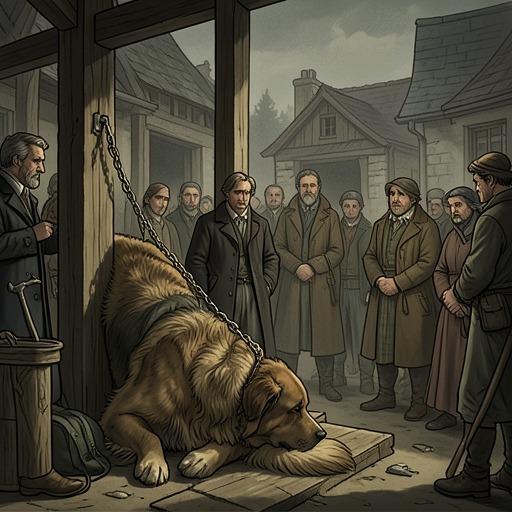
After leaving the estate, Buck enters a world governed by the club and fang. He watches dogs beaten by the man in the red sweater and learns that a man with a club is a lawgiver, a master to be obeyed. Curly’s death, when a circle of huskies tears her apart after she falls, gives him a second lesson: once down, a dog is finished. These experiences reverse the moral atmosphere of Judge Miller’s property, where Buck had guarded children, accompanied daughters, and ruled through confidence rather than fear.
Buck’s memories of the estate persist beside more immediate memories of violence, food, harness, and struggle. By the time he lies near a campfire, the big house, the cement swimming tank, Ysabel, and Toots have become dim and distant. He is not homesick. The past no longer commands him as it once did, because inherited instincts are becoming more powerful than recollections of the Sunland. The relationship with Judge Miller thus survives first as memory, then as a fading contrast to Buck’s awakening primitive life.
Consequences and Significance
Judge Miller’s household gives Buck the confidence, strength, and social assurance with which he meets the North, but the household cannot protect him from the wider system that turns dogs into transport assets. Northern institutions buy dogs for government work, replace those considered worthless, and sell exhausted animals after long mail runs. Later, Buck sees the lethal consequence of that system when Hal shoots Dub after the dog’s untreated shoulder injury worsens and the remaining Outside dogs die on the reduced ration intended for huskies.
The relationship’s deepest significance lies in its contrast with Buck’s later bonds. Judge Miller’s world offers affection, status, and civilized fellowship; the northern trail imposes obedience, labor, hierarchy, and survival. John Thornton’s rescue restores a different kind of trust when he cuts Buck’s traces and refuses to let Hal beat him again, but even that bond ends when John Thornton dies. Afterward, Buck joins the wolf pack, and the last tie binding him to human claims disappears. The memory of Judge Miller’s estate therefore marks the first stage of Buck’s life, not the destination to which he returns: it is the civilized origin against which his transformation into a wild leader becomes visible.