Canadian Government
The Call of the WildThe Canadian Government functions in the novel as both a public authority and an economic organizer of northern transportation. Its need to move important dispatches into the Klondike makes sled dogs valuable state equipment, but the same system treats them as purchasable, replaceable labor. Through that contradiction, the Canadian Government connects distant administration with the bodily suffering of dogs on the trail.
Government Transport and the Klondike Demand
The government’s presence is first felt through the Klondike strike of 1897, which drew people from across the world into the frozen North and sharply increased the price of dogs. When Perrault purchases Buck for three hundred dollars, the seller emphasizes that the money belongs to the government. Perrault accepts the price because the demand for dogs has risen so high, yet he also judges the purchase by its practical value: the Canadian Government will not lose money if its dispatches travel no more slowly. Buck is therefore acquired not as a companion but as an unusually capable component of a communications network.
The transaction places Buck inside an official transport structure. Perrault serves as a courier for the Canadian Government and actively seeks the best dogs for that work. Buck’s quick education delights him because efficiency is the government’s immediate concern: a dog that learns rapidly can be incorporated into the team and help preserve the speed on which official communication depends.
Discipline and the Sled-Dog Labor System
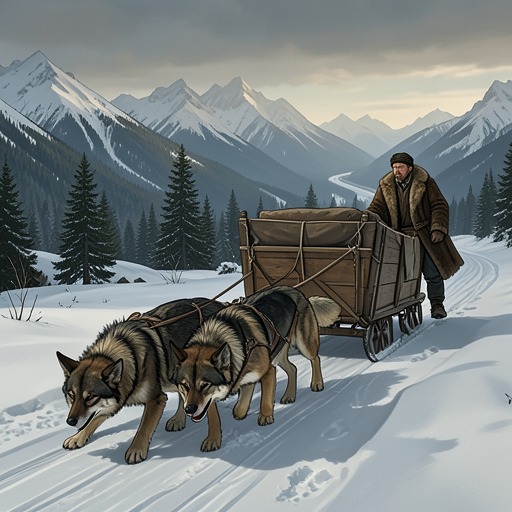
Once three additional Huskies join Buck and Curly, the team reaches nine dogs and is put into harness within the hour. The dogs move toward the Yea Canyon under a division of labor that assigns Dave as wheel dog, Buck behind him, Solleks next, and Spitz as leader. Buck is deliberately placed between experienced workers so that he can be trained through correction, while Francois’s whip backs up the other dogs’ sharp-teethed instruction. The system relies on specialized knowledge, supervision, and punishment to convert a captured animal into a reliable worker.
The harness reveals a form of animal labor that is more demanding than simple obedience. Dave and Solleks, previously passive, become alert, ambitious, and fiercely irritated by delay or confusion once attached to the traces. The work gives their existence a purpose, and the pride of trace and trail makes the dogs themselves enforce the discipline required by the team. Buck learns to clear the traces after being punished for causing a tangle, and his improved performance reduces both the nipping of his companions and the frequency of Francois’s whip. Government service thus depends not only on coercion but also on the dogs’ acquired skills, cooperation, and investment in successful work.
This labor system is also hierarchical. Spitz’s position as lead dog makes him the acknowledged master of the team, while Buck’s strength, endurance, and cunning threaten that arrangement. The coming struggle over leadership is shaped by the demands of the trail: the leader must prevent shirking and confusion, and the entire team’s progress depends on functional authority. The institution does not directly appear in the rivalry, but its transport requirements create the conditions in which canine hierarchy becomes a matter of survival and efficiency.
Record Mail Runs and Official Replacement
The government’s demand for speed produces the team’s record journey to Skaguay. For fourteen days, the dogs average forty miles a day; in one stretch they cover sixty miles from the foot of Lake Le Barge to White Horse Rapids, and they cross the seventy miles of Marsh, Tagish, and Bennett lakes at extraordinary speed. The route reaches the shipping at Skaguay after the team has crossed White Pass. The achievement makes the dogs objects of public admiration, while Perrault and Francois receive invitations to drink and the team becomes the center of attention among dog owners and mushers.
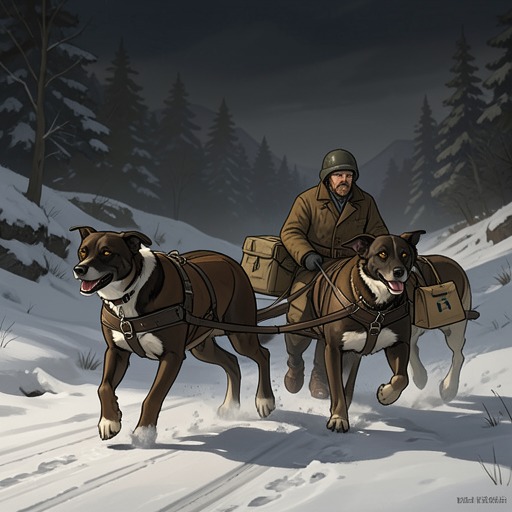
The celebration is brief because official orders immediately redirect the men and dogs. Francois embraces Buck, weeps over him, and then disappears from Buck’s life, while a Scotch half-breed takes charge of the team. The dogs are sent back toward Dawson with the mail train, now carrying news from the wider world to men seeking gold beneath the Pole. The return journey is not a record run but heavy daily labor behind a heavy load, organized by the same public need for communication that had driven the earlier dash to Skaguay.
The mail service operates with machine-like regularity. Camp is broken, dogs are harnessed, and the train begins before dawn; at night the men pitch tents, cut firewood, prepare bedding, carry water or ice, and feed the dogs. The routine gives the enterprise the appearance of an impersonal machine whose schedule absorbs human and animal bodies alike. Buck dislikes the monotony but bears it well, taking pride in the work and compelling his companions to do their share.
Disposal, Exhaustion, and the Value of Life
The same official system that demands speed also determines which animals remain economically useful. After Buck’s team has covered twelve hundred miles with only two days of rest, the congested mail requires fresh batches of Hudson Bay dogs to replace those judged worthless for the trail. The exhausted animals are to be sold because dogs count for little against dollars. Buck and his companions are bought by Hal and Charles for a negligible price, harness and all, and thereby pass from government service into incompetent private hands.
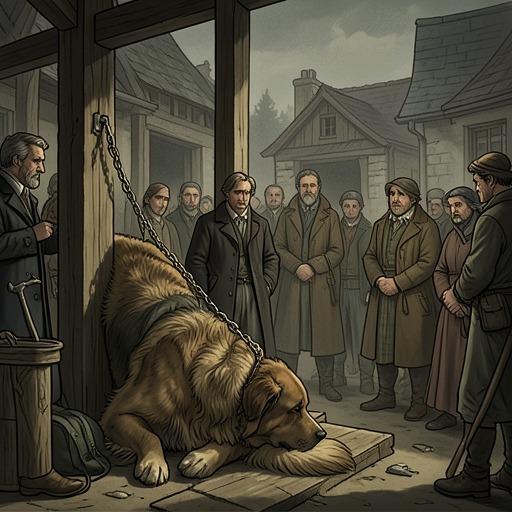
The replacement policy exposes the material logic behind the transport network. A dog’s value is measured by whether it can continue hauling, not by the labor already performed or the suffering endured. Dave’s case makes that logic especially stark. Sick and repeatedly falling in the traces, he is removed from his position, but he resists the substitution of Solleks because the work has become bound to his identity. He attacks the replacement, struggles through the soft snow beside the trail, and finally collapses, howling as the train passes. The pride that made him a dedicated worker cannot protect him once his body no longer satisfies the system’s requirements.
The fate of the other dogs is still more direct. Hal shoots Dub after his untreated shoulder injury worsens, while the Outside dogs die on rations suited to Huskies but insufficient for them. Their deaths show how government logistics, even after the dogs have left government ownership, establish the standards of feeding, endurance, and replacement that govern their treatment. The animals are useful as long as they can convert food into traction; when they fail, the system offers sale, starvation, or killing rather than recovery.
Institutional Violence and the Limits of Authority
The Canadian Government’s transport order exists within a wider culture of coercion. Buck’s first lesson in the North is that a man with a club is a lawgiver, and the dogs at the training yard are beaten, sold, or killed according to whether they obey and work. That disciplinary world makes the official dog teams possible: animals are trained into submission, ranked, harnessed, and evaluated through bodily performance. Yet the government itself is not depicted as personally wielding every club or whip. Its power is distributed through couriers, drivers, buyers, schedules, orders, and prices.
This indirect authority also helps explain the contrast between Perrault’s competent administration and the later abuse under Hal. Perrault and Francois understand dogs, apply justice calmly, and make Buck useful without wasting his strength. Hal’s party, by contrast, cannot feed or manage the dogs properly, delays departure, and uses the whip when the exhausted team will not rise. When John Thornton cuts Buck free from the harness, the remaining team soon disappears with Hal, Charles, and Mercedes through collapsing ice. The disaster reveals the physical limits that official discipline and commercial pressure had ignored: no order can make a starved team safely perform beyond its strength.
The government therefore embodies a double movement. It brings organization, knowledge, and communication to the frontier, and its skilled couriers can turn dogs such as Buck into remarkably effective workers. At the same time, its system participates in a market that makes animals interchangeable and allows exhausted bodies to be discarded. The record mail run celebrates speed, while the later replacement of worn-out teams reveals the hidden cost of that achievement.
Narrative Significance
The Canadian Government is significant less as a speaking character than as an institutional background that shapes Buck’s transformation. Its dispatches carry the demands of civilization into the wilderness, but they do so through a labor regime governed by ropes, harnesses, food, whips, prices, and official orders. Buck’s movement from Judge Miller’s sheltered estate into government service marks the decisive conversion of a respected household dog into a working sled dog.
The institution also establishes the novel’s recurring contrast between monetary value and lived value. Buck can be bought for three hundred dollars because the government needs transport, while Matthewson later places a thousand dollars on the feat he believes Buck can perform. Yet the narrative gives greater weight to the dog’s endurance, intelligence, pride, and attachment to work than to any price assigned to him. The government’s administrative efficiency is real, but the story repeatedly shows that its economic categories cannot fully contain the life of the animal who makes its communications possible.