College Park
The Call of the WildCollege Park is a little flag station near the Miller estate, remembered as the concealed point at which Buck is handed over to a stranger and removed from his former life. Though geographically modest, it functions as the threshold between domestic security and the brutal economy created by the Klondike Gold Rush: Buck arrives there believing he is taking an ordinary walk and leaves as a saleable animal bound for the North.
Setting and Hidden Exchange
The station is reached through the orchard while Judge Miller is absent at a meeting of the Raisin Growers’ Association and the boys are occupied organizing an athletic club. No one from the household sees Buck depart. At College Park, a solitary stranger meets Manuel, one of the gardener’s helpers, and money changes hands. The secrecy of the meeting makes the station less a public gateway than a concealed marketplace, where Buck’s trust and the household’s confidence are exploited together.
The exchange reduces Buck’s identity to a commodity. Manuel has been driven by his dependence on a gambling system and by wages insufficient for his wife and numerous children, while the approaching northern demand for dogs makes Buck valuable to buyers. The station therefore links private betrayal to the larger commercial pressure of the Klondike traffic: a local worker’s financial desperation opens the way for the removal of a respected household companion.
Buck’s Abduction
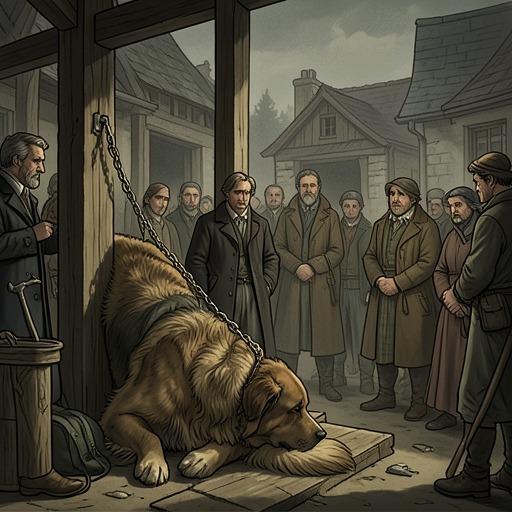
At the station, the stranger instructs Manuel to prepare the “goods,” and Manuel doubles a stout rope around Buck’s neck beneath his collar. Buck accepts the rope with quiet dignity because he trusts familiar men and assumes that human judgment exceeds his own. When the stranger takes the ends, however, Buck growls to express displeasure, still believing that such an indication should command obedience.
The result is the first violent reversal in Buck’s experience at College Park. The rope tightens instead of yielding, and when Buck springs at the stranger, the man grapples him by the throat and throws him onto his back. Choked until his strength ebbs and his eyes glaze, Buck discovers that the authority he once granted to men can be turned against him. The station thus becomes the scene where trust gives way to forced submission and where his former social position offers no protection.
From College Park to the North
After the sale, Buck is taken away with Curly, a good-natured Newfoundland. They are transported from Seattle aboard the Narwhal, and the receding city and warm Southland become the last visible signs of the world he has known. At this point, College Park is already functioning as a point of no return: the journey begins there, but its full consequence is the severing of Buck from Judge Miller’s household, the climate of the Southland, and the familiar human relationships that had defined his life.
Buck soon encounters Perrault and Francois, who take charge of him and Curly. He does not love these new handlers, but he learns to respect them because they are fair, calm, impartial, and knowledgeable about dogs. This contrast clarifies the significance of College Park. The station introduces captivity through deceit and strangulation, whereas later northern authority, though still coercive, operates according to recognizable rules. Buck’s passage through the station begins the education by which he learns to distinguish humane competence from arbitrary violence.
A Threshold in the Book’s Economy
College Park stands at the intersection of two systems of value. In the Miller household, Buck is a one-hundred-and-forty-pound companion whose dignity derives from good living, outdoor activity, and universal respect. At the station, he is wrapped, tied, exchanged for money, and dispatched because dogs have become urgently demanded transport equipment. The later sale of dogs by the Canadian Government, and the purchase of Buck and his exhausted mates by Hal and Charles, repeat the same logic on a larger scale: animals are valued according to their usefulness, price, and ability to move mail or supplies.
The station’s narrative importance lies in this compression of personal betrayal and historical change. Manuel’s gambling debt supplies the immediate cause, but the Klondike demand supplies the market that makes the betrayal profitable. College Park is consequently not merely the place where Buck is taken; it is the first visible point at which a civilized identity is converted into labor, and at which a protected dog enters the chain of exchange, transport, exhaustion, and violence that will reshape him.