Curly's Death
The Call of the WildCurly's Death is the decisive initiation through which Buck learns the governing violence of the Northland. Curly approaches a husky in friendship, but the encounter becomes a swift attack, a coordinated pack killing, and a lasting lesson in survival. The event changes Buck's understanding of danger: in this world, defeat is not a temporary loss but can mean immediate death.
Setting and Immediate Causes
The dogs and men near the log store live without peace, rest, or reliable safety. Their conduct is governed not by civilized rules but by the law of club and fang, and Buck, newly taken from the protected life associated with Judge Miller, has not yet understood what that law permits. Curly's friendliness therefore becomes a fatal vulnerability when she makes advances toward a husky dog as large as a full-grown wolf.
The attack gives no warning. The husky leaps in, tears Curly's face from eye to jaw with a metallic snap of teeth, and leaps away before she can properly respond. The method is the wolf manner of fighting: strike, evade, and strike again. Curly's greater size cannot protect her because the decisive danger lies in what follows once she loses her footing.
The Mauling
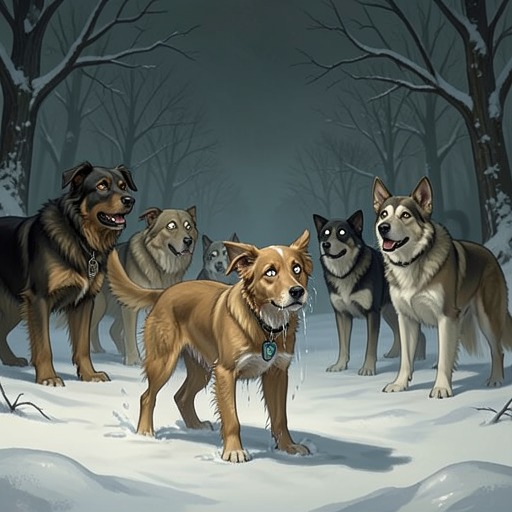
Curly rushes her attacker, who meets her next charge with his chest and tumbles her onto the ground. Thirty or forty huskies have already gathered in a silent, intent circle. Buck does not initially understand their stillness or their eager licking of their chops, but the waiting crowd reveals that the fight is also an opportunity for collective predation. Once Curly is down, the dogs close over her, snarling and yelping, until the bristling mass buries her screams.
Francois intervenes with an axe, assisted by three men carrying clubs. The dogs are scattered within two minutes of Curly's fall, but intervention comes too late. Curly lies limp and lifeless in the bloody, trampled snow, almost torn to pieces, while Francois stands over her and curses. The speed of the killing makes the scene more than an isolated act of aggression: it demonstrates how quickly a vulnerable body can pass from combatant to prey.
Buck's Recognition and Spitz's Enmity
Buck is stunned by the suddenness of Curly's death. He recognizes that there was no fair contest and that being knocked down was the fatal turning point. The memory returns to trouble his sleep, converting an observed death into a recurring psychological wound. His conclusion is practical rather than sentimental: he must ensure that he is never the one who goes down.
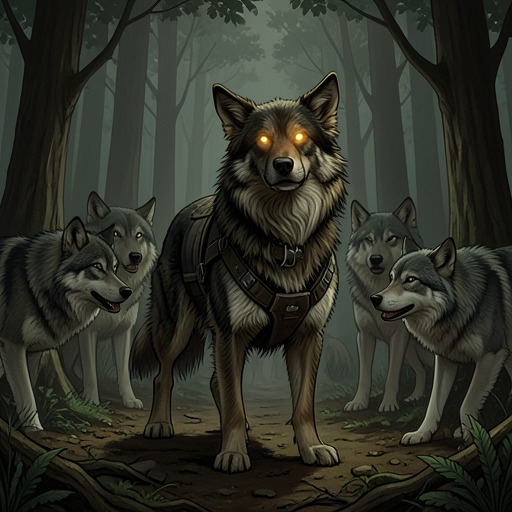
Spitz's response sharpens the lesson into personal conflict. Spitz runs out his scarlet tongue in the manner Buck recognizes as laughter, and he repeats the gesture after Curly has been killed. From that moment Buck hates Spitz with a bitter and lasting hatred. The hostility is not yet a formal challenge for leadership, but Curly's death gives the rivalry its emotional origin: Spitz appears to enjoy the spectacle of helplessness, while Buck understands that Spitz represents the victorious law he must eventually confront.
Consequences for Work and Survival
Before Buck has recovered from the shock, Francois places him in a harness and sets him to hauling a sled. Curly's death is thus followed immediately by Buck's conversion from a stolen domestic dog into a working sled dog. He learns that the same environment demanding constant alertness also demands instant obedience, and that failure is corrected through the whip, sharp teeth, or both.
Dave and Solleks teach him the discipline of the traces, while Spitz leads the team and corrects him whenever he blunders. Buck soon learns to stop at "ho," move forward at "mush," swing wide on bends, and avoid the wheeler when the loaded sled shoots downhill. The transition matters because Curly's fate has shown him the cost of helplessness, while harness work gives him a practical means of remaining useful and therefore less exposed.
Narrative Significance
Curly's Death establishes the pattern that governs Buck's later life: survival belongs to the animal capable of reading danger, mastering technique, and preserving its footing under pressure. The event also introduces the pride of trace and trail that later animates the team. In the harness, Dave and Solleks become alert, active, and fiercely intolerant of delay; their labor is presented as a source of identity as well as exhaustion. Buck's education therefore begins with death but continues through work.
The episode foreshadows Buck's later struggle with Spitz. Spitz's recognized supremacy and Buck's growing strength eventually make a clash for leadership inevitable, but the roots of that conflict lie here, in Buck's first sight of a world where the fallen receive no mercy. Curly's death changes the value at stake from ordinary companionship to physical survival, and it leaves Buck with the rule that shapes his conduct thereafter: he must not go down.