Dave
The Call of the WildDave is the gloomy, morose husky who joins Buck and Curly aboard the Narwhal and remains conspicuously separate from the other dogs. He neither seeks companionship nor provokes it, eating, sleeping, and yawning while the ship crosses Queen Charlotte Sound in violent seas. Even when Buck and Curly become half-wild with fear, Dave merely raises his head, gives them an incurious glance, and returns to sleep. His apparent indifference is not emptiness: it is the guarded self-containment of a dog whose purposes will become legible only when work, illness, and exclusion from the traces test him.
Identity and Introduction
Dave is defined first by withdrawal. Unlike the treacherously friendly dog who steals from Buck’s food, he makes no advances and accepts none; his warning is that he wishes to be left alone and that interference will bring trouble. This solitary manner places him beside Solleks, another dog whose reserve conceals a fierce attachment to a particular order of life. Dave’s silence also distinguishes him from the more visibly dramatic dogs of the team. He does not display fear during the Narwhal’s pitching and rolling, nor does he take interest in the newcomers. The narrative therefore introduces him through refusal: he refuses sociability, excitement, and explanation.
His practical identity emerges immediately after Curly’s death, when Francois fits Buck with a harness and puts him to hauling firewood. Dave is already an experienced wheeler, and his knowledge gives him authority over the inexperienced newcomer. He does not teach through indiscriminate aggression. When Buck errs, Dave nips him; when Buck does not need correction, Dave leaves him alone. His discipline is exact enough that Buck learns to regard it as fair instruction. Dave’s role is thus functional rather than ceremonial: he is not the leader, but he is one of the dogs who make the team’s movement possible.
Work and Team Discipline
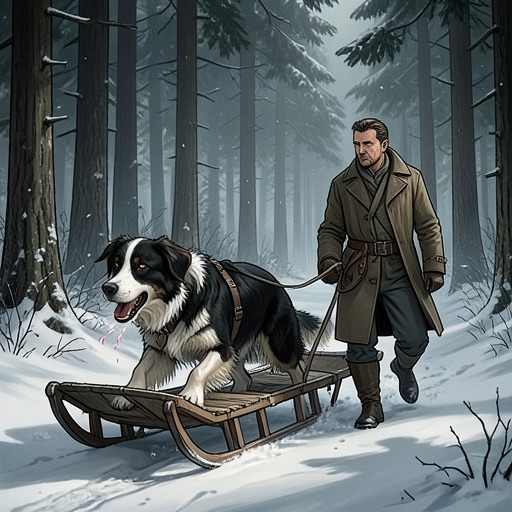
Dave occupies the wheeler position, with Buck immediately behind him and Solleks behind Buck, while Spitz leads the single-file team. Buck is deliberately placed between Dave and Solleks so that both experienced dogs can train him. Their methods are severe but effective. During one halt, Buck becomes tangled in the traces and delays the start; Dave and Solleks administer a sound trouncing, and although the resulting tangle becomes worse, Buck thereafter keeps the traces clear. By the end of the day, the sharp corrections have nearly ceased, because Dave’s instruction has done its work.
The harness reveals a side of Dave that the shipboard introduction conceals. Before work, he is passive and unconcerned; once harnessed, he becomes alert, active, and fiercely irritated by delay or confusion. The labor of the traces is described as the supreme expression of his being, the activity for which he lives and in which he takes delight. Dave’s behavior is not merely obedience imposed by Francois’s whip. It is a form of skilled participation. He understands the order of the team, corrects a novice without wasting effort, and demands that the collective task proceed properly.
This work-centered identity connects Dave to the larger pride of the trace and trail. The same pride transforms him and Solleks at the break of camp, turning their usual sourness into eagerness and ambition, then returns them to gloomy unrest when they are released at night. Dave’s attachment is therefore both social and bodily: the traces give him a position, a task, and a recognized place within the moving structure of the team. Buck eventually recognizes that this pride is not unique to Spitz’s leadership or to Buck’s own ambition; it belongs just as deeply to the wheeler who pulls steadily in front of him.
The Mail Trail and Physical Decline
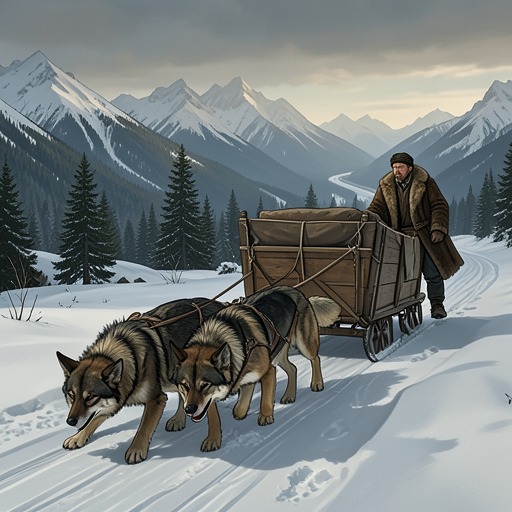
After Perrault and Francois leave the dogs, Dave continues under new drivers during the mail runs between Skaguay and Dawson. The work is monotonous and machine-like: camp is broken, the dogs are harnessed before daylight, the team travels until evening, and the animals are fed and attended to before the men eat or sleep. Dave’s competence remains part of this regularity. Even as conditions worsen, Buck maintains discipline and sees that the dogs do their fair share, while Dave continues to occupy his established place in the team.
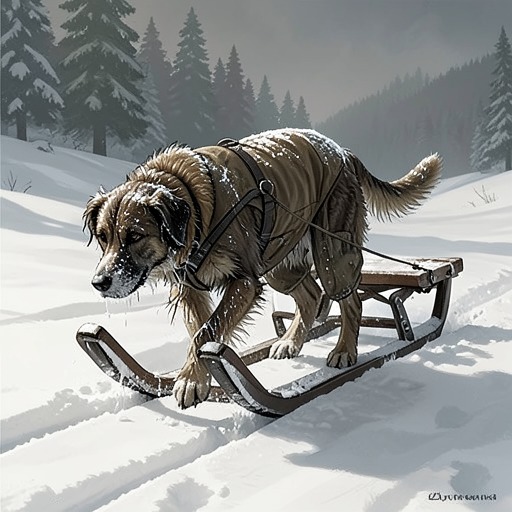
The accumulated distance eventually makes Dave’s body fail. Since the beginning of winter, the dogs have traveled eighteen hundred miles, and the entire journey has reached twenty-five hundred miles in less than five months, with only five days of rest during the final eighteen hundred miles. When the team reaches Skaguay, the animals are severely footsore and stripped of reserve strength. Dave suffers most visibly: he becomes increasingly morose and irritable, makes his nest as soon as camp is pitched, and refuses to rise until harness-up time. In the traces, sudden stops or the effort of starting make him cry out in pain, although the drivers cannot initially locate the cause.
The men examine him by the fire, pressing and prodding until he cries out repeatedly, but they find no broken bones and cannot identify the internal injury. By Cassiar Bar he is so weak that he falls repeatedly in the traces. The Scotch half-breed removes him from the team to let him run free behind the sled and fastens Solleks into the wheeler’s place. The attempt to protect Dave instead becomes a deeper injury, because it removes the role through which he understands himself.
Refusal of Removal and Death
Dave does not accept rest as mercy. When Solleks takes his position, Dave grunts and growls while the traces are unfastened, then whimpers in grief at seeing another dog perform the work he has served for so long. He attacks Solleks, rushes against him, tries to push him into the soft snow, and attempts to leap inside his traces and place himself between Solleks and the sled. The whip cannot drive him away. He refuses the easy beaten trail behind the sled and instead flounders through the more difficult soft snow alongside it until exhaustion forces him down.
At the next stop, Dave uses the last of his strength to return to his own sled. While the driver is briefly away, Dave bites through both of Solleks’s traces and stands directly in front of the sled in his proper place. His eyes plead to remain there. The drivers understand that a dog can break its heart when denied the work that is killing it, recalling cases of old or injured dogs who died after being cut out of the traces. Because Dave is already doomed, they decide that allowing him to work is a mercy: he can die heart-easy and content.
Harnessed again, Dave pulls proudly as before, though his inward hurt repeatedly makes him cry out. He falls several times and is dragged in the traces; once the sled runs over him, leaving him limping on a hind leg. He nevertheless holds out until camp. In the morning he is too weak to travel, but at harness-up he tries to crawl toward his driver. He staggers, falls, and then drags himself inch by inch toward the harnesses being placed on his mates. His last visible effort is directed not toward escape but toward rejoining the team.
The dogs hear Dave’s mournful howling after the train moves behind a belt of river timber. The Scotch half-breed stops, returns slowly to the abandoned camp, and comes back after a revolver shot. The whips snap, the bells ring, and the sleds continue, but Buck and every other dog understand what has happened. Dave’s death is therefore both an act of humane release and an indictment of a labor system that has taught him to value continued service above bodily survival.
Narrative Significance
Dave gives the sled team a form of animal subjectivity grounded in skill, judgment, fatigue, and desire rather than in sentimental anthropomorphism. He is a worker who knows his position, corrects a colleague, resists inefficient movement, and distinguishes between meaningful labor and mere survival. His conduct shows that the dogs are not passive equipment: they collectively produce the mail journey, and their bodies bear its measurable cost.
His tragedy also sharpens the contrast between recognition and disposability. The drivers attend to the dogs first, examine Dave, and hesitate to strike him harder when he ignores the whip; yet the system still carries him through exhausting distances and finally permits him to die in harness. Later, exhausted dogs are sold cheaply to Hal and Charles because they are judged worthless for the trail, while the animals’ long service is reduced to a monetary transaction. Dave’s fate makes that logic personal. His value is acknowledged only through the work he can perform, while his suffering becomes visible when work is taken away.
Dave’s emotional life is expressed through action rather than companionship. He begins by demanding solitude, but his strongest attachment is to the traces and to the team’s ordered movement. His death completes the paradox: the labor that destroys him is also the labor that gives him dignity, purpose, and contentment. In the world of the northern trail, Dave’s final journey makes the pride of trace and trail inseparable from exhaustion, dispossession, and death.