Dave's Death in Harness
The Call of the WildDave's Death in Harness is the final crisis of the mail team’s exhausting run and the clearest expression of Dave’s identity as a working sled dog. His illness makes continued labor fatal, yet being excluded from the traces is presented as an even deeper injury to his pride and purpose. By returning to his place and pulling until he can no longer rise, Dave turns a transport routine into a scene of dignity, suffering, and irreversible loss.
Causes and Background
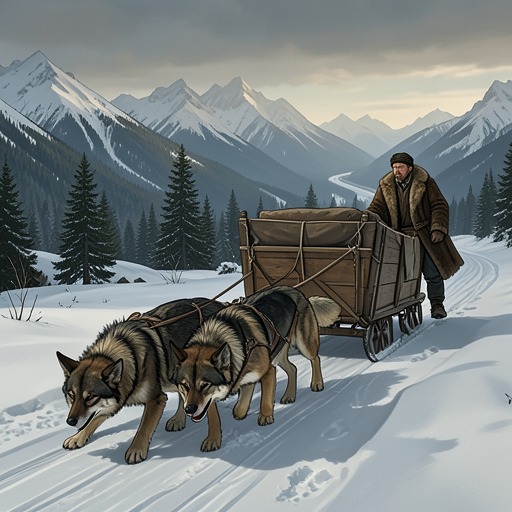
Dave’s decline appears during a journey in which the dogs have already traveled eighteen hundred miles while dragging sleds, with the heavy mail work steadily reducing their strength. Unlike the other dogs, Dave becomes increasingly morose and irritable, immediately making a nest when camp is pitched and remaining there until harness-up the following morning. Sudden stops or difficult starts cause him to cry out, but examination reveals no broken bones and the drivers cannot identify the source of the pain.
The men finally hold a consultation and bring Dave to the fire, pressing and prodding him until he cries out repeatedly. They establish only that something is wrong inside him. By the time the team reaches Cassiar Bar, he is so weak that he repeatedly falls in the traces. The driver therefore removes him from the team and fastens Solleks to the sled, intending to let Dave rest and run freely behind the moving train.
What Happens
Dave violently resists the change. He grunts and growls while the traces are unfastened, then whimpers when Solleks takes the position he has held. The event is not merely a medical removal from work; it is an assault on what the narrative calls his pride of trace and trail. Even sick unto death, Dave cannot bear another dog doing his task.
When the sled starts, Dave attacks Solleks, trying to drive him into the soft snow, leap inside his traces, and place himself between the replacement dog and the sled. The whip fails to stop him, and the driver cannot bring himself to strike harder. Dave refuses the easier beaten trail behind the sled and instead flounders through the soft snow alongside it until exhaustion forces him down. He lies where he falls, howling as the long train passes.
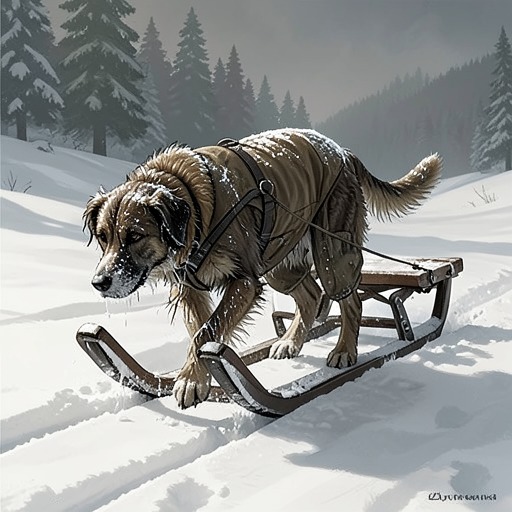
Dave nevertheless spends his last strength returning to his own sled. At the next halt he staggers past the other sleds and stands beside Solleks. When the driver starts the dogs, the team stops in surprise: Dave has bitten through both of Solleks’s traces and is standing directly in his proper place. His eyes plead to remain there. The men understand that denying him the work might break his heart, and, since his death is already expected, they decide that dying in the traces will be a mercy. Dave is harnessed in again.
He pulls proudly, as he did before, though his inward injury repeatedly makes him cry out. He falls several times and is dragged in the traces; once the sled runs over him, leaving him limping on a hind leg. Yet he continues until the team reaches camp. There, his driver makes a place for him by the fire, but morning finds him too weak to travel.
At harness-up time Dave tries to crawl toward his driver and the other dogs. He manages to stand through convulsive effort, staggers, falls, and then drags himself toward the harnesses in a series of short movements: advancing his forelegs and hitching the rest of his body forward. His strength finally leaves him in the snow while he still yearns toward the team. The dogs hear his mournful howling as they disappear behind river timber.
Death and Immediate Aftermath
The train is halted, and the Scotch half-breed retraces his steps to the abandoned camp. The men stop talking. A revolver shot sounds behind the belt of trees, after which the man returns hurriedly. The whips snap, the bells ring, and the sleds move on, but Buck and every dog understand what has happened. Dave’s death is therefore both concealed from direct view and fully witnessed through sound, silence, and the team’s shared knowledge.
The event also marks a reversal in the meaning of harness labor. The traces have exhausted Dave’s body, but they have given him order, status, and contentment. Removal is intended as care, while return to the traces becomes the form in which he can remain himself. The men’s decision is compassionate but tragic: they preserve his final sense of purpose by allowing the work that kills him.
Significance in the Team’s Story
Dave’s death exposes the cost hidden beneath efficient mail transport. The team’s discipline, long mileage, and continuing movement depend on bodies that can be treated as instruments until they fail. At the same time, Dave is not portrayed as an interchangeable hauling device. His resistance, grief, strategic return, and final yearning give the labor a personal meaning that the schedule cannot contain.
For Buck, the episode deepens his knowledge of the team’s harsh social order. He has already learned that survival depends on discipline, endurance, and alertness, but Dave’s fate reveals that devotion to work can become as absolute as fear of punishment. The revolver shot ends the visible episode, while the continuing motion of the sleds makes its moral consequence harder to escape: the trail absorbs the death and goes on.
Dave’s final run also stands in contrast to later forms of danger. The dogs face disease, starvation, violence, and rotten ice elsewhere on the trail, but Dave’s crisis is an inward bodily collapse met by an outward demand for performance. His death is neither a simple accident nor a moment of heroic triumph. It is the meeting point of illness, institutional necessity, pride, and attachment to a role, making Dave’s last appearance one of the book’s most concentrated accounts of what the life of a sled dog costs.