Dawson
The Call of the WildDawson is the great working settlement of the Yukon in Buck’s northern journey, a place where countless men, dogs, freight routes, mining ambitions, and government dispatches gather into one frozen system. Buck’s arrival there marks both a geographical milestone and a change in scale: the team’s internal rebellion unfolds against a town organized around relentless animal labor, while the settlement’s transport demands soon pull Buck into an even more punishing circuit.
Dawson as a Yukon Labor Center
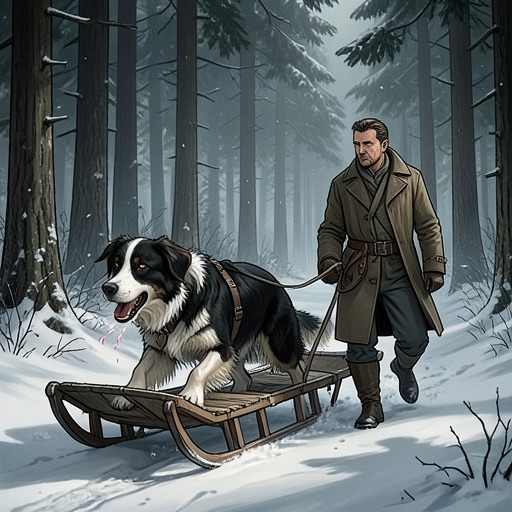
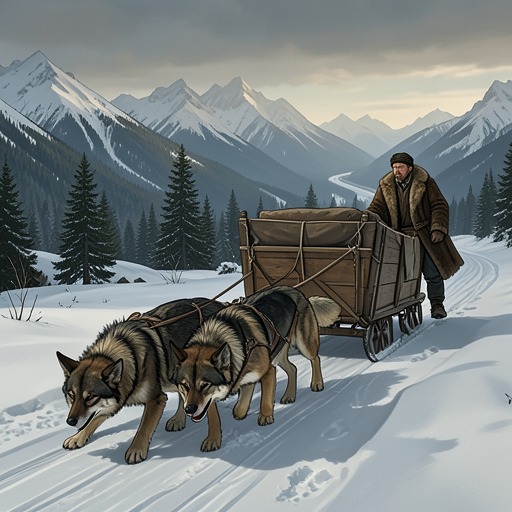
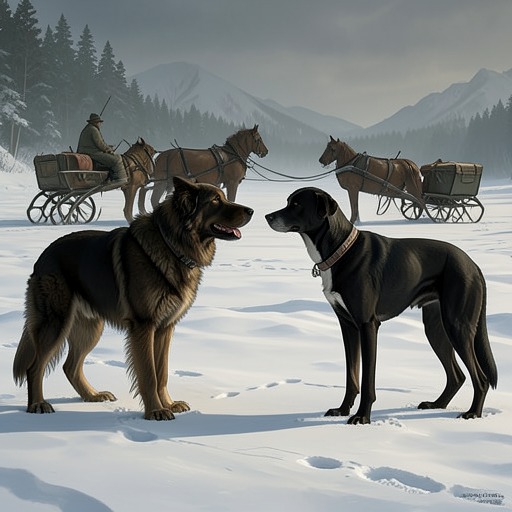
Dawson appears to Buck as a world in which dogs are expected to work. Teams move all day along the main street, and their bells continue to jingle through the night. Dogs haul cabin logs and firewood, carry freight toward the mines, and perform the work that horses had done in the Santa Clara Valley. Although Buck occasionally encounters dogs from the Southland, most of the animals belong to the wild wolf-husky breed associated with the North. The town therefore reveals labor not as an exceptional hardship but as the ordained order of life for dogs.
The settlement also gives Buck a new nocturnal soundscape. At nine, midnight, and three each night, the huskies raise a strange collective song beneath the aurora borealis or the frost-bright stars. Buck joins it with delight. The chant is presented as older than any human settlement, carrying the pain, fear, and mystery inherited from the dogs’ wild ancestors. Dawson thus stands at a crossing point: it is a heavily trafficked human town, yet the dogs’ song opens onto a much older world beyond buildings, schedules, and human claims.
Arrival and the Unfinished Rivalry
Buck and the team reach Dawson after the perilous approach from the coast. Their route has taken them through the Canyon and Sheep Camp, past the Scales and the timber line, across glaciers and immense snowdrifts, and over the Chilkoot Divide, the barrier between salt water and the North’s interior. The journey includes the dangerous Thirty Mile River, whose open water and unstable ice require six days of exhausting travel. Perrault repeatedly breaks through ice bridges, while the sled once breaks through with Dave and Buck aboard; both dogs are nearly drowned and must be thawed and dried beside a fire.
By the time the team enters Dawson, Buck’s covert resistance to Spitz has transformed the whole team. Buck intervenes when Spitz punishes other dogs, sometimes openly and sometimes when Francois is absent. Pike steals food under Buck’s protection; Dub and Joe challenge Spitz without receiving the punishment they would once have expected; even Billee becomes less placating. Spitz is no longer surrounded by the old awe, and Buck repeatedly snarls, bristles, and swaggeringly passes close before him. Dawson receives them with the decisive fight between the rivals still unresolved, making the settlement a place of suspension: the old leadership has weakened, but the new order has not yet been established.
The Record Route Out of Dawson
Seven days after arriving, the team leaves Dawson by the Barracks and descends to the Yukon Trail, heading toward the sea. Perrault carries dispatches more urgent than those he brought in and is also determined to make the year’s record trip. The dogs have recovered during their week’s rest, the trail is packed hard by later travelers, and police deposits of food allow the party to travel light. These conditions turn Dawson into a temporary staging ground for speed, official communication, and competitive transport.
The outward run is extraordinarily fast. The team covers Sixty Mile, a fifty-mile run, on the first day, then races up the Yukon toward Pelly. Buck’s revolt has damaged the team’s unity, however, and Francois must contend with continual petty offenses and challenges to Spitz’s authority. The route remains a test of both speed and discipline: the dogs can run brilliantly, but the social structure that once made them a single instrument has begun to fracture.
Mail, Commodification, and Exhaustion
The record journey ends at Skaguay, where the team’s achievement briefly makes Buck and his companions objects of public admiration. For fourteen days they average forty miles a day. Perrault and Francois spend three days throwing chests up and down Skaguay’s main street while crowds of dog drivers and mushers gather around the team. Yet official orders soon erase this triumph. Francois embraces Buck and weeps before leaving him; Perrault and Francois pass out of Buck’s life, and a Scotch half-breed takes charge of the dogs.
The next movement is back toward Dawson with a dozen other teams, now as a mail train. The work is slower and heavier, carrying messages from the wider world to men seeking gold under the shadow of the Pole. The journey exposes the economic logic surrounding Dawson: the dogs’ speed can produce public glory, but their value is ultimately measured by transport needs and official demand. After the teams have covered twelve hundred miles with only two days of rest, fresh Hudson Bay dogs are ordered to replace those considered worthless for the trail. Because dogs count for little against dollars, the exhausted animals are sold; Buck and his companions are bought by Hal and Charles for almost nothing.
Dawson therefore belongs to a recurring cycle rather than a single destination. Routes converge there, teams are rested or reorganized there, and the demand created by the Klondike Gold Rush sends them back onto the trail. The settlement’s commercial energy depends upon animal endurance while remaining indifferent to the bodily cost of that endurance.
Seasonal Threshold and Narrative Significance
The northern setting around Dawson is governed by severe environmental change. The approach includes temperatures of fifty below zero and ice that may hold in quiet water but fail in the current. Later, spring arrives with earlier dawns, lingering twilight, rising sap, green buds, returning birds, thawing streams, and the Yukon straining against its ice. Against this awakening landscape, the weakened dogs and humans stagger onward like travelers toward death. Dawson is consequently not merely a town on a map; it is a threshold between frozen transport and the seasonal breakdown that makes continued travel increasingly perilous.
Its narrative importance comes from this conjunction of geography, labor, and transformation. Dawson gathers the human order that exploits and organizes Buck, but it also intensifies the memories and instincts that draw him away from civilization. From the settlement, Buck eventually enters longer journeys along the Yukon, the Stewart River, and unknown eastern trails, where John Thornton seeks a lost mine and finds instead a rich placer. Much later, after John Thornton’s death, the wolf pack reaches Buck’s valley from the land of streams and timber. The town’s bells and working teams belong to the world Buck leaves behind; the wolf call that finally claims him belongs to the older world awakened within him. In that larger arc, Dawson is the pivotal northern city where economic civilization is most concentrated just before Buck’s movement toward the wild becomes irreversible.