Dolly
The Call of the WildDolly is a husky in Perrault’s sled-dog team whose defining episode is her sudden attack of rabies at the Pelly. Though previously unremarkable, she becomes a source of immediate danger when madness overtakes her, pursuing Buck across islands, channels, and the river until Francois kills her with an axe. Her death also reveals how precarious life is within the team: even a trained working dog can become, without warning, a mortal threat to the others.
Identity and Place in the Team
Dolly was the last husky added to the team at Yea. She is introduced not through leadership, exceptional strength, or habitual conflict, but precisely through her lack of distinction: she had never been conspicuous for anything. In the nine-dog team, her place was therefore functional rather than celebrated. She belonged to the disciplined routine of harnessing, hauling, camping, feeding, and recovery that governed the sled dogs’ existence.
That routine depended on collective coordination. The dogs were transformed by the harness into alert and active workers, fiercely irritated by delay or confusion, and the team’s labor became a shared expression of their being. Dolly participated in this order alongside Buck, Spitz, Dave, Solleks, Billee, Joe, Pike, and Dub, but the narrative gives her no recognized authority or special skill before her illness. Her ordinariness makes the later transformation more shocking: the danger comes not from an established fighter such as Spitz, but from a familiar team member whose condition changes abruptly.
The Rabies Attack at the Pelly
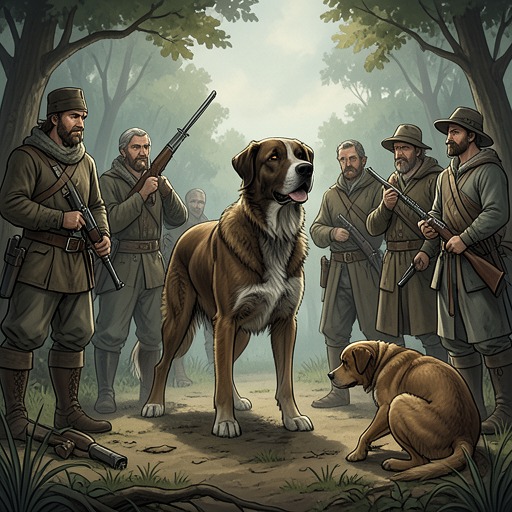
At the Pelly, while the dogs were being harnessed, Dolly suddenly went mad. She announced the change with a long, heartbreaking wolf howl that made every dog bristle with fear, then sprang directly at Buck. Buck had never seen a dog become mad and had no prior reason to fear madness, yet he recognized the horror of the moment and fled in panic. Dolly pursued him with extraordinary persistence, panting and frothing, remaining one leap behind throughout the chase.
The flight carried Buck through the wooded breast of the island and down to its lower end. He crossed a rough-ice back channel to another island, reached a third, curved back toward the main river, and finally began to cross the river itself. The geography turns the pursuit into more than a simple attack: Buck is forced through a succession of hazardous routes while Dolly’s presence remains inescapable. He does not look back, but he can hear her snarling just one leap behind him. Terror, rather than strategy, drives his movement, while the narrow distance between them keeps the danger immediate.
Buck eventually heard Francois calling from a quarter of a mile away and doubled back, still only one leap ahead of Dolly. Exhausted and gasping, he placed his faith in the dog-driver’s intervention. Francois stood with an axe poised; as Buck shot past him, the axe crashed down upon Dolly’s head. Her death ends the pursuit at the instant when Buck can no longer safely escape by his own strength.
Consequences for Buck and Spitz
Buck staggered against the sled, helplessly sobbing for breath after the chase. His exhaustion immediately created another danger. Spitz seized the opportunity and sprang upon him, biting twice into his unresisting body and ripping the flesh to the bone. Francois then brought down his lash, giving Spitz the worst whipping any dog in the team had yet received. Dolly’s attack therefore has a direct consequence beyond her own death: it leaves Buck temporarily defenseless and allows the team’s established leader to exploit his weakness.
The incident also sharpens the rivalry between Buck and Spitz. Perrault remarked that Spitz might one day kill Buck, while Francois predicted that Buck would eventually become furious and tear Spitz apart. From that point onward, their conflict was openly described as war. Spitz feared Buck because the Southland dog endured and prospered where other Southland dogs had failed, matching the husky’s strength, savagery, and cunning. Buck’s patience and ability to choose his moment made him especially dangerous. Dolly’s madness does not cause their rivalry, but it supplies one of the clearest early scenes in which Buck is physically exhausted, exposed, and forced to survive both an external terror and an internal contest for dominance.
Death, Labor, and Narrative Significance
Dolly later appears among the wounded dogs after the team’s camp is attacked by famished huskies. The nine dogs seek shelter in the forest, and every one of them bears several wounds; Dolly is specifically described as having a badly torn throat. The injury places her among the team’s visible casualties and emphasizes the repeated violence of sled-dog life, in which work, hunger, attack, and bodily damage are inseparable. Her later madness follows this already brutal environment, though the narrative does not establish that the throat wound caused her illness.
Dolly’s episode contrasts sharply with the ordinary discipline of the traces. The sled dogs normally learn through harness position, commands, the whip, and corrective bites from experienced teammates. Dave and Solleks teach Buck by nipping him when he errs, while the driver’s whip reinforces the lesson; the team’s survival depends on bodies responding predictably to one another. Dolly’s rabies destroys that predictability. Her howl, frothing pursuit, and refusal to stop replace cooperative labor with an individual danger that must be eliminated for the team to continue.
Her death also belongs to the book’s larger rejection of gentler moral assumptions. In the world governed by the law of club and fang, falling is perilous, weakness invites attack, and mercy is not guaranteed. Francois kills Dolly not as an act of sentimental rescue but as an urgent necessity, saving Buck and preventing the madness from consuming the working group. The scene makes the sled team a community of labor and mutual dependence, but also a place where a single altered body can become fatal to all the others. Dolly’s brief arc thus gives concrete form to the instability of frontier survival: the dogs are valued as workers, yet their lives remain subject to exhaustion, violence, disease, and immediate utility.