Dub
The Call of the WildDub is an experienced Northland sled dog remembered chiefly for clumsiness, theft, and steadfast labor. Though he is repeatedly caught and punished, his awkwardness does not cancel his usefulness: he remains a faithful worker until an untreated shoulder injury makes continued travel impossible. His story gives the sled team’s collective toil a vulnerable individual body, showing how a working dog can be valued for endurance while being denied any humane alternative to exhaustion and death.
Identity and Place in the Team
Dub belongs to the team assembled for Perrault and Francois’s government dispatch journey. He is not presented as a leader or a cunning strategist. Instead, he is described as an awkward blunderer who is always being caught, a contrast to Pike, whose thefts are deliberate and skillful. When Buck secretly steals bacon and Dub is punished for the crime, Dub’s established reputation makes him the obvious scapegoat. The incident reveals both his limited cleverness and the unequal consequences of life in camp: a more capable dog can exploit the disorder, while Dub absorbs the punishment.
His position in the traces is functional rather than prestigious. Dave is the wheeler, Buck is placed behind him for instruction, Solleks follows Buck, and Spitz occupies the lead. Dub therefore belongs to the larger working body whose discipline depends on every dog maintaining the team’s movement. The pride of trace and trail is especially associated with Dave and Solleks, but Dub’s later conduct shows that the same attachment reaches even a dog whose talents are less conspicuous. His loyalty is expressed through persistence rather than distinction.
Labor and Discipline
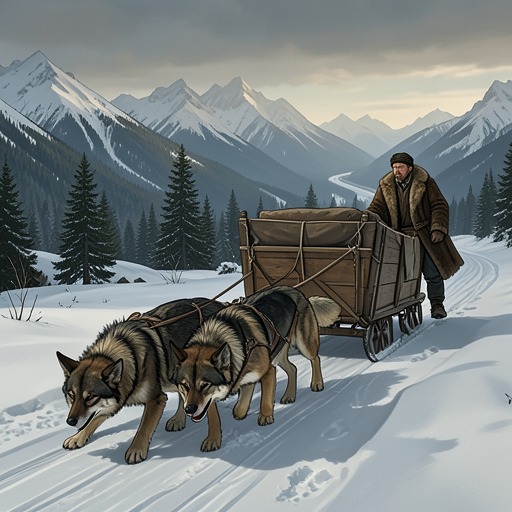
The nine-dog team is transformed by harness. Dave and Solleks become alert and fiercely irritable whenever confusion or delay threatens the work, and the traces become the central expression of their existence. Dub participates in this collective labor under the same severe regime. He is taught through the whip, the pressure of the harness, and the teeth of neighboring dogs; during the team’s early training, a mistake or delay can bring immediate physical correction.
The work is relentless. The dogs break camp in darkness, travel through the short daylight, eat their fish ration, and sleep in the snow. Later, the mail train repeats the same pattern with machine-like regularity: camp is broken, the dogs are harnessed, the sled moves before dawn, and evening brings feeding and another camp. Dub’s contribution is measured in miles and in the ability to keep the traces taut, not in comfort or recovery. The team’s labor is treated as both necessity and identity, while the dogs’ hunger and injuries are treated as obstacles to be managed.
When Buck challenges Spitz’s authority, Dub is among the dogs affected by the resulting disorder, though Dave and Solleks remain committed to their work. After Buck becomes leader, he disciplines the unruly members of the team and restores its solidarity. Dub is part of this repaired working order: the dogs again leap together in the traces, their individual movements subordinated to coordinated effort. The episode places Dub within a collective production system in which leadership matters because it determines whether every animal pulls its share.
Injury and Refusal
By the time the team reaches Cassiar Bar, Dub’s shoulder-blade injury has worsened from lack of treatment and rest. He is falling repeatedly in the traces, so the Scotch half-breed removes him and fastens Solleks into his place. The removal is intended as a practical mercy, but Dub experiences it as a deprivation. He grunts and growls while the harness is taken from him, then whimpers when Solleks occupies the position he has held for so long.
Dub refuses the supposedly easier role of following behind the sled. He attacks Solleks, tries to force him from the traces, and struggles to place himself between the replacement dog and the sled. When the driver attempts to drive him away with the whip, Dub ignores the lash. He runs beside the trail through soft snow, choosing the hardest ground rather than accepting separation from the work. Exhaustion finally brings him down, but his collapse does not end his effort.
At the next stop, Dub reaches his own sled and bites through both of Solleks’s traces. He stands in his proper place and pleads with his eyes to remain there. The men recognize that some dogs die when denied the labor that has become their purpose, and they decide that, since Dub is dying anyway, it is merciful to let him die in the traces. Reharnessed, he pulls proudly, despite involuntary cries from his internal injury. He repeatedly falls and is dragged, and the sled runs over him once, leaving him limping on a hind leg, but he continues until camp.
Death and Narrative Significance
At camp Dub is placed by the fire, yet he is too weak to travel the following morning. When the other dogs are harnessed, he tries to crawl toward them. He advances his forelegs and drags his body forward in small hitching movements, yearning toward the team even as his strength disappears. His companions last see him gasping in the snow; they continue to hear his mournful howl until the train passes behind the river timber. A revolver shot then confirms what Buck and the other dogs understand: Dub has been killed.
Dub’s death is not an isolated misfortune but part of the accumulated cost of the mail run. The team reaches Skaguay after traveling twenty-five hundred miles in less than five months, with only five days of rest during the final eighteen hundred miles. The dogs are footsore, underweight, and without reserve strength; Dub arrives suffering from the wrenched shoulder blade that has finally destroyed his ability to recover. His fate therefore concentrates the larger history of the team’s labor into one irreversible consequence: the system requires total effort and has no place for a worker whose body can no longer supply it.
The contrast between Dub’s earlier reputation and his ending is crucial. He is a blundering thief who is easily punished, yet he is also faithful enough to resist removal from the traces even when the work is killing him. His final choice is not framed as a rational escape from suffering. It is an attachment to function, team, and accustomed duty so complete that rest becomes a form of exclusion. Dub’s death gives concrete force to the pride of trace and trail: the same pride that makes the dogs pull with extraordinary solidarity can also make them pursue labor beyond the limits of their bodies.