Dyea
The Call of the WildDyea is the first major northern setting in which Buck’s identity is forcibly remade. On its beach, he is exposed to violent sled-dog society, learns the Law of Club and Fang, is fitted with a harness, and begins the labor that will carry him through the frozen routes toward Dawson. The place therefore functions not merely as a point on a map but as the threshold between domesticated comfort and the dangerous, work-centered life of the Northland.
A Threshold into the Northland
Dyea receives Buck immediately after his sudden removal from civilization. His first day on the beach is presented as a nightmare of perpetual motion and danger: there is no peace, rest, or reliable safety, and the men and dogs around him obey no settled law except the law of club and fang. The setting replaces the ordered world associated with Judge Miller’s estate with a landscape in which alertness is necessary every moment and weakness can become fatal.
The beach also introduces Buck to the material conditions of northern travel. Snow is strange to him, and his first attempt to investigate it leaves him puzzled while onlookers laugh at his confusion. The laughter marks his displacement as much as the climate does: Buck is physically powerful, but he is inexperienced in the elemental environment into which he has been cast.
Violence and the Law of Club and Fang
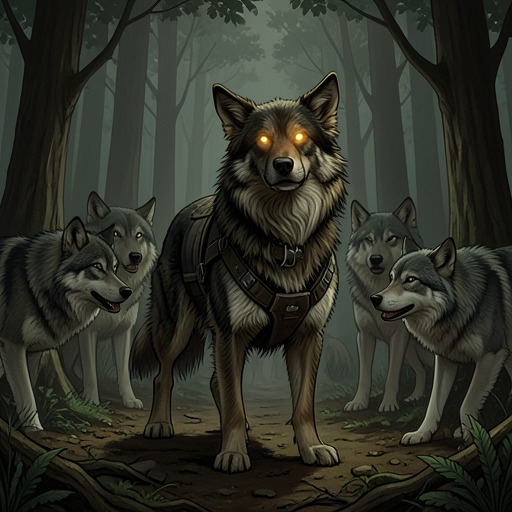
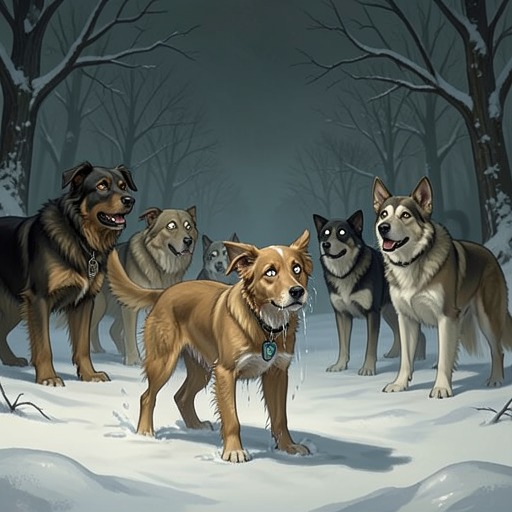
Dyea is the scene of Curly’s death, the event that gives Buck his first direct lesson in the rules governing the camp. Curly approaches a husky in a friendly manner, but the larger dog suddenly leaps in, tears her face open from eye to jaw, and retreats before she can respond. When Curly falls, thirty or forty huskies close around her in a silent, waiting circle and then overwhelm her. Francois, swinging an axe, and three men using clubs finally scatter them, but Curly lies lifeless in the bloody, trampled snow only two minutes after she went down.
The spectacle permanently changes Buck’s understanding of conflict. He recognizes that there will be no fair contest once a dog is down, and he resolves never to fall. He also sees Spitz laughing at Curly’s destruction, and that gesture turns his suspicion of the lead dog into a bitter, enduring hatred. Dyea thus establishes both the general law of the new environment and the particular rivalry that will organize much of Buck’s later life on the trail.
The Beginning of Sled Labor
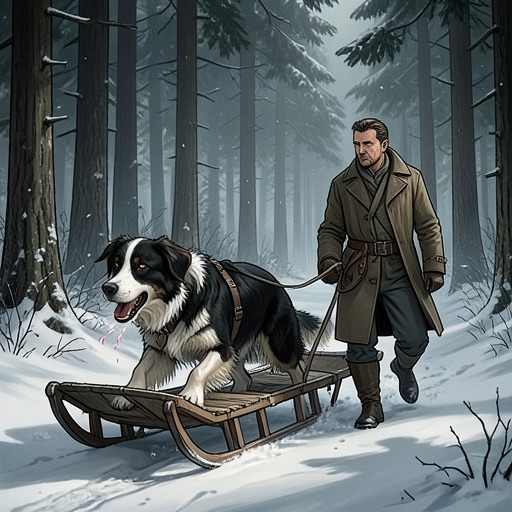
At Dyea, Francois fastens Buck into a harness modeled in his memory on the equipment used for working horses. Buck’s dignity is wounded by being made a draught animal, but he understands quickly that rebellion would be futile. Under Francois’s stern commands and whip, Dave’s corrective bites, and Spitz’s sharp reproofs and strategic pressure in the traces, Buck learns the practical grammar of sled work: he stops at “ho,” moves forward at “mush,” swings wide on bends, and avoids the wheeler when a loaded sled rushes downhill behind the team.
His progress is rapid. Francois tells Perrault that Buck pulls exceptionally well and learns quickly, while Perrault values him especially because, as a Canadian Government courier carrying important dispatches, he needs the best dogs available. Three additional huskies are soon added, bringing the team to nine, and Buck is placed between Dave and Solleks so that their experience can instruct him. When he becomes tangled in the traces and delays departure, both dogs punish him; the lesson is severe but effective, and by the end of the day his mistakes have nearly ceased.
Dyea therefore begins Buck’s transformation from captive animal into skilled worker. The harness imposes an external discipline, but the labor also awakens an unexpected capacity within him. The team’s eagerness communicates itself to Buck, while Dave and Solleks become utterly transformed by the harness: passive dogs become alert, ambitious, and fiercely intolerant of delay. The work of the traces appears as the central expression of their being, a pride that binds them to the trail even as it exhausts them.
The Route Beyond the Beach
From Dyea, the team moves up the canyon through Sheep Camp, past the Scales and the timber line, across glaciers and deep snowdrifts, and over the Chilkoot Divide, the formidable barrier between salt water and the northern interior. The route links the immediate violence of the beach to the larger infrastructure of the Klondike Gold Rush. The dogs carry human messages and supplies across terrain in which thin ice, swift water, cold, and distance continually threaten both animals and drivers.
The team reaches Lake Bennett, where thousands of gold-seekers are building boats for the spring breakup, and later faces the open water of the Thirty Mile River. There, six exhausting days are required to cover thirty miles. Perrault repeatedly breaks through ice bridges in temperatures of fifty below zero, while Buck and Dave once fall through with the sled and are nearly drowned. Their ice-coated bodies must be kept running around a fire until they thaw, close enough to the flames to be singed. These later hazards reveal what the first harnessing at Dyea has initiated: the beach is the entrance to a route whose demands are ecological, economic, and bodily all at once.
Narrative Significance
Dyea condenses the book’s central contrast between civilization and the wild. It is where Buck’s former assumptions about safety, fairness, and status are overturned, but also where he discovers competence, endurance, and the pride of trace and trail. The place joins human systems of communication and commerce to animal labor: Perrault’s government dispatches depend on Buck and the team, while the dogs’ own skill and effort make the northern movement possible.
Although Buck eventually travels far beyond Dyea, the location remains decisive because it contains the first complete pattern of his northern existence: violence that demands caution, work that creates discipline, companionship shaped by correction, and a landscape that tests every body crossing it. The beach is the point at which Buck begins to learn not simply how to survive the Northland, but how to become powerful within its order.