Husky
The Call of the WildHusky names the wolfish northern sled-dog type that governs much of Buck’s life in the North. These dogs are not merely background animals or transport equipment: they are skilled workers, rivals, predators, teachers, victims, and members of a collective order whose customs reshape Buck’s body and instincts. Through the Huskies, the narrative presents northern life as a world of labor and danger ruled by the law of club and fang, while also showing an older social and biological continuity between sled-dog, wolf, and pack.
Identity and Northern Setting
Huskies appear to Buck immediately as creatures unlike the dogs of civilization. After Buck and Curly are taken aboard the Narwhal, they encounter a large, snow-white dog from Spitzbergen, formerly associated with a whaling captain and later with a Geological Survey expedition in the Barrens. His friendliness is treacherous: he smiles while plotting an underhand trick and steals from Buck’s food at the first meal. The episode establishes the Husky as intelligent and socially dangerous, capable of concealment, opportunism, and rapid calculation.
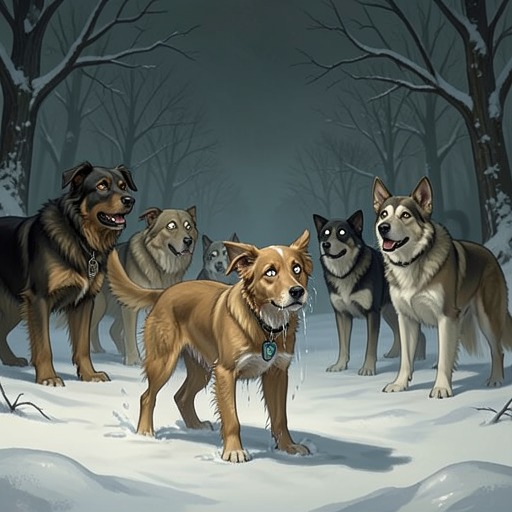
The wider northern community is even more imposing. When Buck first reaches camp, the dogs and men around him are described as savage figures who recognize no law but the law of club and fang. Their world offers neither peace nor safety; every moment demands alertness because food, position, and survival are constantly contested. Curly’s death makes this order visible. After a Husky attacks and tears open her face, thirty or forty Huskies gather in a silent, intent circle, waiting until she is knocked down. They then close over her and tear her apart while she screams. The pack’s behavior is collective, silent, and opportunistic rather than ceremonially fair, teaching Buck that once a dog falls, the fight is over.
The Huskies also inhabit a landscape shaped by movement. They travel through the Yea Canyon, across glaciers and snowdrifts hundreds of feet deep, over the Chilcoot Divide, and down to the camp at the head of Lake Bennett, where thousands of gold-seekers are preparing boats for the spring breakup. Their existence is tied to the routes, schedules, supplies, and economic pressures of the Klondike Gold Rush. They carry people, freight, and official dispatches through terrain where ordinary transport would fail, making them indispensable participants in the northern economy.
Pack Labor and Hierarchy
When three more Huskies are added to Buck’s team, the total rises to nine, and the dogs are quickly put into harness. Buck is astonished by the change that harness produces in Dave and Solleks. Away from work they can appear passive or unconcerned; in the traces they become alert, active, anxious for the team to function properly, and fiercely irritated by delay or confusion. Labor is not presented as a simple external burden. For these dogs, the work of the traces has become the supreme expression of their being, the activity for which they live and in which they take pride.
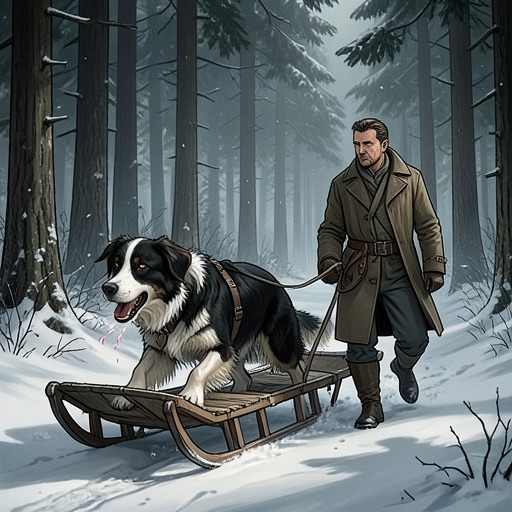
The team has a precise functional hierarchy. Dave is the wheeler, Buck runs in front of him, Solleks follows Buck, and Spitz occupies the lead-dog position. Buck is deliberately placed between Dave and Solleks so that he can learn. Dave teaches him fairly but firmly, biting only when correction is needed; Solleks does the same, while Francois’s whip reinforces the lesson. When Buck becomes tangled in the traces and delays the start, both dogs punish him, and the experience makes him keep the lines clear thereafter. His progress is measured not by sentiment but by reduced correction: Francois’s whip snaps less often, and Perrault even examines Buck’s feet as a sign that the dog is becoming valuable and dependable.
The pride of trace and trail organizes the entire team. It transforms the dogs at the beginning of a run and sustains them through exhausting distances, while failure, shirking, or removal from the harness threatens their sense of purpose. Spitz uses this pride to discipline dogs that blunder or hide at harness-up time. Buck shares the same impulse, but it turns him against Spitz because he wants the leadership that would allow him to embody the team’s highest ideal. The conflict is therefore more than a personal quarrel: it is a struggle over who has the right to direct the collective labor of the Huskies.
The team’s daily routine is machine-like. Each morning the cooks rise, fires are built, breakfast is eaten, camp is broken, and the dogs are harnessed before daylight has fully arrived. At night the men pitch tents, cut firewood and pine boughs, carry water or ice, and feed the dogs. The Huskies treat feeding as the day’s central event, followed by a brief period of rest among the other dogs. In this large traveling population, violence remains a means of establishing rank. After three fights with the fiercest dogs, Buck achieves mastery, and other Huskies retreat when he bristles and shows his teeth.
Violence, Hunger, and Collective Behavior
Husky society is repeatedly driven by hunger. At one camp, four or five score starving Huskies from an Indian village scent the food and creep into the camp while Buck and Spitz are fighting. When Perrault and Francois attack them with clubs, the animals fight back, crazed by the smell of provisions. One dog buries its head in the grub-box; when the box is overturned, a score of famished Huskies scramble for the bread and bacon. The blows do not stop them until every crumb has been eaten. Their conduct shows hunger overriding fear, pain, and obedience, while also exposing how narrowly the human supply system separates organized work from mass starvation.
The pack’s hunting behavior reveals another dimension of Husky life. Near the Tahkeena, Dub starts a snowshoe-hare chase, and the entire team is joined by fifty Huskies from a Northwest Police camp. Sixty dogs pursue the rabbit along the frozen river and creek. The rabbit runs lightly over the snow while the dogs force their way through it, and Buck leads the pack through the moonlit bends. His excitement is not abstract: he wants to catch living meat and kill it with his own teeth. The pursuit joins group coordination, bodily exertion, bloodlust, and nourishment, linking the working sled-dog to the predator hidden beneath domestication.
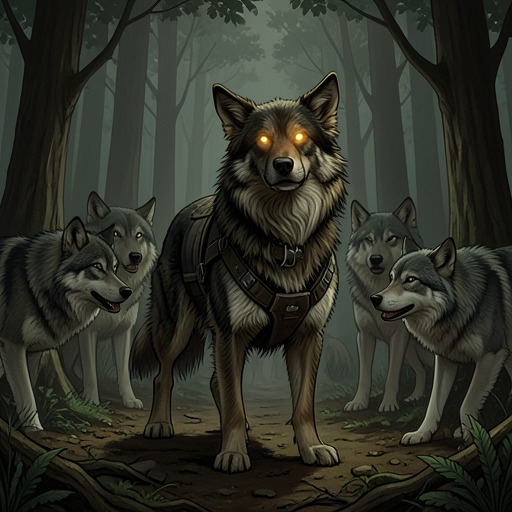
The Huskies’ pack logic also prepares Buck for his later relationship with wolves. A wolf initially flees from him, but Buck repeatedly corners it without attacking, using threatening and friendly gestures until the smaller animal finally sniffs noses with him. They play, run side by side through the forest and over a divide, and become brothers for a night and a day. The encounter suggests that the social intelligence Buck has learned among Huskies can be redirected toward a less coercive form of group belonging. The sled-dog pack and the wolf pack are not identical, but the narrative treats them as connected expressions of inherited social life.
Labor, Injury, and Death
The Husky order demands extraordinary endurance, but it also consumes the bodies that sustain it. On the return mail run from Skaguay to Dawson, the dogs dislike the monotonous work yet continue to take pride in doing it and enforce each member’s fair share. Their discipline makes the mail train possible, but its regularity conceals a severe physical cost. After thirty days, the team returns to Skaguay in a wretched state. Buck’s weight has fallen from one hundred and forty pounds to one hundred and fifteen, while Pike, Solleks, and Dub suffer genuine injuries or lameness.
The team’s condition is not ordinary temporary fatigue. The dogs have traveled twenty-five hundred miles in less than five months, with only five days of rest during the final eighteen hundred miles. Their feet are terribly sore, their bodies have lost all spring, and they possess no reserve strength for recovery. Every muscle, fiber, and cell has been drained. They can barely keep the traces taut and must struggle simply to stay clear of the sled on down grades. The Husky’s celebrated toughness thus has a double meaning: it is a real capacity for adaptation, but it also becomes a resource that human systems can exhaust.
Dave’s decline makes the emotional and bodily stakes especially clear. When illness causes him to fall repeatedly in the traces, the Scotch half-breed removes him and places Solleks in his position. Dave resists being taken out, attacks Solleks, and refuses the easier path behind the sled. He breaks both of Solleks’s traces so that he can stand again in his proper place. The men understand that a dog devoted to the work may break its heart when denied it, and they return Dave to the harness because he is already dying and wants to die in the traces. He pulls proudly despite his internal injury, falls several times, is dragged, and is once run over by the sled. The next morning he crawls toward the harnesses, yearning to rejoin his mates until his strength leaves him in the snow. A revolver shot behind the river timber confirms his death, and every dog, including Buck, understands what has happened.
From Sled-Dog to Wild Pack Member
The Husky is central to Buck’s physical and psychological transformation. Experience hardens his muscles, makes him indifferent to ordinary pain, sharpens sight, scent, and hearing, and teaches him to break ice for water and clear ice from between his toes. More importantly, the domesticated generations fall away. Instincts inherited from ancestors that hunted in packs through primeval forests return without conscious instruction. Buck learns the wolf snap and the cut-and-slash of ancestral combat as though these techniques had always belonged to him.
The nightly Husky song makes this descent into ancestral life audible. At Dawson, the dogs sing at nine, midnight, and three, under the aurora borealis or the frost-bright stars. Buck joins them with delight. The song is not cheerful celebration but a minor-key mixture of wailing, sobbing, fear, and endurance, carrying what the narrative presents as the accumulated sorrow of generations. His response marks how completely he has begun to reach backward through domestication toward the raw beginnings of life.
When the wolf pack finally enters Buck’s valley, it arrives while hunting migrating moose. Buck stands alone in the moonlit clearing and meets the first attackers with lethal precision, breaking one wolf’s neck and driving others back with slashed throats and shoulders. After half an hour, the pack is discomfited. The wild brother then approaches cautiously, and the two touch noses. Buck’s victory does not end in solitary domination. After John Thornton’s death, the last human tie no longer binds him, and the Husky’s inherited pack nature finds its final home among wolves. In this movement, the northern sled-dog becomes the bridge between human labor and wild belonging: shaped by harness, discipline, hunger, and communal work, yet ultimately reclaimed by the older life that the Husky body had never wholly forgotten.