Joe
The Call of the WildJoe is a husky acquired by Perrault as part of the expanding sled team. He is introduced alongside his brother Billee, yet the brothers could not be more unlike: Billee is excessively good-natured, while Joe is sour, introspective, and perpetually snarling. Joe’s importance lies in the way his belligerence becomes a form of survival. He does not submit easily to domination, but neither does his resistance free him from the labor system that finally exhausts him.
Identity and Introduction
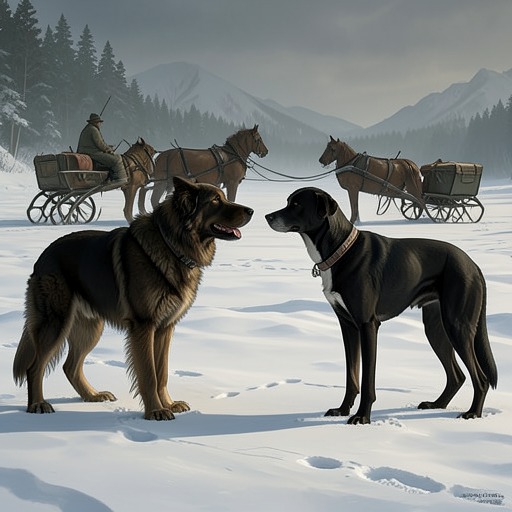
Joe and Billee are brothers and true huskies, both called into service when Perrault is assembling a team for the Canadian Government’s dispatches. Buck receives them in a comradely fashion, while Dave ignores them. Spitz, already the leader, immediately tries to establish his authority by thrashing each newcomer. Billee attempts appeasement, wagging his tail and running when appeasement fails, but Joe answers domination with confrontation.
When Spitz circles him, Joe whirls on his heels, raises his mane, lays back his ears, bares his lips, and snaps his jaws with a malignantly gleaming eye. His appearance expresses fear transformed into aggression rather than calm mastery. Spitz is so impressed by the danger of this resistance that he abandons the attempt to discipline Joe and instead turns on the inoffensive Billee. Joe therefore enters the team not as a gentle companion but as an animal whose defensive violence commands limits even within an already violent hierarchy.
Conduct in the Team
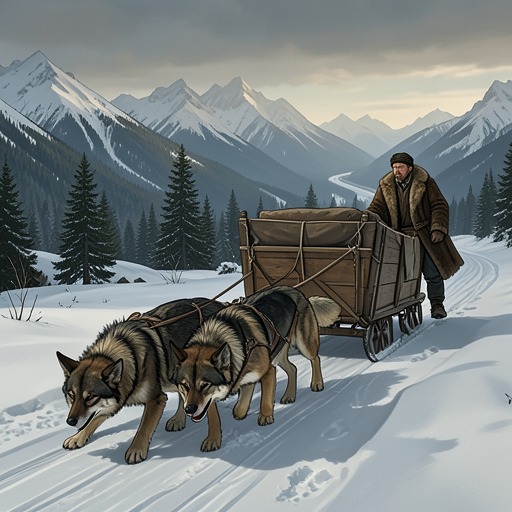
Joe’s behavior remains difficult, but it is not simple disorder. The sled team is governed by immediate correction, with Francois’s whip reinforced by the teeth of experienced dogs. Dave and Solleks teach Buck through sharply timed punishment, while Spitz enforces the discipline of the traces. Joe’s snarling disposition makes him resistant to Spitz’s authority, yet he remains a working dog within the collective routine of harnessing, hauling, and camp.
During the attack by starving huskies, Joe’s ferocity becomes an asset to the entire team. He fights beside the wounded Dave and Solleks, snapping like a demon; when his teeth close around a husky’s foreleg, he crunches through the bone. Pike then kills the crippled attacker. Joe’s violence is thus both individual defense and contribution to group survival. He is not portrayed as merely antisocial: under extreme pressure, his combativeness protects the team even as the team itself is being overwhelmed.
The attack leaves Joe permanently marked. When the nine dogs regroup in the forest, every animal is wounded, but Joe has lost an eye. The injury makes his earlier appearance—already centered on a threatening eye and a defensive posture—more tragic in retrospect. His surviving eye and continued presence in the traces show endurance, but they also reveal the bodily cost demanded by the trail.
Labor, Exhaustion, and Decline
The harness gives the sled dogs a collective purpose that is different from their behavior at rest. Dave and Solleks become alert, active, and fiercely irritable when work is delayed, because the toil of the traces seems to be the supreme expression of their being. Joe shares this world of compulsory labor. His personality remains sour, but he continues to pull through the repetitive schedule of camp, harness, trail, feeding, and sleep.
After the team’s long mail journeys, Joe becomes sourer than ever. The dogs have traveled eighteen hundred miles since the beginning of winter, and their accumulated fatigue is not a temporary tiredness from which a few hours can restore them. Their bodies have lost their reserves. Even though the drivers attend to their feet and feed the dogs before eating themselves, the work continues, and Joe’s increasing bitterness registers the pressure of a body and temperament being driven beyond endurance.
Joe’s decline becomes unmistakable under the ownership of Hal, Charles, and Mercedes. The new owners buy the exhausted dogs, harness and all, for very little. Hal insists that the animals are lazy and must be forced onward, dismissing the experienced assessment that they are weak from overwork and need rest. When food runs out at the Five Fingers, the dogs are given frozen horsehide, a nearly useless substitute that turns into leathery strings and irritating hair in their stomachs. Joe, already damaged and starving, is reduced to the same skeletal condition as the rest of the team.
Final Suffering and Fate
As the journey continues, Joe is described as too far gone to be malignant. This is a decisive reversal of his defining trait. The snarl that once made Spitz retreat has no remaining force; hunger and exhaustion have consumed the energy necessary even for hostility. When Billee collapses, Hal kills him with an axe and removes his body from the harness. The following day Koona is also gone, leaving Joe, Pike, Solleks, Teek, and Buck.
Joe’s continued presence among the survivors does not signify recovery. Pike is crippled and only half-conscious, Solleks remains faithful to the work despite having almost no strength, and Buck can scarcely maintain discipline or even clearly perceive the trail. Joe’s condition belongs to this collective extinction of capacity. The dogs are no longer functioning as robust workers but as bodies carrying only faint sparks of life, repeatedly forced upright by the whip and club.
When John Thornton warns that the rotten ice may give way, Hal refuses to stop and declares that the team will continue toward Dawson. Thornton states that only fools could risk the ice and that he would not endanger himself on it for all the gold in Alaska. After Thornton intervenes to protect Buck, he cuts Buck’s traces. The remaining team then departs: Pike leads, Solleks is at the wheel, and Joe and Teek are between them, all limping and staggering. Joe’s last recorded movement is therefore part of a doomed procession. Thornton and Buck watch as the ice collapses, carrying the sled, its human passengers, and the surviving dogs into a yawning hole.
Narrative Significance
Joe embodies a form of animal resistance that the trail can use but never truly honor. His aggression prevents Spitz from overpowering him, and his fighting helps repel the starving huskies, yet the same system that values his strength also treats him as replaceable property. The dogs’ skills, pain, and attachment to the work are visible, but their worth is repeatedly measured against money, distance, and delivery schedules.
His arc also clarifies the difference between temperament and condition. Joe begins as the team’s snarling, combative dissenter; after injury, starvation, and relentless labor, he becomes too weak even to be malignant. That change is not a moral reform or a reconciliation with authority. It is the erasure of personality by exhaustion. Through Joe, the narrative shows how the sled dog is both a sentient worker with specialized capacities and an exploited body within the Klondike economy, while his disappearance beneath the breaking ice confirms the lethal consequences of mistaking endurance for an unlimited resource.