Judge Miller
The Call of the WildJudge Miller is the owner of the great estate in the sunlit Santa Clara Valley where Buck is born and spends the first four years of his life. His household gives Buck a position of unusual privilege: Buck is neither confined to the house nor kept merely as a kennel animal, but moves through the entire demesne as its acknowledged ruler. The loss of Judge Miller’s world is therefore not simply a change of residence. It is the decisive removal of Buck from a protected aristocratic order into a commercial system that treats powerful dogs as valuable labor and disposable property.
Identity and Estate
Judge Miller’s place stands back from the road behind trees, with a wide veranda, winding graveled drives, lawns, tall poplars, stables, servants’ cottages, outhouses, grape arbors, pastures, orchards, berry patches, an artesian pumping plant, and a large cement swimming tank. The scale of the estate supplies the material basis for Buck’s authority. It is a complete social and agricultural domain rather than a simple residence, populated by grooms, boys, servants, house dogs, kennel dogs, and the Judge’s family.
Buck’s relation to this domain distinguishes Judge Miller’s household from the later camps and trails. Other dogs come and go through the kennels or remain obscurely within the house, while the fox terriers are contained and supervised by housemaids armed with brooms and mops. Buck belongs to neither category. The whole realm is his territory, and the narrative presents his sovereignty as accepted fact: he moves among humans and animals with the confidence of an estate-born aristocrat.
Buck’s Protected Life
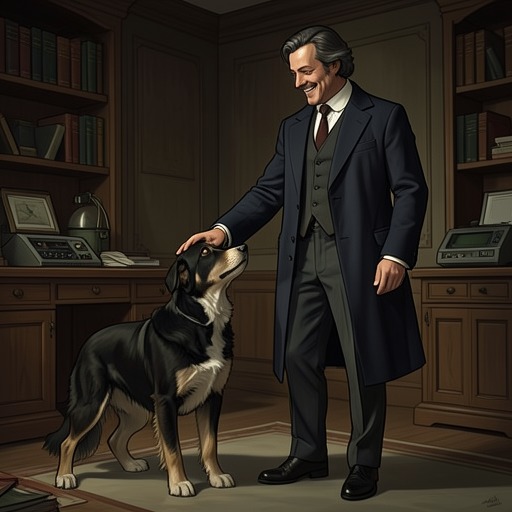
Judge Miller’s family incorporates Buck into daily life as companion, guardian, playmate, and working gentleman. He swims in the tank, hunts with the Judge’s sons, escorts Mollie and Alice on twilight and early-morning rambles, lies at the Judge’s feet before the library fire, carries his grandsons on his back, and guards them during expeditions toward the fountain, paddocks, and berry patches. His guardianship of the children extends beyond the immediate domestic grounds, showing that his status rests not only on size but also on trust.
Buck’s father, Elmo, a huge St. Bernard, had been Judge Miller’s inseparable companion, and Buck appears likely to inherit that place. Buck is smaller than his father because his mother, Shep, was a Scotch shepherd dog, yet he weighs one hundred and forty pounds. Good living, universal respect, outdoor exercise, hunting, and swimming give him both dignity and physical strength. He is proud and somewhat egotistical, but he is not merely pampered: the outdoor life keeps him muscular and preserves the latent capacity that later allows him to endure the Northland.
The Rupture of the Estate
The world Judge Miller has created cannot protect Buck from forces operating beyond its boundaries. In the fall of 1897, the Klondike strike draws men toward the frozen Northland, where the demand is for heavy, muscular dogs with warm coats. Manuel, one of the gardener’s helpers, is financially desperate because of his devotion to Chinese lottery and his belief in a winning system. While Judge Miller attends a meeting of the Raisin Growers’ Association and the boys organize an athletic club, Manuel lures Buck away through the orchard under the pretense of an ordinary stroll.
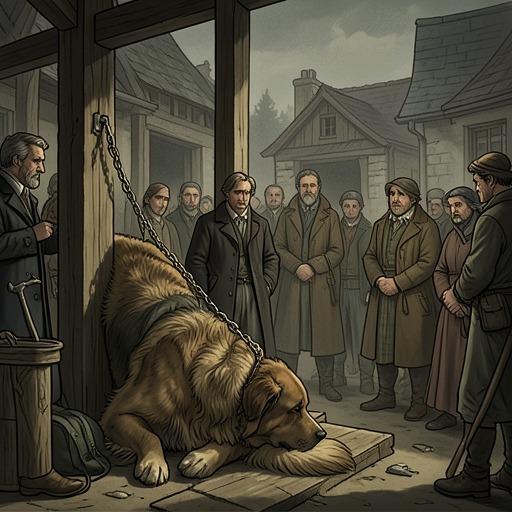
At College Park, Manuel hands Buck over to a stranger for money. The transaction converts the estate’s sovereign companion into what the buyers call goods. A rope is tightened around Buck’s neck, and the absence of Judge Miller and the family becomes the immediate condition of the kidnapping. Judge Miller’s authority is powerful inside his demesne but absent at the station; the wider market reaches into the protected household through an underpaid employee and removes its most valued animal without resistance.
Buck’s passage from Judge Miller’s estate to Seattle, and then into the hands of Perrault and Francois, establishes the contrast that governs the rest of his trajectory. The Canadian Government pays three hundred dollars for him because the demand for dogs has driven prices sharply upward. Perrault recognizes Buck as an exceptionally fine animal, but the recognition is commercial rather than familial. Buck leaves the warm Southland with Curly and begins the journey toward the Yukon Trail, where obedience, strength, and survival replace the customs of the California estate.
Memory and Narrative Significance
Judge Miller’s world remains one of Buck’s memories, but it gradually loses its power. Near the fire during the monotonous life of the trail, Buck sometimes recalls the big house, the cement swimming tank, Ysabel, the Mexican hairless, and Toots, the Japanese pug. Yet he is not homesick. The Sunland has become dim and distant, while the memory of the man in the red sweater, Curly’s death, his fight with Spitz, and the food of the Northland possess greater force. The narrative thus makes Judge Miller’s estate a remembered origin rather than a destination to which Buck hopes to return.
That fading memory marks Buck’s transformation. The routines and abundance of Judge Miller’s household have given way to harness work, communal feeding, frozen camps, and the primitive law taught by the club and fang. Even so, Buck’s inherited strength and his early experience of command remain embedded in him. His later mastery among the sled dogs, his refusal to submit inwardly to brutal authority, and his eventual life with John Thornton all develop against the initial image of the dog who once ruled a California estate.
Judge Miller’s importance therefore lies less in later action than in structural contrast. His household represents civilized security, affectionate fellowship, property protected by social order, and a life in which Buck’s power is honored rather than exploited. The later world exposes how quickly those protections collapse when Buck becomes a commodity in the Klondike economy. By the end, Buck has entered a radically different existence as the Ghost Dog associated with the wolf pack, while Judge Miller’s estate survives only as a distant image of the life from which the call of the wild eventually carried him away.