Junbō
The Call of the WildThe club is the decisive object in Buck’s passage from civilized security into the Northland’s primitive order. In the hands of the man in the red sweater, it defeats Buck’s strength, teaches him that force can establish law, and permanently changes the way he assesses danger. Its influence continues through training, labor, and later human cruelty: the club is not merely a weapon but the material sign of a hierarchy in which bodies are made obedient through pain. Yet its final appearance also marks the collapse of that hierarchy, when John Thornton attacks Hal rather than allow the exhausted Buck to be beaten into moving.
The Club as Instrument of Initiation
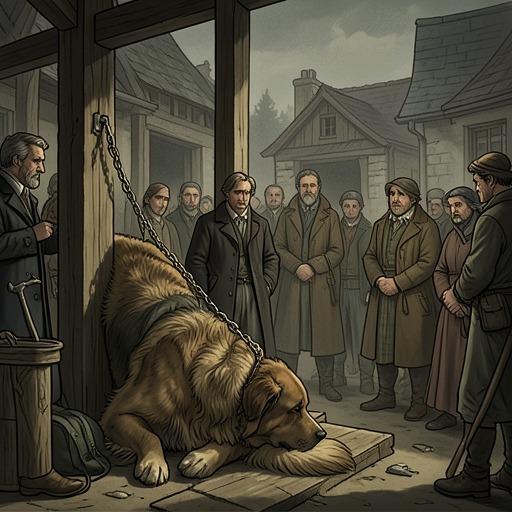
The club first appears in a small, high-walled back yard, where the man in the red sweater brings it out with a hatchet to open Buck’s crate. Buck interprets the man as his next tormentor and throws himself against the bars, while the man calmly works at the wood. When an opening is made, Buck launches his one hundred and forty pounds directly at him, carrying the accumulated fury of two days and nights without food or water. The club interrupts that charge in mid-air and brings Buck down before he can close his jaws.
Buck does not understand the first blow because he has never been struck by a club. His madness drives him to attack again, and again the weapon breaks his charge and smashes him to the ground. He rushes a dozen times. The man varies the violence, striking him repeatedly, then deliberately delivering a frightful blow to the nose, the point of pain that provokes Buck into one last furious assault. The man catches him by the under jaw, throws him through a twisting circle, and finally lands the blow he has withheld, leaving Buck senseless.
The scene establishes the club’s peculiar authority. It does not defeat Buck by superior speed or intelligence in open combat; it turns his own momentum into repeated humiliation. Buck’s body becomes the place where a new law is written. After the beating, the man can pat the head he has mercilessly pounded, and Buck, though his hair bristles involuntarily, endures the touch. Water and raw meat follow the violence, but neither kindness nor food cancels the lesson. Buck knows that he has been beaten, yet he has not been broken.
Revelation of Primitive Law
The club’s deepest consequence is intellectual as well as physical. Buck sees once and for all that he has no chance against a man with a club, and he never forgets the knowledge. The weapon becomes a revelation: it introduces him to what the narrative calls the reign of primitive law, a world in which authority rests on the capacity to inflict decisive pain. Buck meets this world halfway, not by surrendering his will, but by awakening the latent cunning needed to survive it.
He watches other dogs arrive in crates or at the ends of ropes. Some submit quietly; others rage as he did. One by one, they pass under the dominion of the man in the red sweater, and each brutal performance confirms the same rule: a man with a club is a lawgiver and a master to be obeyed, though not necessarily conciliated. Buck refuses the submissive gestures he sees in beaten dogs that fawn, wag their tails, or lick the man’s hand. He also witnesses the fatal alternative when a dog will neither obey nor conciliate and is killed in the struggle for mastery. The club therefore governs a range of behavior, from calculation to terror, while leaving Buck determined to preserve an inward refusal of affection toward the power that defeats him.
The weapon’s authority operates even when it is not striking. Buck remembers it whenever a new threat appears, and its possible return shapes his choices. In this sense, the club produces self-discipline: Buck learns to measure distance, recognize its range, and retreat before a blow rather than waste himself in a hopeless attack. His obedience is never simple submission. It is a tactical adjustment to a power whose material force he has learned exactly.
Discipline in the Sled Team
Once Francois puts Buck into a harness, the club’s lesson remains part of the training environment even though the principal instruments are the whip, the harness, and the teeth of his fellow dogs. Buck is placed between Dave and Solleks so that he can be instructed, while Spitz leads the team and Francois drives it. Errors bring immediate physical correction: Dave and Solleks nip him, Francois’s whip backs them up, and Buck discovers that changing his behavior is cheaper than retaliating.
The club’s logic is thus extended into a larger system of bodily discipline. Buck must learn where to stand, how to keep the traces clear, when to stop at “ho,” move at “mush,” swing wide on bends, and avoid the wheeler when the loaded sled rushes downhill behind him. His body is reorganized into the team’s working mechanism. The dogs’ line is precise—Dave at the wheel, Buck ahead of him, Solleks before Buck, and Spitz at the lead—and discipline depends on every animal occupying its place and responding instantly to pressure.
The traces also show that coercion can become a productive routine. Dave and Solleks are transformed by harness work from passive animals into alert, irritable workers whose being seems expressed through the labor itself. Buck gradually acquires the same efficiency. The work is hard, the days begin in darkness, and the dogs sleep in snow after eating their fish, but Buck learns rapidly and earns fewer corrections. The club’s original lesson has become part of a broader bodily knowledge: survival requires not only courage but trained reflex, spatial awareness, and submission to the team’s demands.
Fear, Revolt, and the Limits of Coercion
Buck’s relation to the club is tested when he seeks the lead position. After displacing Solleks, he remembers the man in the red sweater and retreats from Francois’s heavy club, watching it closely and remaining just beyond its reach. The retreat is not an attempt to escape the camp or abandon the team. Buck is willing to risk circling, snarling, and enduring pursuit because he wants leadership, which he believes he has earned and which he refuses to exchange for safety.
When Francois and Perrault throw clubs at him, Buck dodges them and continues circling the camp. The weapon still commands his caution, but it no longer commands his entire purpose. He will come back when his demand is met. This distinction is crucial: the club can prevent a charge, but it cannot make Buck desire the position assigned to him. It can enforce immediate behavior, not extinguish ambition. Buck’s resistance therefore reveals both the strength and the boundary of coercive power.
The club returns in the crisis involving Hal, Charles, Mercedes, and their exhausted team. After the dogs fail to move the overloaded sled, Hal prepares to lash them with a whip, and Mercedes takes it from him. Later, after the team has collapsed, Hal uses the whip and then exchanges it for the customary club. Buck refuses to rise under the heavier blows. Unlike his companions, he has made up his mind not to get up, sensing disaster ahead on the thin, rotten ice. His refusal is not ordinary disobedience but the last preservation of judgment in a body nearly emptied of life.
At that moment the club loses its supposed right to command. John Thornton suddenly springs upon Hal and hurls him backward, stopping the beating before Buck is driven onto the dangerous ice. Thornton’s intervention replaces the law of the club with an act of protective loyalty. The weapon remains physically powerful, but it can no longer define the moral meaning of the scene: its violence exposes Hal’s incompetence and Thornton’s refusal to permit authority without responsibility.
Narrative Significance
The club links several stages of Buck’s transformation. It defeats him when he first enters the Northland, teaches him to recognize the supremacy of force, disciplines his movements indirectly during sled labor, and later becomes the object he must calculate around while seeking leadership. It also helps explain his changing moral conduct. Under the conditions of the Northland, he learns to steal secretly when hunger demands it and to preserve himself rather than defend abstract property or sentiment. The primitive code first embodied by the club makes survival more important than the moral habits of his former life.
Yet the club is not presented as an all-powerful explanation of behavior. Buck never loves the man who wields it, and fear does not erase his intelligence, pride, or capacity for revolt. Its authority is effective because it is materially real, but it remains vulnerable to a stronger ethical force. When John Thornton places himself between Buck and Hal, the narrative does not deny the club’s lesson; it completes and revises it. Buck knows what the club can do, and precisely because he knows, Thornton’s refusal to let it fall becomes an unmistakable act of rescue. The object that first teaches Buck the law of domination ultimately clarifies the difference between mastery through pain and loyalty expressed through protection.