Klondike Gold Rush
The Call of the WildThe Klondike Gold Rush is the historical pressure that sets the entire narrative in motion. After men discover gold in the Arctic darkness, steamship and transportation companies publicize the find, drawing thousands toward the Northland. The rush does not merely move people northward: it reorganizes the value of animals, labor, transport, and survival. Heavy dogs with strong muscles and warm coats become essential equipment for the journey, and Buck is taken from Judge Miller’s prosperous estate because his body answers the frontier’s immediate demands.
Origins and Expansion
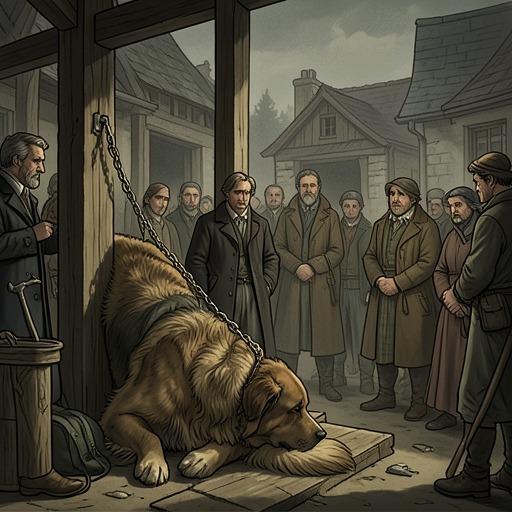
The rush begins with the discovery of a yellow metal, but its effects spread through commercial networks from Puget Sound to San Diego. Men preparing to enter the frozen North need dogs capable of hauling heavy loads through snow and frost. This demand reaches Buck’s sheltered home in the Santa Clara Valley, where Manuel, a gardener’s helper burdened by gambling debts and faith in a money-making system, sells him. The event reveals how the gold economy penetrates even the apparently secure world of Judge Miller’s household: Buck’s strength becomes a commodity, and personal trust gives way to financial desperation.
The sale also exposes the unequal human and animal economies produced by the rush. Buck is taken to College Park, bound with rope, and exchanged for money before being shipped north. Perrault recognizes that the inflated demand has made a fine dog valuable, purchasing Buck for three hundred dollars with government funds. The price reflects both Buck’s physical capacity and the larger transportation crisis created by the rush; dogs are valued because mail, supplies, and official dispatches must continue moving across terrain where ordinary transport is impossible.
Routes, Labor, and Environmental Risk
The Klondike Gold Rush creates a vast corridor of movement through mountain passes, frozen lakes, rivers, and improvised camps. Buck’s first journey north carries him through the Canyon, Sheep Camp, the Scales, the timber line, glaciers, and snowdrifts hundreds of feet deep before crossing the Chilkoot Divide. At Lake Bennett, thousands of gold-seekers build boats for the spring breakup, showing how the rush follows a seasonal rhythm imposed by ice, thaw, and water as much as by human plans.
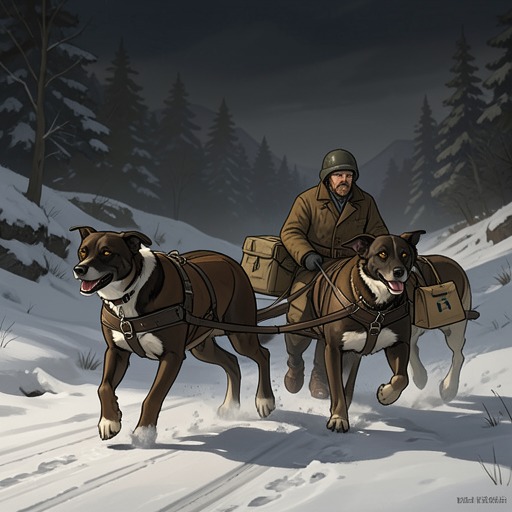
The Yukon routes are not passive settings but active hazards. On the Thirty Mile River, open water defeats the frost, and Perrault’s team requires six exhausting days to cover thirty miles. Perrault repeatedly breaks through thin ice while carrying a long pole, and once the sled plunges through with Buck and Dave. The dogs and men are nearly drowned, then coated in ice and forced to run around a fire while they thaw. The rush therefore depends on animal endurance and human expertise while continuously exposing both to cold, drowning, exhaustion, and disease fears.
The same transportation system produces record-breaking speed and organized provisioning. After a week’s rest in Dawson, Perrault heads down the Yukon Trail toward the coast with urgent dispatches and the ambition of making the year’s record trip. Packed trails, police-maintained food deposits, and a light load help the team travel rapidly, covering a nominal fifty-mile route in sixty miles on the first day. Yet the achievement is purchased through labor: Buck and the other sled dogs pull for hundreds of miles, while the changing condition of snow determines whether they can travel efficiently or must break their own trail.
Commodification and Exhaustion
The rush turns dogs into replaceable transport assets. Buck’s team covers twelve hundred miles with only two days of rest, but the congested mail created by the mass movement of people prevents the exhausted animals from stopping. Official orders require fresh dogs to replace those deemed worthless for the trail, and the worn-out animals are sold because dogs count for little against dollars. Buck and his companions are bought cheaply by Hal and Charles, demonstrating the brutal contrast between the high demand that initially raises canine prices and the rapid disposal of animals once their labor declines.
This system treats food, weapons, sleds, mail, and dogs according to exchange value while concealing the bodily cost of production. Buck’s work is measured in miles, speed, and hauling capacity; his companions are removed when they can no longer meet those measures. The gold rush thus produces a frontier economy in which life is constantly assessed against transport needs and profit. The value of the gold later discovered by John Thornton and his partners stands in sharp contrast to the suffering required to reach it.
Gold, Discovery, and the Frontier Landscape
The rush supplies the motive for further expeditions even after the initial routes have been crossed. Once Buck earns sixteen hundred dollars for John Thornton by pulling a thousand-pound sled load, Thornton can pay debts and join Pete and Hans in searching for a legendary lost mine. Their journey follows the Yukon and Stewart River into an uncharted eastern wilderness, where abandoned paths, a ruined hunting lodge, a Hudson Bay Company flintlock, and the Lost Cabin tradition preserve traces of earlier failed searches.
They do not find the legendary cabin. Instead, they discover a shallow placer where gold lies visibly across the bottom of the washing pan. Each day of work produces thousands of dollars in dust and nuggets, which are packed in fifty-pound moosehide bags and piled outside the lodge. The discovery fulfills the material promise that drew people north, but its narrative consequence is not a return to settled prosperity. With little work left for the dogs, Buck spends long hours by the fire, and the stillness allows memories of an older, more fearful world to rise more insistently.
The gold landscape also marks a limit to the human expedition. Thornton’s party enters the wilderness seeking a treasure concealed by history, but the place they find is valuable precisely because it is beyond ordinary settlement. The men’s success makes possible wealth, yet it also leaves Buck increasingly free to hunt, wander, and respond to the forest. The rush opens the frontier as a field of extraction while simultaneously exposing a world that resists human ownership.
Consequences and Wild Reversal
The Klondike Gold Rush ultimately changes more than routes and fortunes; it accelerates Buck’s movement away from civilization. Human commerce first removes him from Judge Miller’s estate, then places him in the labor system of the sled trail, where he learns discipline, cooperation, rivalry, and endurance. Later, after Thornton’s death, the wolf pack crosses into Buck’s valley while migrating with the moose. Buck confronts the pack alone, kills the first wolf that attacks, repels three more, and holds his position until the wolves withdraw.
That confrontation completes the rush’s deepest irony. The economic event that makes Buck valuable as a transport animal also carries him toward the conditions in which he becomes a hunter and a leader among wolves. The arrival of the pack follows the death of John Thornton, the last human bond that restrains him. Buck’s final choice is therefore shaped indirectly by the gold rush: the same frontier economy that brings him north, exhausts other dogs, and enables Thornton’s fortune also leaves him at the threshold of a nonhuman social order.
In the novel’s larger design, the Klondike Gold Rush is both historical background and transformative force. It links distant ports, government mail, mining camps, trails, rivers, and wilderness; converts strength into money and exhaustion into disposability; and establishes the conditions under which Buck’s inherited wildness can reawaken. Its gold is the visible lure, but its lasting consequence is the remaking of relationships among humans, dogs, wolves, prey animals, ice, and the land itself.