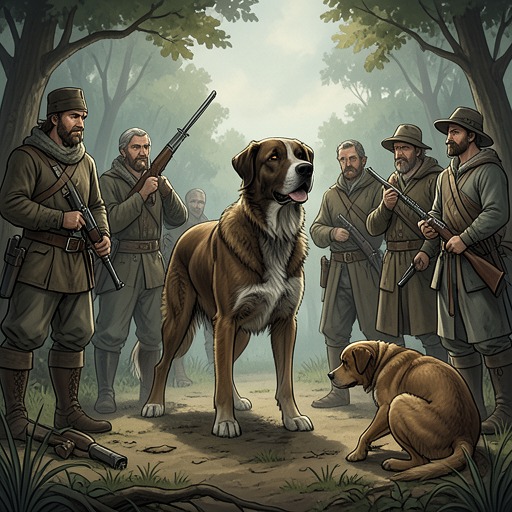
Pelly River
The Call of the WildPelly River is a perilous route and a crucial testing ground in Buck’s transformation. At its banks, the dogs face the combined pressures of difficult terrain, relentless travel, hunger, disease, and rivalry. The river therefore functions less as a passive backdrop than as an active force: its islands, channels, ice, and surrounding wilderness compel Buck to develop endurance, alertness, and the instincts required for survival.
Setting and Trail Conditions
The Pelly River is reached after the team has endured demanding travel over unstable northern routes. Perrault and Francois must manage the sled, the dogs, and the changing conditions of the trail, while the animals work for long hours with little rest. The journey repeatedly measures progress in miles and exhaustion: after reaching better ice near the Hootalinqua River, the team covers thirty-five miles to the Big Salmon, another thirty-five to the Little Salmon, and forty more toward the Five Fingers. The river route thus belongs to a landscape governed by distance, weather, ice, and the urgent schedules of transport.
The dogs’ labor is especially severe. They break camp in darkness, reach the trail at first light, and return after nightfall to eat fish and sleep in the snow. Buck receives a pound and a half of sundried salmon each day but remains perpetually hungry, while the lighter dogs receive one pound and retain better condition. His body, not yet hardened like that of the northern huskies, records the cost of the journey more visibly than the trail itself.
Dolly’s Madness
At the Pelly River, the ordinary danger of the trail suddenly becomes an individual emergency when Dolly goes mad. She announces her condition with a long, heart-breaking wolf howl, then launches herself at Buck. He has never encountered madness in a dog, but he recognizes its horror immediately and flees in panic, with Dolly panting and frothing only one leap behind him.
The pursuit carries Buck through the wooded island, down to its lower end, across a rough-ice back channel to another island, and then toward the main river. The geography turns the river into a maze of possible escape and renewed danger. Buck cannot shake Dolly, yet he cannot stop to confront her; terror keeps him moving while her madness keeps her relentlessly close.
Francois finally calls to Buck from a quarter of a mile away. Buck doubles back, still barely ahead of Dolly, exhausted and gasping, trusting that Francois will save him. As Buck passes, Francois brings down his axe upon Dolly’s head. Buck collapses against the sled, helpless from exhaustion, but the danger does not end with Dolly’s death: Spitz immediately attacks him, biting and tearing his flesh until Francois intervenes with the lash. Perrault observes that Spitz is a devil who may one day kill Buck, linking the violence at the Pelly River to the rivalry that will later threaten the entire team’s order.
Hunger, Violence, and Adaptation
The Pelly River episode belongs to a wider northern system in which scarcity governs conduct. Buck has already learned that food cannot be protected by civilized assumptions. When Pike steals bacon, Buck imitates him the next day and escapes blame while Dub is punished. Hunger changes Buck’s behavior from fastidious eating to rapid consumption, theft, and secrecy. The trail, including the Pelly River, is therefore a place where moral habits formed under the law of love and fellowship give way to the law of club and fang.
The same principle operates among the dogs. Earlier, Buck witnessed Curly’s death after a husky knocked her down and the surrounding dogs closed over her. There was no fair contest and no mercy once she fell. At the Pelly River, Dolly’s madness and Spitz’s attack repeat the lesson in another form: weakness invites immediate violence, and survival depends upon alertness, speed, and the ability to endure physical punishment.
A Threshold in Buck’s Transformation
The river marks an important stage in Buck’s physical adaptation. His softened feet become a source of acute suffering; he limps all day and lies down at camp like a dead dog, too exhausted even to collect his ration. Francois carries the fish to him, rubs his feet for half an hour each night, and sacrifices the tops of his own moccasins to make four protective coverings for Buck. The improvised moccasins bring relief, and Buck later refuses to move when Francois forgets to put them on, waving his feet appealingly until they are supplied. In time, his feet harden to the trail and the worn-out footwear is discarded.
This bodily change anticipates Buck’s larger movement away from domesticated life. Later, he leads a pack of sixty dogs in pursuit of a snowshoe hare, experiences the bloodlust of killing, runs beside a wild brother, hunts independently, kills a black bear, scatters wolverines, and eventually brings down a great moose. The Pelly River does not contain all of these later events, but it helps establish the harsh conditions through which Buck acquires the endurance and practical intelligence that make them possible.
Narrative Significance
Pelly River is significant because it concentrates the novel’s principal pressures into a single landscape. Ice and distance test the body; hunger tests conduct; Dolly’s madness tests flight and trust; Spitz’s attack exposes the continuing struggle for dominance; and Francois’s intervention briefly preserves Buck within human-directed labor. The river is both a physical obstacle and a threshold between civilization and the wild. Buck survives it not by remaining the dog he once was, but by learning, suffering, and adapting to the conditions that will eventually make his complete return to the wilderness possible.