Pete
The Call of the WildPete is one of John Thornton’s two long-term partners, alongside Hans, and serves as a competent companion in the difficult life of travel, river work, and prospecting. He is not given an elaborate personal history, but his conduct establishes him as dependable, clear-sighted, and physically courageous. His importance lies less in individual ambition than in the practical loyalty with which he works beside John Thornton and helps protect both the expedition and Buck.
Identity and Partnership
Pete belongs to the small working group formed around John Thornton after Buck’s rescue. When the raft finally arrives in Dawson, Pete and Hans join Thornton, and Buck initially refuses to notice them until he understands that they are close to his master. Buck then tolerates them rather than offering the spontaneous intimacy he gives to Thornton, Skeet, and Nig. Pete nevertheless understands Buck’s nature and does not press for a familiarity that Buck has not granted. This restraint is characteristic of the partnership: Pete lives close to the earth, thinks simply, sees clearly, and accepts the dog as a creature with his own loyalties and limits.
Pete and Hans are also presented as men who recognize the danger of Buck’s devotion. After Thornton’s reckless command sends Buck toward the edge of a three-hundred-foot cliff, Pete observes that the dog’s obedience is uncanny. He then declares that he is not eager to be the man who lays hands on Thornton while Buck is nearby, a conclusion Hans shares. The remark is partly humorous, but it also identifies the protective force governing Buck’s relationship with Thornton: Pete understands that Buck’s attachment has become a form of active guardianship.
Work in the Wilderness
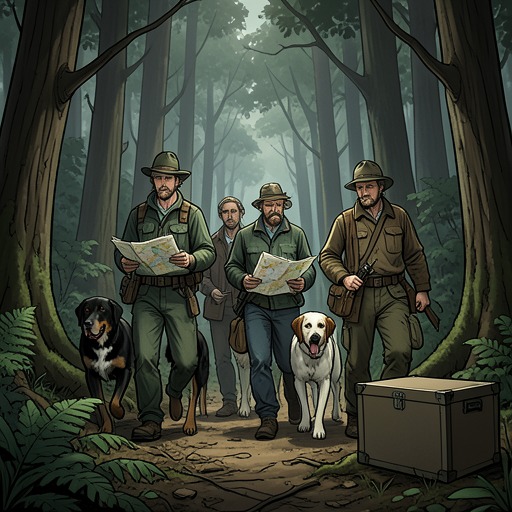
Pete’s practical value becomes clearer when the partners leave Dawson after financing themselves from the proceeds of their raft. The men and dogs travel toward the headwaters of the Tanana, carrying only the tools, ammunition, and supplies required for a wandering life. Pete shares the labor of a journey that demands endurance rather than speed. The expedition moves through uncharted country, across mountain divides, summer blizzards, glacier-shadowed ground, insect-ridden valleys, and a silent lake region. Pete’s role is not to dominate this landscape but to work competently within it, as one member of a cooperative party in which survival depends on shared effort.
The same competence appears in the river episode at Forty Mile Creek. The three partners are guiding a long, narrow poling boat down a dangerous stretch of rapids. Hans works from the bank with a Manila rope, while John Thornton remains in the boat, using a pole and shouting directions. Pete is stationed with Hans on shore, helping manage the boat’s descent and later assisting in the attempt to save Thornton. The arrangement shows Pete as a working partner rather than a passive observer: he is placed directly within the technical problem created by the current, the rocks, the rope, and the unstable boat.
The Forty Mile Creek Rescue
The crisis begins when the boat clears a ledge of barely submerged rocks and races downstream like a mill-race. Hans checks it with the rope, but the sudden stop overturns the boat and throws John Thornton into the current. Thornton is carried toward the worst section of the rapids, where the water becomes so violent that no swimmer could survive it. Buck immediately launches himself after his master and catches him after three hundred yards, but the current carries both dog and man rapidly toward destruction.
When Thornton releases Buck and orders him to go, Buck obeys only after giving what seems like a final look back. Pete and Hans drag him ashore at the point where swimming becomes impossible. They then fasten the line used for snubbing the boat around Buck’s neck and shoulders, taking care that it will not strangle him or hinder his swimming. The first attempt fails because Buck enters the stream at the wrong angle. Hans snubs the rope as though Buck were a boat, jerking him beneath the surface until his body strikes the bank. Pete helps Hans pound the water from Buck and restore his breath; Buck staggers upright, collapses, and rises again when the faint sound of Thornton’s voice reaches him.
The second attempt is calculated more successfully. Buck swims straight into the stream, holds his line until he is positioned above Thornton, and then turns downstream toward him. When Buck reaches Thornton, the force of the current drives them together with such violence that Thornton closes both arms around the dog’s shaggy neck. Hans secures the rope around a tree, and Pete helps manage the rescue as the two are dragged underwater, battered against rocks and snags, and finally brought toward the bank. Thornton is revived by the men, and Pete’s attention immediately returns to Buck, whose body appears limp and lifeless while Nig howls and Skeet licks his face.
Pete is involved in the physical aftercare that follows. Once Buck is brought around, Thornton examines him and finds three broken ribs. The injuries are serious enough to halt the expedition, and the partners establish camp beside the rapids until Buck has healed and can travel. Pete’s contribution therefore extends beyond the dramatic launch and recovery: he helps transform a desperate rescue into sustained care, making possible the continuation of the group’s shared life.
The Expedition and Its Stakes
Pete later participates in the conversation at the Eldorado Saloon that leads to Buck’s thousand-pound sled pull. The three partners need the money and equipment that such a feat could provide, because they hope to travel into the unmapped East in search of a legendary lost mine. When John Thornton’s boast is challenged, Pete and Hans stand beside him despite their doubts. Their combined funds, together with Thornton’s, amount to only two hundred dollars, their entire capital at a low point in their fortunes, yet they place it against Matthewson’s six hundred without hesitation.
The wager matters because Pete is not merely accompanying a spectacle; he is risking the partnership’s limited resources on Thornton’s faith in Buck. Buck’s success earns sixteen hundred dollars in five minutes, allowing Thornton to pay debts and enabling the partners to undertake the eastern journey. Pete therefore shares in the causal chain that carries the group from a public test of canine strength to the long search for the lost mine. The mine itself remains undiscovered, but the partners eventually find a shallow placer where gold lies visibly across the bottom of the washing pan. They stop searching and work the deposit, producing thousands of dollars in gold dust and nuggets each day. Pete is part of this reward and of the labor that makes it possible.
Death and Narrative Significance
Pete’s life ends during the attack on the camp by the Yeehats. Returning through the forest, Buck first finds Nig dead from an arrow wound and then encounters another sled dog struggling in its death-throes. At the ruined camp he sees Hans lying facedown and covered with arrows. Pete is found dead in his blankets, killed in the first moment of surprise. His death confirms the total destruction of the human community that had surrounded John Thornton and Buck.
Pete’s function in the narrative is consequently double. In the earlier wilderness episodes, he represents the competent human companionship that makes difficult travel possible. He understands Buck without trying to possess him, shares the risks of prospecting, supports Thornton’s ventures, and helps save Buck and Thornton from the rapids. In the final attack, however, even such competence cannot withstand sudden violence. Pete’s death marks the collapse of the expedition and leaves Buck without the human partners who had shared his last period of purposeful travel. After John Thornton’s death is confirmed in the pool, the world of human fellowship is irretrievably ended, and Buck turns toward the wolf pack and the call of the wild.