Pike
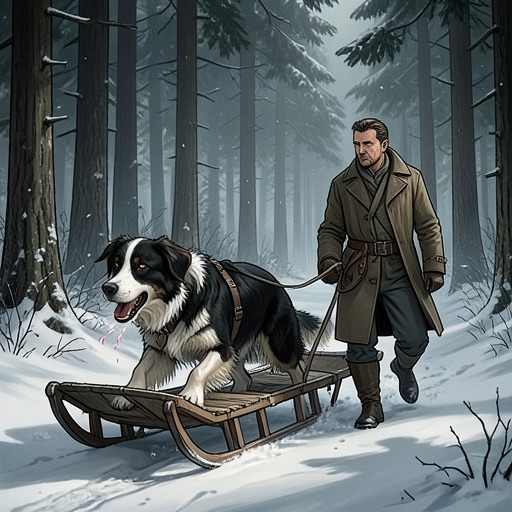
The Call of the WildPike is a sly, undersized sled dog whose talent for evasion makes him one of the clearest examples of survival through cunning in the Northland. He is not defined by strength or loyalty to a leader, but by opportunism: he avoids work, steals when supervision fails, and uses the disorder around him to protect himself. His career in the team traces the movement from clever adaptation to physical ruin, while also showing how Buck’s changing authority reshapes the behavior of the dogs around him.
Identity and Survival Skills
Pike enters the team as a clever malingerer and thief. Unlike the dogs whose value is expressed through sustained labor in the traces, he attempts to conserve his strength by appearing injured or by shirking whenever he can do so without immediate punishment. His resourcefulness is practical rather than heroic. In a camp governed by hunger, cold, labor, and the threat of violence, Pike treats concealment and opportunism as tools for staying alive.
His most revealing exploit occurs when he sees Pike steal a slice of bacon while Perrault’s back is turned. Buck watches the method and copies it the following day, escaping with an entire chunk of bacon while Dub, the awkward dog who is habitually caught, receives the punishment. Pike therefore serves as Buck’s example in a crucial lesson: food can be secured by observation, secrecy, and speed rather than by appealing to the older moral expectations of civilized life. The incident marks not only Pike’s cleverness but also the environment’s power to transmit that cleverness to a stronger and more consequential animal.
Conflict with Spitz and Buck’s Revolt
Pike becomes important in the struggle between Buck and Spitz because his shirking gives the conflict a concrete social target. After a heavy snowfall, Pike hides securely beneath a foot of snow instead of appearing for harness-up. Spitz searches the camp in mounting fury, intending to punish him as an offender and to reaffirm his authority over the team.
Buck intervenes when Spitz finally uncovers Pike. He deliberately places himself between the leader and the culprit, hurling Spitz backward and off his feet. Pike, who had been trembling abjectly, takes courage from the reversal and springs upon the fallen leader; Buck joins him, having abandoned the older code of fair play. Francois stops the mutiny with the whip and its wooden butt, striking Buck repeatedly while Spitz punishes Pike. The episode leaves Pike physically subordinate to the human driver, but politically altered: he has learned that Spitz can be challenged and that Buck may shield those who resist him.
Thereafter Pike acts under Buck’s protection. Pike steals half of Spitz’s fish and eats it safely while Buck stands behind him. On another occasion, Buck’s encouragement helps other dogs challenge Spitz, and the team’s former discipline deteriorates into bickering and open insubordination. Pike’s conduct is thus both personal and structural. He is a shirker seeking immediate advantage, but his protected acts become small breaches in the authority of the lead dog, widening into a general revolt.
Leadership, Labor, and Discipline
Buck’s rebellion does not mean that he accepts Pike’s laziness. Once Buck defeats Spitz and assumes the lead position, he imposes a different order on the same team. Pike pulls immediately behind him and habitually places no more than the minimum of his weight against the breastband. Buck repeatedly shakes him for loafing, and before the first day is over Pike is pulling harder than ever before in his life.
This reversal distinguishes Buck’s leadership from his earlier alliance with the rebels. Buck had used Pike’s evasions to weaken Spitz, but he does not permit those evasions to weaken the team. Under Buck, work becomes a collective obligation, and Pike’s cleverness no longer protects him from consequences. The team recovers its solidarity, once again moving as though it were one dog in the traces. Pike remains an individual strategist, but his strategy must now operate inside a disciplined working group.
Pike’s labor also reveals the difference between functional leadership and personal dominance. Dave and Solleks care chiefly that the team toils mightily, while Buck actively enforces the work of the less committed dogs. Pike becomes the test case for this new regime: his old methods are recognized, contained, and converted into productive effort through superior force and vigilance.
Exhaustion and Physical Decline
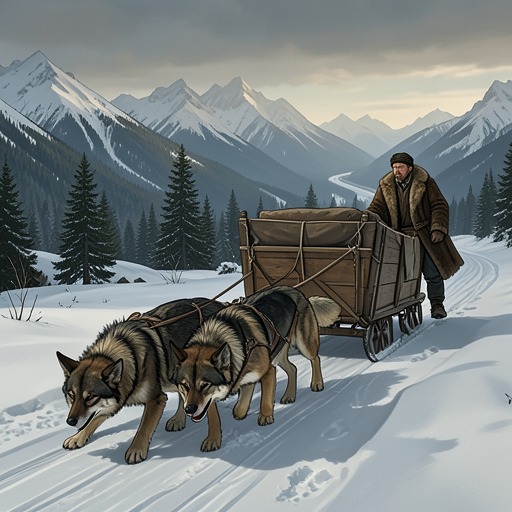
The mail runs gradually destroy the physical reserve of the team. After traveling eighteen hundred miles since the beginning of winter, the dogs are tired, underweight, and driven onward despite needing a substantial rest. Their drivers attend to them before eating or sleeping, but care cannot erase the accumulated cost of months of hauling. Pike’s practiced performance changes under these conditions. The dog who had often feigned a hurt leg begins to limp in earnest.
By the time the exhausted team reaches Skaguay after twenty-five hundred miles in less than five months, with only five days of rest during the final eighteen hundred miles, Pike is crippled and limping, only half-conscious and no longer conscious enough to malinger. His earlier deception has become indistinguishable from genuine bodily failure. The transformation is bitterly precise: a behavior once used to escape work has been overtaken by the consequences of the work itself.
Pike’s decline occurs alongside the collapse of the other dogs. Billee is killed when he can no longer rise; Koona is gone the next day; Joe is too weakened to remain malignant; Solleks still pulls despite having little strength; and Buck can barely maintain the trail. Pike survives into the final stage of the team’s deterioration, but survival no longer means clever control over circumstances. His body has become another record of the labor system’s depletion.
Abandonment and Narrative Significance
When Hal, Mercedes, and Charles take the weakened team onward, Pike is among the dogs left to haul the loaded sled toward Dawson. He is still leading when Buck watches them depart, but the team is reduced to limping, staggering animals. The journey ends catastrophically when the ice gives way and the people and dogs disappear into a yawning hole in the trail. Pike’s fate is not separately confirmed after that moment, but the last image places him within a team already physically ruined and exposed to an avoidable environmental disaster.
Pike’s role is therefore smaller than that of Buck or Spitz but essential to the novel’s account of adaptation. He begins as a thief and malingerer, a dog who survives by reading weakness in authority and exploiting gaps in supervision. Buck first learns from him, then defeats his evasions, making Pike a measure of the transition from scattered camp opportunism to organized labor. In the end, the same brutal conditions that rewarded his cunning reduce him to real lameness, demonstrating that intelligence can postpone suffering without abolishing the system that produces it.