Rabies
The Call of the WildRabies is presented as a sudden and terrifying disruption of sled-dog life: an illness that transforms a familiar team member into an uncontrollable threat. Its appearance reveals how quickly disease can become a collective emergency in the Northland, where men and dogs travel through hunger, frost, exhaustion, and violence with little margin for recovery.
Recognition and Fear
The danger first emerges through Perrault’s worried suspicion after the dogs survive a night raid. Several animals are badly wounded, much of the food is gone, and the damaged equipment includes leather traces, moccasins, and part of Francois’s whip. Looking over the injured team, Francois wonders aloud whether the many bites may have made the dogs mad. Perrault’s doubtful response carries practical weight: with four hundred miles of trail still between the team and Dawson, an outbreak could destroy the expedition as surely as hunger or broken ice.
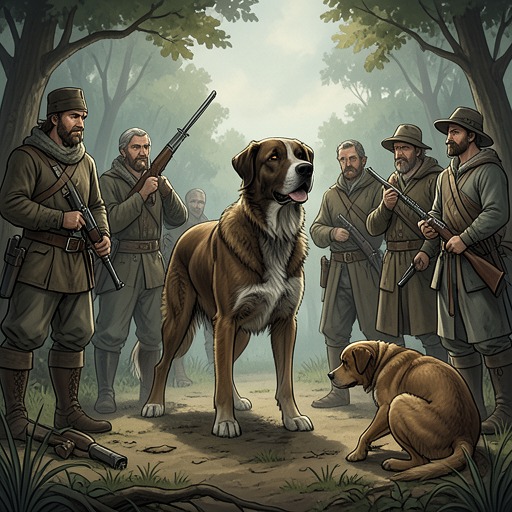
The illness is not treated as a condition that can be calmly diagnosed or managed. Its signs are behavioral and immediate. At the Pelly, Dolly, who had never been conspicuous for anything, suddenly gives a long, heart-breaking wolf howl that makes every dog bristle with fear. She then springs directly at Buck. He has never witnessed madness in a dog and has no personal reason to anticipate it, yet he recognizes the horror in her attack and flees in panic.
Dolly’s Outbreak
Dolly’s pursuit becomes a sustained test of Buck’s endurance. She remains only one leap behind him, panting, frothing, and snarling, while Buck races through the wooded island, down to its lower end, across a rough-iced back channel, onto another island, and back toward the main river. His terror gives him extraordinary speed, but it does not free him from the danger: he cannot leave Dolly behind, and he cannot risk looking back while hearing her close pursuit.
Buck eventually hears Francois calling from a quarter of a mile away and doubles back, trusting the dog-driver to save him. Francois waits with an axe poised. As Buck races past, the axe crashes down upon Dolly’s head. The act is presented as an emergency intervention rather than a contest or punishment. Francois ends the threat at the moment when Buck, exhausted and gasping, can no longer escape safely.
Immediate Consequences for Buck
The chase leaves Buck helpless beside the sled. His exhaustion creates an opening for Spitz, who attacks twice and tears into him while he is unable to resist. Francois then lashes Spitz and gives him the harshest whipping any dog in the team has yet received. Rabies therefore becomes an indirect trigger in the power struggle between Buck and Spitz: Dolly’s illness does not merely threaten Buck’s life; it places him temporarily at the mercy of the team’s dominant dog.
Perrault and Francois interpret the encounter as evidence of the danger Buck represents to Spitz. Perrault remarks that Spitz may one day kill Buck, while Francois predicts that Buck will eventually turn on Spitz and tear him apart. From that point, the rivalry becomes open war. Buck’s survival through Dolly’s attack and Spitz’s assault helps clarify the difference between illness-driven violence and the purposeful struggle for leadership that follows.
A Wider Northern System of Risk
Rabies belongs to the same harsh environment that governs the team’s labor. The dogs are animated by the work of the traces, yet that work also drains them; they face wounds, hunger, frost, unstable ice, and prolonged fatigue. The team’s function depends on every animal remaining able to pull, obey, and cooperate. A mad dog cannot be integrated into that order, so the response must be immediate and fatal.
This vulnerability is intensified by the team’s conditions. The dogs travel for long periods with little rest, and their health is judged through performance in harness. Later, Dave’s illness is treated differently because he remains mentally attached to his work and desperately seeks to stay in the traces. His case shows that not every dangerous or disabling condition produces the same response: Dolly’s madness makes her an immediate threat to others, whereas Dave’s sickness becomes a crisis of exclusion from the labor that gives his life meaning.
Narrative Significance
Rabies gives physical form to the book’s law of club and fang. In the Northland, ordinary social protections and leisurely judgment have no force when a dog becomes violently uncontrollable. The outbreak also teaches Buck that survival depends on alertness, rapid interpretation, and reliance on working bonds with human handlers. Francois’s axe saves him, but the rescue is inseparable from the brutal conditions that make such a method necessary.
The episode further strengthens the movement from disciplined teamwork toward open hierarchy. After Dolly’s death, Buck and Spitz no longer merely oppose one another through threats and interference; their conflict becomes inevitable. The team’s pride in the traces, its strict enforcement of order, and its readiness to turn upon weakness all converge around the outbreak. Rabies is thus both a medical danger and a narrative catalyst: it exposes the fragility of the sled system, tests Buck’s physical resilience, and clears the way for his eventual challenge to Spitz.