Santa Clara Valley
The Call of the WildSanta Clara Valley is the sunlit domestic world from which Buck is taken and against which his later life in the Northland is measured. It represents abundance, order, and inherited status, but its apparent safety cannot protect him from the economic forces unleashed by the Klondike Gold Rush. In Buck’s memory, the valley becomes increasingly distant as hardship awakens instincts formed long before his civilized life.
Setting and Estate
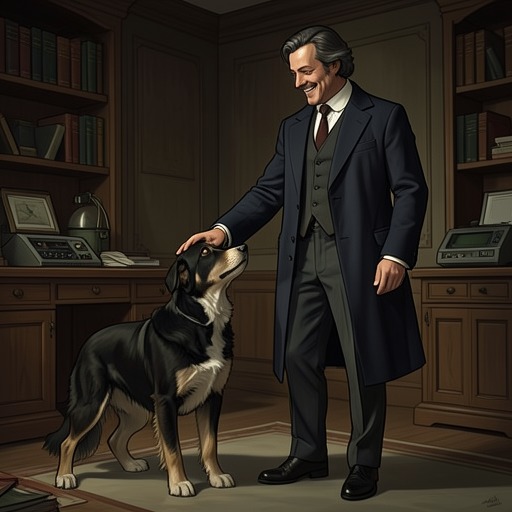
Santa Clara Valley is presented through Judge Miller’s large country estate, a place set back from the road and partly concealed among trees. A wide, cool veranda surrounds the house, while graveled drives curve through spreading lawns and beneath tall poplars. The setting is not merely a residence but an extensive, carefully ordered domain whose cultivated openness contrasts sharply with the frozen routes Buck later travels.
Behind the house, the estate expands into great stables, servants’ cottages, outhouses, grape arbors, green pastures, orchards, and berry patches. It also contains an artesian-well pumping plant and a large cement tank where Judge Miller’s sons swim in the morning and cool themselves during the hot afternoon. The abundance of these facilities establishes Santa Clara Valley as a world of managed nature, comfort, and leisure.
Buck’s Original Home
Buck was born on the estate and lived there for the first four years of his life. He effectively ruled the domain. Other dogs occupied the kennels or obscure corners of the house, including Toots, the Japanese pug, and Ysabel, the Mexican hairless, while the fox terriers remained noisy but subordinate figures. Their presence emphasizes Buck’s unusual standing rather than threatening it.
Buck’s physical inheritance and upbringing fit the valley’s aristocratic order. His father, Elmo, was a huge St. Bernard and Judge Miller’s inseparable companion; his mother, Shep, was a Scotch shepherd dog. Buck weighed one hundred and forty pounds, and good living together with universal respect gave him a distinctly commanding bearing. Hunting and outdoor activity kept him from becoming merely a pampered house dog, hardening his muscles and preserving his love of water, yet his habits and self-regard remained those of a sated country aristocrat.
From Security to Removal
The valley’s security is undermined by forces far beyond the estate. In the fall of 1897, the Klondike strike drew men northward, and transportation companies increased the demand for heavy dogs with strong muscles and warm coats. Buck cannot know of this changing market because he does not read newspapers; his privileged life has insulated him from the historical pressures gathering around him.
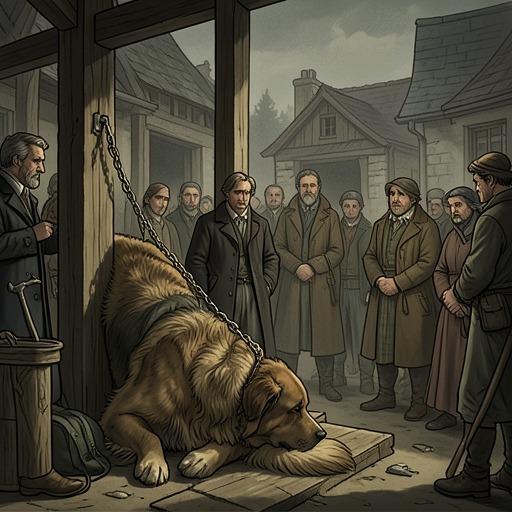
Manuel, a gardener’s helper on the estate, becomes the immediate agent of the rupture. His dependence on Chinese lottery gambling, combined with inadequate wages and family obligations, leaves him in need of money. While Judge Miller is away at a Raisin Growers’ Association meeting and the boys are organizing an athletic club, Manuel leads Buck through the orchard under the pretense of an ordinary stroll. At College Park, a solitary stranger pays Manuel, who then doubles a stout rope around Buck’s neck. The cultivated valley thus becomes the starting point of Buck’s forced passage into a world where dogs are commodities and strength is a marketable resource.
Memory and Contrast
After leaving Santa Clara Valley, Buck sometimes recalls Judge Miller’s house, the cement swimming tank, Ysabel, and Toots while resting beside a fire. These memories do not make him homesick. The Sunland has become dim and distant, and recollection of the estate no longer commands him as powerfully as memories of the man in the red sweater, Curly’s death, his fight with Spitz, and the food associated with survival.
This change gives Santa Clara Valley a precise narrative function. It begins as Buck’s entire world, a place where status appears natural and permanent, but later survives only as one layer of memory beneath older hereditary instincts. As Buck works through the Chilkoot Divide, endures the open water of the Thirty Mile River, and moves through the frozen Northland, the valley’s cultivated abundance is opposed by ice, exhaustion, danger, and labor. Spring in the Northland brings a vast awakening of water, plants, birds, and animals, yet the exhausted travelers and huskies stagger through it toward death; the contrast makes the valley’s earlier warmth feel like a lost form of protection.
Place in Buck’s Wider Journey
Santa Clara Valley is the geographical and symbolic point of departure for Buck’s transformation. His later routes extend along Lake Bennett, the Yukon, and the Stewart River toward an unknown eastern trail, while the seasonal movements of moose and the return of the wolf pack place his life within a larger natural geography. The valley belongs to a settled, human-managed order; the Northland reveals a world governed by ice, migration, predation, and endurance.
By the end of Buck’s story, the valley no longer defines his identity. His former home has been replaced by an allegiance to the wild: after John Thornton’s death, Buck answers the wolf pack’s call, confronts the arriving wolves, and joins the world beyond human claims. Santa Clara Valley therefore remains decisive not because Buck returns to it, but because the memory of its comfort clarifies the scale of his departure and the depth of his eventual transformation.