Seattle
The Call of the WildSeattle marks the decisive threshold between Buck’s protected life in the Santa Clara Valley and his forced existence as a marketable sled dog. He reaches the city after two days and nights without food or water, his rage intensified by physical torment, and is immediately absorbed into a chain of purchase, transport, and labor that carries him toward the Klondike.
Arrival After Captivity
Buck’s arrival in Seattle follows his removal from Judge Miller’s estate by Manuel, whose gambling debts lead him to sell the dog. After the stranger at College Park pays Manuel, Buck is bound with a stout rope, resists violently, and is shipped away in a crate. The deprivation of the journey changes him profoundly: hunger matters less than the absence of water, which leaves his throat and tongue parched and swollen, while ill treatment drives him into a fever. By the time the express messengers unload him at Seattle, his eyes are bloodshot and he has become so violently altered that even Judge Miller would not have recognized him.
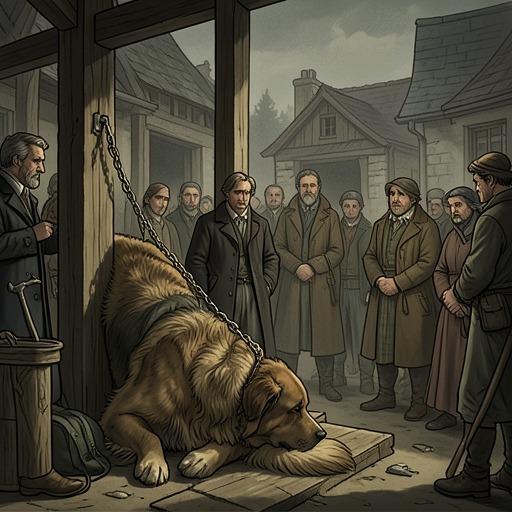
Four men carry the crate from a wagon into a small, high-walled backyard. The setting is not a place of refuge but a confined transfer point, where Buck’s body is treated as secured cargo. A stout man wearing a sagging red sweater signs the driver’s book, and Buck identifies him as the next source of torment. When Buck throws himself against the bars, the man answers with a hatchet and a club, beginning the assault later defined by the red sweater and the club.
Seattle as a Marketplace
The city’s role is made explicit through exchange. Buck is not received as a companion or rescued as a wronged animal; he is delivered, inspected, and prepared for resale. The money that changes hands converts his strength into a price, while the crate, rope, and transport arrangements conceal the violence by which he entered the transaction. Seattle therefore joins the Klondike economy before Buck has seen the northern trail: the demand for dogs has already made his body valuable as equipment for human movement.
That commercial logic continues when Perrault encounters Buck. The man in the red sweater sells him for three hundred dollars, explaining that the money is government money. Perrault accepts the price because the demand for dogs has driven values sharply upward, and he recognizes Buck as an exceptionally fine animal. The purchase is justified by the practical needs of Canadian Government dispatches, but the scene also exposes the contradiction at the center of the trade: a dog whose individuality and formidable capacity are recognized is nevertheless transferred as property.
Departure from the City
Seattle is also the last place Buck sees the man in the red sweater and the last place he sees the warm Southland. From the deck of the Narwhal, he watches the city recede with Curly, another newly purchased dog. Perrault takes both animals below and turns them over to Francois, a French Canadian half-breed. These men are unfamiliar to Buck, yet their calm and impartial treatment gradually earns his respect. The contrast is sharp: Seattle is the scene of commercial capture and impending violence, while the ship becomes the passage into a new system governed by harness, trail discipline, and practical knowledge of dogs.
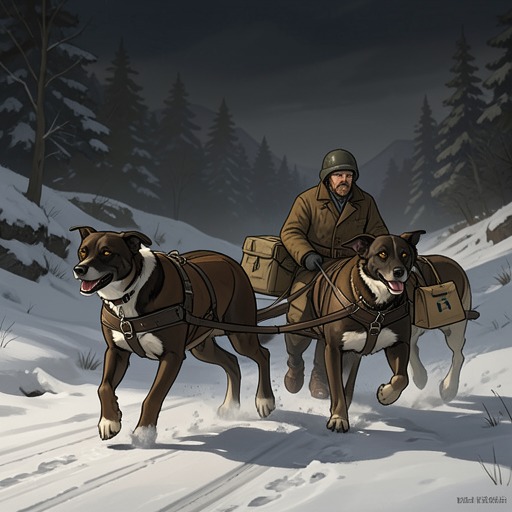
Within an hour of Buck’s transfer, three more huskies join the team, bringing it to nine dogs, and the enlarged team leaves for the Yea Canyon. Buck is relieved to leave Seattle. The work ahead is hard, but the trail gives his captivity a new direction: he begins learning the rules of the traces, receives instruction from Dave and Solleks, and discovers that the team’s labor possesses its own demanding order and pride.
Narrative Significance
Seattle concentrates the book’s shift from domestic status to exchange value. Buck arrives as the well-fed companion of Judge Miller, a one-hundred-and-forty-pound dog shaped by comfort, outdoor exercise, and universal respect; he leaves as a purchased worker whose survival will depend on strength, obedience, judgment, and adaptation. The city is thus less a lasting setting than a hinge in the narrative, linking the unseen treachery of Manuel and the red-sweater man with the northern world of government mail, sled teams, exhaustion, and gold.
The distance between Buck’s arrival and his later life also gives Seattle retrospective force. The dog who is sold there will eventually master the team, challenge Spitz for leadership, endure the prolonged labor of the mail trail, and become central to John Thornton’s northern fortunes. Yet every later achievement carries the mark of this threshold: Seattle is where Buck’s former identity is stripped away through confinement, thirst, violence, and sale, and where the commercial system of the North first claims him as a living instrument.