Solleks
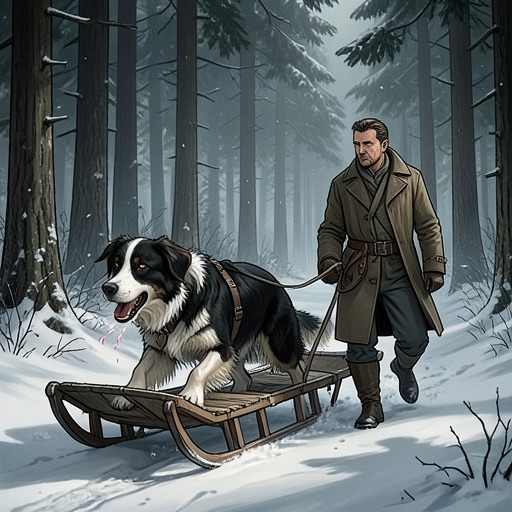
The Call of the WildSolleks is an old, long, lean, gaunt husky whose battle-scarred face and single eye announce hard-won strength. Known as the Angry One, he commands respect without seeking attention, and his most revealing quality is not simple ferocity but an uncompromising attachment to his own boundaries and to the work of the traces. He belongs to the Northland’s working order: a dog who asks for little, gives little, and expects only to be allowed to do his appointed labor.
Identity and Introduction
Solleks enters Perrault’s team after Billee and Joe, an experienced animal among younger and more unsettled dogs. His scarred face and single flashing eye make his prowess immediately legible to the others, including Spitz, who leaves him alone. Unlike a dog who must continually prove himself through quarrels, Solleks carries authority in reserve. He is described as resembling Dave in asking nothing, giving nothing, and expecting nothing, while his inward life remains largely private.
His name, meaning the Angry One, corresponds to a precise and dangerous rule: he cannot tolerate being approached on his blind side. Buck discovers this accidentally rather than provocatively. Solleks whirls on him and slashes his shoulder, cutting deeply for three inches up and down to punish the violation. The wound is not the beginning of a lasting feud. Buck learns the rule, thereafter avoids Solleks’s blind side, and the two have no further trouble during their comradeship. Solleks’s anger is therefore bounded by a code; once the code is understood, coexistence becomes possible.
Work in the Traces
Solleks is transformed by harness. Before work begins, he appears passive and unconcerned, but once fastened to the sled he becomes alert, active, and fiercely irritable toward any delay or confusion. The toil of the traces is presented as the supreme expression of his being, not merely an imposed burden. In harness, he is anxious that the work go well and takes delight in the strenuous order of collective movement.
Perrault places Buck between Dave and Solleks so that the newcomer can learn. Solleks teaches through his teeth, correcting mistakes with the immediate physical authority accepted by the team. When Buck becomes tangled in the traces during a halt and delays the start, Dave and Solleks give him a sound trouncing. The lesson is severe, but it produces practical knowledge: Buck thereafter keeps the traces clear, and the need for correction quickly diminishes. Solleks is thus one of the working dogs who initiate Buck into the team’s discipline, where competence is learned through repetition, pressure, and consequences.
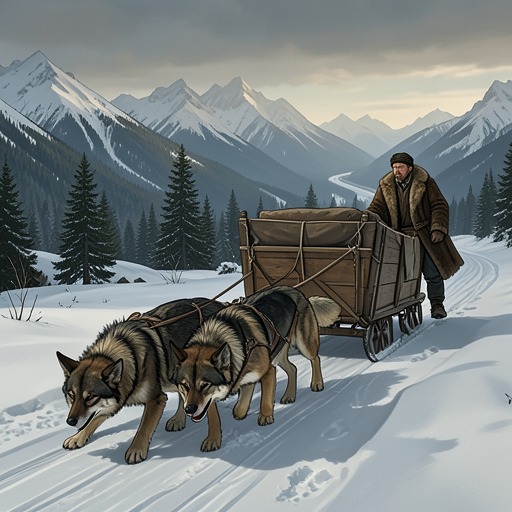
His position is first behind Dave, with Buck between them, while Spitz leads the single-file team. The arrangement places Solleks among the experienced laborers rather than the ambitious contenders. His ambition appears to be solitude, but the narrative later reveals that he shares with Dave a deeper and more vital purpose: the pride of trace and trail. This pride awakens at the breaking of camp, drives the dogs through the day, and leaves them gloomy and discontented when work ends. Solleks’s character makes the paradox visible: labor exhausts him, yet exclusion from labor would deny the identity through which he lives.
Leadership and Conflict
After Buck defeats Spitz, Francois brings Solleks forward as the best remaining lead-dog. Solleks is reluctant to contest Buck’s claim and shows plainly that he is afraid when Buck springs upon him and drives him back. When Francois removes Buck and restores Solleks, Solleks does not resist the second displacement; he is not unwilling to surrender the coveted position. The scene distinguishes him from both Spitz’s domineering ambition and Buck’s insistence on mastery. Solleks is a capable worker, but leadership is not his objective.
Once Buck becomes leader, Solleks accepts the change because it does not interfere with his real business: to toil mightily in the traces. His response demonstrates the team’s hierarchy of values. The lead-dog may command, but the working dogs judge leadership chiefly by whether order and labor are preserved. Under Buck, Solleks continues pulling with all his strength, contributing to the restored solidarity in which the team once again leaps as one dog.
Illness, Displacement, and Death
Solleks’s later importance is sharpened by Dave’s illness. When Dave becomes too weak to remain in his position, the driver takes him out and fastens Solleks to the sled in his place. The substitution is practical, but for Dave it is an unbearable rejection, because Solleks occupies the work Dave has served for so long. Dave attacks him, attempts to force him from the traces, and finally bites through both of Solleks’s traces so that he can stand again in his proper place.
Solleks is not portrayed as an aggressor in this episode. He is the sound working dog whose body becomes the visible sign of Dave’s displacement. The men eventually harness Dave again, accepting that it is a mercy for him to die in the traces, and Solleks resumes his position after Dave’s final effort. Through this arrangement, Solleks participates indirectly in the tragic principle that the dogs’ pride can outlast bodily survival: the work is not simply something they perform, but the condition by which they recognize themselves.
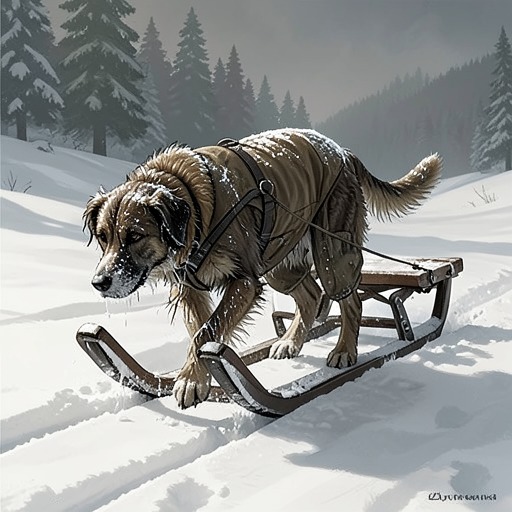
The mail run leaves Solleks limping and terribly footsore. After the team covers twenty-five hundred miles in less than five months, with only five days of rest during the final eighteen hundred miles, every dog arrives at Skaguay without reserve strength. Solleks’s lameness records the physical price of the system that also gives his existence meaning. He is later sold with the exhausted team to Hal, Charles, and Mercedes, along with harness and all, because dogs deemed worthless for the trail count for little against dollars. He is seen limping and staggering when the ruined party finally leaves Buck behind; the narrative does not give him a separate later fate, but his exhausted departure belongs to the wider human abandonment of the dogs.
Narrative Role and Significance
Solleks serves as a counterpoint to Buck’s rising ambition. He possesses strength, experience, and a dangerous temper, yet he does not seek supremacy. His identity is organized around competence, boundaries, and labor rather than command. By teaching Buck, accepting Buck’s leadership, and continuing to pull under new conditions, he helps define the difference between authority over the team and devotion to the team’s work.
At the same time, Solleks embodies the pride of trace and trail that governs the sled dogs more powerfully than human orders alone. The same harness that appears to enslave the animals also releases their energy, solidarity, and purpose. Solleks therefore complicates any simple opposition between freedom and labor: his suffering is real, but so is the meaning he finds in disciplined exertion. His scarred body, guarded blind side, and persistent labor make him one of the clearest figures of the Northland’s harsh working ethic, where survival depends on learning the code and where belonging is proved by pulling.