Spitz
The Call of the WildSpitz is the big white dog from Spitzbergen who joins Buck aboard the Narwhal after having been taken from a whaling captain and later accompanying a Geological Survey into the Barrens. He enters the northern world with extensive experience of Arctic travel and dog fighting, and he quickly occupies the position of lead dog. His authority rests not on affection but on competence, vigilance, and the ability to punish any dog that delays or evades the work of the team.
Identity and Place in the Team
Spitz is introduced as a seasoned sled dog whose past has already trained him for the harsh conditions Buck is only beginning to encounter. Unlike the newcomers, he understands the habits of camp and trail, and his position at the head of the team gives him practical control over the other dogs. When Buck is first put into harness, Spitz helps instruct him by growling sharp reproof and cunningly throwing his weight into the traces to jerk Buck into the correct movement. His leadership is therefore functional as well as coercive: the team must move efficiently, and Spitz knows how to make inexperienced dogs conform.
His behavior is also marked by treachery. He smiles into a dog’s face while contemplating an underhand trick, and at the first meal he steals from Buck’s food. Buck springs to punish him, but Francois’s whip reaches Spitz first. This intervention makes Buck respect Francois’s fairness, while Spitz’s conduct establishes the hostility that will define their relationship. Spitz is not merely unfriendly; he tests others through concealed aggression and treats every exchange as a calculation of advantage.
Rivalry with Buck
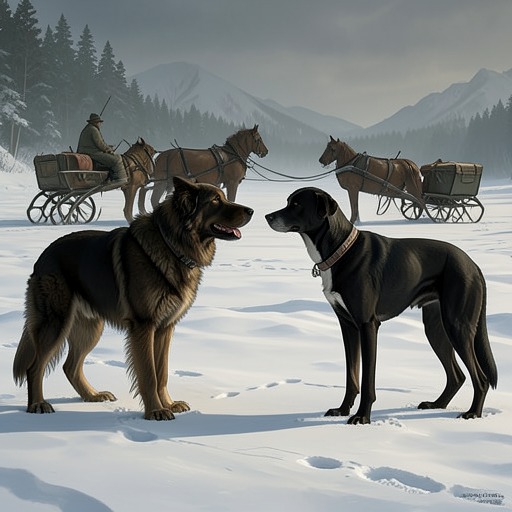
Spitz recognizes Buck as a dangerous rival before Buck openly declares himself one. He repeatedly shows his teeth and goes out of his way to bully Buck, attempting to provoke the fight that can end only with the death of one dog. Buck initially avoids direct conflict. The discipline imposed by the man in the red sweater has removed blind rashness from his desire for mastery, leaving him cautious, deliberate, and capable of waiting. Spitz interprets this restraint as timidity, failing to understand that Buck’s patience is part of his growing strength.
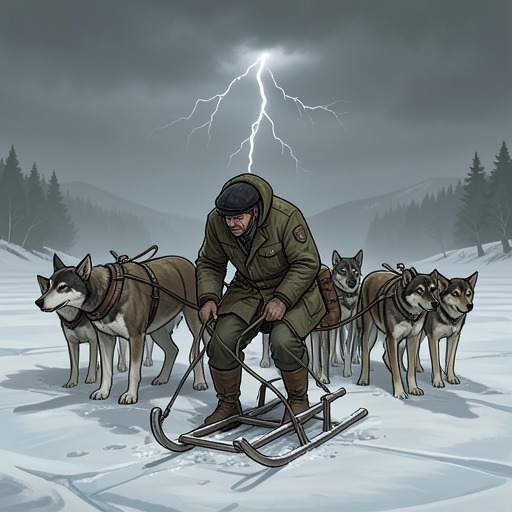
The rivalry first breaks into violence at a miserable camp on the shore of Lake Le Barge. A driving snowstorm and cutting wind force Perrault and Francois to camp on the lake ice, while Buck makes a warm nest beneath a rock. After Buck eats his ration and returns, he finds Spitz occupying it. The intrusion crosses the limit of what Buck has been willing to endure. He springs upon Spitz with a fury that surprises both of them, and the two dogs circle for an opening before starving huskies invade the camp, drawn by the smell of food. The conflict is interrupted, not resolved: Perrault and Francois must fight off four or five score famished dogs, while Spitz and Buck remain locked in a contest whose stakes have become unmistakable.
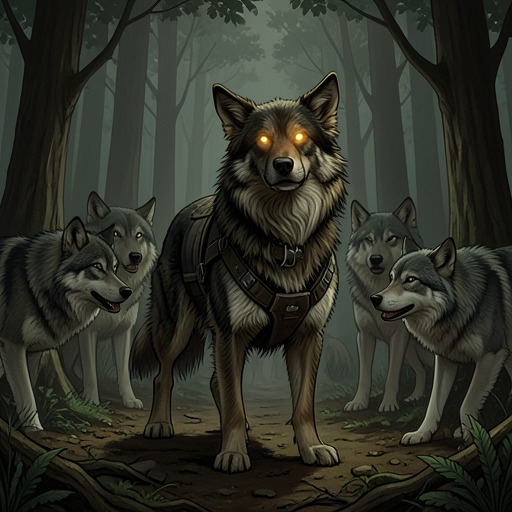
The attack of the starving huskies reinforces the law governing Spitz’s world. The dogs fight without warning, surround weakness, and close in when an opponent falls. Buck has already seen Curly torn apart after being knocked down, and the spectacle has taught him that there is no fair play once a dog loses its footing. Spitz laughs at Curly’s death, and Buck’s hatred of him becomes bitter and deathless. Spitz thus becomes associated not only with personal cruelty but with the larger rule that governs the camp: dominance belongs to the dog able to remain standing.
Combat and Defeat
The final contest is prepared by the team’s changing balance of power. After Buck has endured the trail and prospered where other Southland dogs would have failed, Spitz understands that his supremacy is threatened. Buck’s strength is matched by cunning and patience, while Spitz remains an accomplished fighter whose long experience extends from Spitzbergen through the Arctic, Canada, and the Barrens. He has mastered many kinds of dogs and has never allowed passion to erase tactical judgment. He does not rush until prepared to meet a rush, and he does not attack without first defending against the counterattack.
The decisive opportunity arises during a nighttime chase after a snowshoe hare. The whole team, joined by fifty dogs from a Northwest Police camp, pursues the animal down a frozen creek. Buck runs at the head of the pack, consumed by the old predatory excitement and determined to kill living meat with his own teeth. Spitz, however, leaves the direct pursuit and cuts across a narrow neck of land. He intercepts the hare at a bend, leaps into its path, and breaks its back in midair. The pack’s cry of delight marks the instant when the chase becomes the long-awaited duel.
Buck drives into Spitz shoulder to shoulder, but misses the throat. Spitz recovers almost immediately, slashes Buck’s shoulder, and retreats to better footing. The dogs fight in a silent circle of watching huskies. Buck repeatedly seeks the softer flesh of Spitz’s neck, but Spitz’s fangs meet his every attack. Buck then changes tactics, feinting toward the throat before trying to overthrow Spitz with his shoulder; each attempt is answered by Spitz’s speed and practiced defense. Spitz remains untouched while Buck bleeds and pants, and the fight becomes increasingly desperate.
The decisive move comes when Buck finally makes shoulder meet shoulder squarely. Spitz disappears from the circle, and Buck stands as the successful champion, the dominant primordial beast who has made his kill. The result is more than the death of an enemy. It removes the acknowledged master of the team and proves that Buck’s apparent timidity concealed a superior combination of strength, patience, adaptability, and tactical intelligence.
Leadership and Consequences
The next morning Francois finds Spitz missing and Buck covered with wounds. He recognizes that Spitz fought fiercely, but judges Buck’s fighting power as greater. Buck immediately claims the place Spitz occupied as leader. Francois instead brings Solleks forward, considering him the best remaining lead dog, but Buck attacks Solleks, drives him back, and takes the position. Solleks is not unwilling to yield, yet Francois refuses to accept the change and physically drags Buck aside.
Buck’s response shows that his rebellion is not an attempt to escape labor. When Francois threatens him with a heavy club, Buck remembers the man in the red sweater and retreats beyond the weapon’s reach. He watches the club carefully, knowing how clubs work and how to dodge one. But he does not flee the camp. He wants leadership, believes it is his by right, and considers it earned through the fight. For nearly an hour, Francois and Perrault chase him, curse him, and throw clubs; Buck circles them, answering their anger with snarls while making clear that he will return once his demand is met.
Spitz’s defeat therefore changes the structure of the entire team. It ends the trouble associated with his rule and allows Buck to replace coercive authority with a leadership grounded in demonstrated superiority. The team’s later work is described as animated and purposeful, and Buck’s mastery over other fierce dogs is established through further battles. Spitz’s absence remains the condition that makes this new order possible: his death creates the vacant position through which Buck’s rise becomes visible.
Narrative Significance
Spitz is the chief antagonist of Buck’s early northern life and the most concentrated expression of the Law of Club and Fang. He is neither a simple brute nor an incompetent tyrant. His intelligence, experience, discipline, and tactical restraint make his leadership credible, while his bullying and treachery make it intolerable to Buck. The rivalry is consequently a contest between two forms of survival: Spitz’s established mastery and Buck’s emerging capacity to learn, wait, adapt, and strike at the right moment.
His role also clarifies the difference between labor and domination. Spitz understands the pride of trace and trail and can transform the team’s energy into effective work, yet he maintains order by punishing weakness and suppressing rivals. Buck learns the same demanding world through the harness, but his ascent begins when he refuses to accept a place beneath the dog he has defeated. Spitz’s fall turns Buck from an exceptional newcomer into the central leader of the sled team and foreshadows the wider movement from trained work toward the wild authority that eventually draws him beyond human society.