Starvation
The Call of the WildStarvation is not a single episode in the northern journey but a progressively worsening condition that reshapes Buck’s body, conduct, and understanding of survival. It first appears as perpetual hunger beneath the disciplined routine of the sled trail and ultimately becomes a form of humanly intensified violence: the dogs are overworked when they need rest, fed unsuitable substitutes when supplies fail, beaten when their bodies can no longer respond, and driven toward death by travelers who cannot manage either themselves or their team.
Chronic Hunger and Adaptation
Day after day, Buck and the team broke camp in darkness, traveled through the short gray dawn, and reached camp only after nightfall. His daily ration was a pound and a half of sun-dried salmon, yet even that amount seemed to disappear without relieving him. The other dogs, lighter and born to the life, received only a pound and remained in condition; Buck, still adjusting from a more sheltered existence, suffered continual hunger pangs beneath the same labor.
Hunger quickly altered his conduct. Formerly a dainty eater, Buck could no longer afford to leave food unfinished, because his mates immediately seized whatever remained. He learned to eat as rapidly as they did, to defend his ration while fighting off several dogs, and eventually to take food that was not his. Watching Pike steal bacon while Perrault’s back was turned, Buck reproduced the method the following day and escaped with an entire chunk, while the clumsy Dub was punished for the theft. The incident marks starvation as an adaptive pressure rather than merely a sensation: Buck’s capacity to survive depends on speed, concealment, and a willingness to discard standards that belonged to the Southland’s law of love and fellowship.
This adaptation does not make hunger harmless. It makes Buck more capable of enduring a world in which food is contested and private ownership offers no protection. The same condition that sharpens his intelligence also strips away the habits of his former life, turning nourishment into an immediate struggle and morality into a question of whether a behavior preserves life.
Food Scarcity and the Sled Trail
The first journey establishes how closely starvation is tied to the logistics of Arctic travel. After the team suffered the raid of starving huskies, nearly half the food disappeared, along with edible leather, pieces of the traces, and part of Francois’s whip. The loss mattered because the team still had four hundred miles between it and Dawson. The wounded dogs had to continue over the dangerous Thirty Mile River, where six exhausting days were needed to cover thirty miles of open water, thin ice, and breakable ice bridges. Repeated immersion, extreme cold, and the labor of drying clothes by fire consumed reserves that could not easily be replaced.
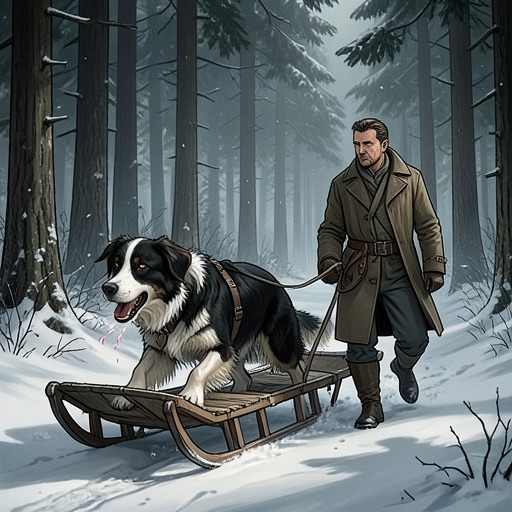
Buck’s physical needs became visible in his feet as well as his stomach. His feet, softened through generations of domestication, were poorly suited to the trail compared with those of the huskies. He limped in agony and sometimes refused even to move for his fish ration. Francois carried the food to him, rubbed his feet for half an hour each night, and made four moccasins from the tops of his own moccasins. The improvised footwear eventually allowed Buck’s feet to harden, but the episode shows that hunger and exhaustion operate together: even food cannot restore an animal whose body is being destroyed by the route itself.
Disease added another peril to deprivation. At the Pelly, Dolly suddenly became violently mad and pursued Buck across islands and rough back channels, driven by a horror he had never witnessed but instinctively understood. Buck’s panic exhausted him further until Francois killed Dolly with an axe. In this environment, the team’s food shortage exists alongside madness, cold, drowning, and violence; survival depends on managing several overlapping risks rather than solving hunger in isolation.
The Outsiders’ Mismanagement
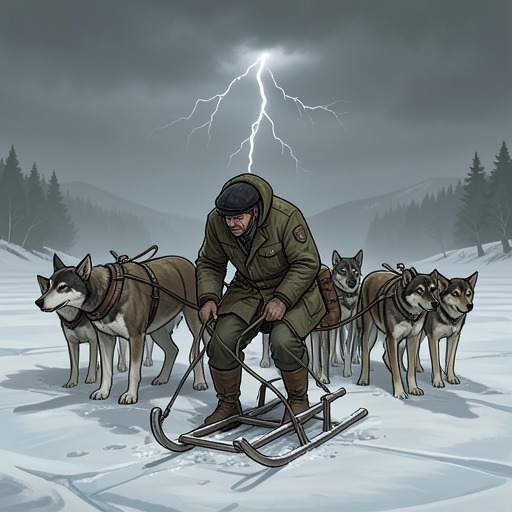
The most destructive phase begins when Charles, Hal, and Mercedes take charge of a team already worn out by twenty-five hundred miles of continuous trail. They are proud of possessing fourteen dogs, but their calculations ignore the food required to maintain so large a team. Their camp is slow and disorderly, their loads must repeatedly be rearranged, and some days they travel fewer than ten miles, while none approaches the distance assumed in their calculations. Their failure to work the dogs is matched by their failure to organize their own labor.
Their feeding decisions intensify the crisis. The inexperienced dogs have voracious appetites, and Hal, seeing the exhausted huskies pull weakly, doubles the orthodox ration. Mercedes secretly removes fish from the sacks to give the dogs still more when tears and pleading fail to persuade him. Yet the animals do not primarily need additional food; they need rest, and the heavy outfit continues to drain their strength. Because the party covers only a fraction of its planned distance, the food disappears faster than the trail does.
Once Hal realizes that half the dog food is gone while only a quarter of the distance has been covered, he cuts the ration below the normal amount and demands greater daily travel. This is a fatal contradiction. Less food cannot make exhausted dogs move faster, and the travelers’ inability to begin early or continue for long hours prevents them from compensating through work. Starvation therefore emerges from a chain of errors: excessive numbers, excessive loading, overfeeding, incompetence, and finally punitive underfeeding.
Mercedes’s conduct adds weight in the literal sense. Hurt by the loss of the chivalrous treatment she expects, she repeatedly rides in the sled despite weighing one hundred and twenty pounds. Her presence becomes an additional burden for animals already collapsing. When Charles and Hal remove her, she goes limp and refuses to walk, forcing them to unload the sled, return for her after three miles, and put her back aboard. Human misery makes the travelers callous toward the dogs, while their own quarrels and helplessness impose still more labor on the animals.
Physical Collapse and Death
At the Five Fingers, the food finally gives out. The only available substitute is frozen horsehide traded by an old woman for Hal’s revolver. The hide, stripped from horses months earlier, is hard like galvanized iron; after thawing inside a dog, it becomes thin leather, short hair, and indigestible fibers. It occupies the stomach without providing the nourishment needed for labor, converting hunger into a torment that food itself cannot relieve.
Buck staggers at the head of the team as though moving through a nightmare. He pulls when he can, but when he cannot, he falls and remains down until Hal’s whip or club forces him upright. His coat loses its stiffness and gloss, hanging limp, draggled, or matted with dried blood. His muscles waste into knotty strings, his flesh pads vanish, and every rib and bone shows through loose, empty folds of skin. The narrative preserves one remnant of resistance in him: the man in the red sweater had taught Buck that his heart could survive what his body endured.
The other dogs become perambulating skeletons. Seven remain at first, and the lash and club no longer produce ordinary fear because pain has become distant and the animals’ perceptions have dulled. When they halt, they drop into the traces like dead dogs; when beaten, the faint spark of life flickers just enough to make them stand and stagger onward. Their condition is neither ordinary life nor ordinary death, but a prolonged suspension in which labor continues after the body has nearly ceased to sustain itself.
Billee, the good-natured dog, is the first of the final losses described. When he falls and cannot rise, Hal kills him with the axe and cuts his body from the harness. On the next day Koona dies as well. Five remain: Joe is too weakened even for his former malice, Pike is crippled and barely conscious, Solleks remains faithful to the work despite having little strength, Teek is beaten because he is still comparatively fresh, and Buck continues at the head of the team without the strength to enforce discipline. He is blind with weakness much of the time and follows the trail through its dim outline and the faint sensation beneath his feet.
Rescue and Consequences
John Thornton recognizes the danger that Charles, Hal, and Mercedes refuse to accept. He warns that the rotten ice beneath the trail may give way and says he would not risk his life on it for all the gold in Alaska. Hal answers with contempt and insists on continuing to Dawson, but Thornton places himself between Hal and Buck. When Hal attacks, Thornton knocks away his knife, takes it, and cuts Buck’s traces.
The rescue separates Buck from a system that treats starvation as a problem to be overcome by force. Buck is too near death to haul the sled, and Thornton searches him with rough, kindly hands, finding terrible starvation and many bruises but no broken bones. While the abandoned team crawls onward, the ice collapses beneath it: dogs and people disappear into a yawning hole, confirming Thornton’s warning and showing that the animals’ starvation had been accompanied by an equally reckless exposure to environmental danger.
Thornton’s intervention does not erase the damage, but it creates the conditions in which recovery and a different human-animal relationship become possible. The contrast is decisive. Perrault and Francois demanded hard work but maintained a functioning expedition; Charles, Hal, and Mercedes convert weakness into a reason for more punishment; Thornton responds to the same weakened body by stopping the labor and examining the injured animal. Starvation thus measures not only the dogs’ physical reserves but also the quality of the people who command them.
Beyond Starvation
The book’s later scenes reveal what becomes possible once Buck is no longer governed by hunger and exhaustion. He can answer the call of the wild, meet a wolf without immediate violence, and establish friendship through persistence and mutual recognition. He can also hunt living prey, including a formidable bull moose standing over six feet tall, whose fourteen-point antlers span seven feet. These episodes distinguish the bodily vitality of free predation from the wasting labor of a starving sled dog.
When the wolf pack finally enters Buck’s valley, Buck meets it from a position of strength. He kills the first wolf that leaps at him, turns back three others with slashed throats or shoulders, and holds the pack at bay for half an hour from a protected angle beside a gravel bank. The wild brother then approaches peacefully, and the two touch noses. The scene reverses the earlier circles of hunger and violence around the camp: the starving huskies had converged upon food, while the wolf pack encounters Buck as a fully realized member of a living order.
Starvation therefore functions as a threshold in Buck’s transformation. It teaches vigilance and opportunism at first, destroys bodies under incompetent human management, and exposes the lethal consequences of confusing discipline with force. Once Buck is rescued, the narrative contrasts the hollowed-out dog who could barely remain in harness with the powerful animal who hunts, resists, and finally belongs to the wild. The condition is both a material crisis and a measure of civilization’s failure when labor, possession, and speed are valued above the life that makes them possible.