Stewart River
The Call of the WildStewart River is presented as both a route and a test: a watercourse that carries John Thornton, Pete, Hans, Buck, and their dogs away from settled travel and into an increasingly uncharted Northland. Its importance lies less in permanent habitation than in its function as a corridor through which exploration, gold-seeking, animal labor, seasonal movement, and the return of the wild converge.
Route into the Uncharted East
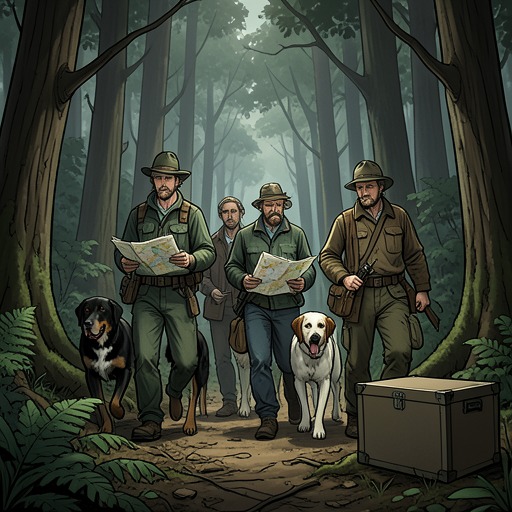
The Stewart River becomes part of John Thornton’s expedition after Buck earns sixteen hundred dollars in five minutes, enabling Thornton to settle certain debts and travel with Pete and Hans in search of a legendary lost mine. The party sleds seventy miles up the Yukon River before turning left into the Stewart River, then continues past the Mayo and McQuestion until the Stewart itself dwindles into a streamlet among the peaks forming the backbone of the continent. The river therefore marks a transition from a known transport network to a route whose diminishing watercourse leads toward geographical and historical uncertainty.
The expedition is deliberately slow and self-sufficient rather than governed by a strict schedule. Thornton carries salt, a rifle, ammunition, tools, and little else; he hunts during the day’s travel and accepts that the journey may continue for as long as the wilderness requires. For Buck, the passage through the Stewart River region is a source of delight because it opens an indefinite life of hunting, fishing, and movement through places unfamiliar to the human world from which he came.
A Landscape Governed by Ice and Season
The river belongs to a northern environment in which travel depends upon changing ice conditions. Elsewhere on the journey, the party crosses the Thirty Mile River when its wild water remains open, finding ice only in eddies and quiet places. Six days are needed to cover thirty terrible miles, with Perrault repeatedly breaking through ice bridges and using a long pole to keep himself from drowning. The same environment leaves Dave and Buck half-frozen and nearly drowned when the sled breaks through, requiring fire and constant movement to thaw their bodies. These earlier river crossings establish the physical hazards that make northern waterways routes of survival rather than simple passages.
The seasonal rhythm surrounding the Stewart River is equally important. Spring transforms the frozen country: sap rises, willows and aspens bud, birds return, insects emerge, and the Yukon strains against its ice. Yet the thaw does not bring immediate safety. Human travelers, dogs, and the woman and men associated with the difficult overland journey stagger through the renewed landscape as if moving toward death. Later, as autumn brings migrating Moose down toward lower valleys, the movement of prey helps draw Buck deeper into the ecological life of the region.
From Gold Route to Wild Valley
The Stewart River route ultimately leads not to the legendary Lost Cabin but to a shallow placer in a broad valley where gold appears across the bottom of the washing pan. Thornton and his companions stop searching and work the deposit every day, filling moosehide bags with fifty pounds of gold dust and nuggets and stacking the bags outside their spruce-bough lodge like firewood. The river thus connects the dream of lost wealth with the material labor of extraction: the expedition begins as a quest through rumor and ends in an unexpectedly productive mining landscape.
Once the placer is found, the dogs have little to do beyond hauling meat that Thornton kills, and Buck spends long hours beside the fire. The reduction of sled work changes his relation to the surrounding country. Memories of the short-legged hairy man and an older, frightening world return more often, while the immediate landscape invites Buck to inhabit the wilderness rather than merely cross it. The Stewart River is consequently a threshold between transportation and settlement, even though the settlement remains provisional and vulnerable.
Animals, Migration, and Violence
The region is structured by animal movement as much as by human routes. A great bull Moose appears on a divide at the head of the creek after a band of twenty has crossed from the land of streams and timber. More than six feet tall, armed with antlers branching to fourteen points and spanning seven feet, and maddened by a feathered arrow lodged near its flank, the bull becomes the formidable quarry Buck desires. Its presence turns the landscape into a hunting ground governed by pursuit, endurance, and inherited predatory skill.
The same migration later brings a Wolf pack across from the land of streams and timber into Buck’s valley. After John Thornton’s death, the wolves pour into the clearing where Buck stands, and he fights them from an angle in a gravel bank, protected on three sides. When the pack finally accepts him, he runs away with it beside the wild brother he recognizes. The river country therefore does not merely contain wild animals; it provides the routes by which they move, meet, compete, and reorganize the story’s social world.
Narrative Significance
Stewart River embodies the tension between human mapping and wilderness continuity. It is named as a navigable stage in a carefully described expedition, yet the watercourse eventually shrinks into a streamlet, while the surrounding peaks, abandoned trails, ruined hunting lodge, and unexplained flintlock preserve histories that the travelers cannot recover. Human ambition seeks a mine and measures progress in miles and gold; the landscape answers through ice, thaw, migration, and disappearance.
The river’s broader significance becomes clear in the ending. After the Yeehats attack the camp and kill John Thornton, Buck’s final bond with human life is broken. The wolf pack enters the valley, and Buck joins it. In later years the Yeehats fear a Ghost Dog that leads the wolves, raids camps, kills dogs, and avoids their hunters; each autumn they refuse to enter the valley. In summer, however, a great wolf crosses alone from the timberland to the abandoned camp, where gold still leaks from rotted moosehide sacks into the grass. The Stewart River world thus outlasts the expedition’s economic purpose: human extraction decays, while animal movement and Buck’s transformation give the landscape its enduring legend.