Tanana River headwaters
The Call of the WildTanana River headwaters marks the eastern wilderness reached by John Thornton, Hans, Pete, Buck, and several other dogs after Thornton’s windfall allows him to pay his debts and pursue a legendary lost mine. The journey into this region transforms travel from a commercial duty into an open-ended encounter with unmapped country, where the party hunts, fishes, crosses difficult terrain, and eventually finds a shallow placer rich enough to end the quest. For Buck, the headwaters become both a place of companionship with John Thornton and a threshold toward the wild life that will ultimately claim him.
Route into the Headwaters
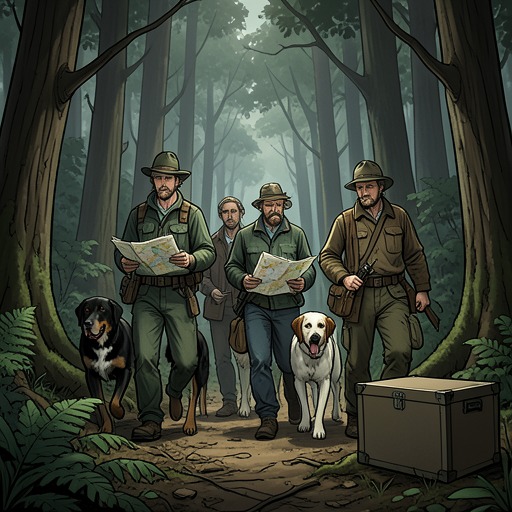
The party left Dawson after Buck earned sixteen hundred dollars in five minutes, an achievement that enabled John Thornton to settle certain debts and travel with his partners toward the supposed lost mine. The mine was surrounded by an old tradition: an ancient, ramshackle cabin, testimony from dying men, and nuggets unlike any other known grade of gold in the Northland. Although many had searched for the treasure and some had never returned, John Thornton, Pete, Hans, Buck, and roughly half a dozen other dogs set out along an unknown trail where earlier explorers had failed.
Their route first followed the Yukon for seventy miles before turning into the Stewart River. They passed the Mayo and the McQuestion, continuing until the Stewart dwindled into a streamlet among the peaks forming the backbone of the continent. This movement placed the party farther from established routes and settlements and deeper into a landscape measured less by schedules than by watersheds, mountain divides, game, and weather.
A Wilderness of Travel and Sustenance
John Thornton traveled without haste and with little dependence on fixed supplies. With salt and a rifle, he could enter the wilderness and remain there as long as necessary; hunting supplied the party’s meat when successful, and failure merely meant continuing until food was found. Ammunition and tools made up most of the sled’s load, while the journey’s timetable extended into an effectively limitless future. The headwaters therefore function as an alternative to the mail trails and government routes that had previously governed Buck’s life: movement here is exploratory rather than official, and survival depends on practical knowledge rather than institutional infrastructure.
The country tested the travelers through changing seasons and difficult terrain. They crossed divides during summer blizzards, endured the midnight sun on bare mountains between the timber line and eternal snow, descended into valleys thick with gnats and flies, and passed beneath glaciers where strawberries and flowers grew. In a strange lake country they encountered the approach of autumn through chill winds, forming ice, and empty shores where wild fowl had already departed. During another winter they followed obliterated traces left by earlier travelers, found an ancient path that began and ended without explanation, and discovered the wreckage of a hunting lodge containing a long-barreled Hudson Bay Company gun. These remnants suggested earlier human presence without explaining its purpose, preserving the wilderness as a place filled with traces but resistant to complete historical knowledge.
The Discovery of the Placer
The search did not locate the legendary cabin. In spring, however, the party found a shallow placer in a broad valley where gold showed across the bottom of a washing pan like yellow butter. They abandoned the search for the lost mine because the new discovery offered a more tangible reward than the uncertain legend. Each day of work produced thousands of dollars in gold dust and nuggets. The gold was packed into moosehide bags weighing fifty pounds each and stacked outside the lodge like firewood.
The placer changed the economic meaning of the headwaters. The party had entered in pursuit of a rumored treasure whose history was obscured by death and mystery; they remained because the land itself yielded an abundant, measurable fortune. Yet the discovery did not turn the valley into an ordinary settlement. The men worked daily, while the dogs had little to do beyond occasionally hauling meat killed by John Thornton. The gold accumulated beside a spruce-bough lodge, combining immense wealth with a sparse and temporary human occupation.
Buck and the Threshold of the Wild
With work reduced, Buck spent long hours beside the fire, and the headwaters gave greater prominence to memories of the short-legged, hairy man from the ancestral world that repeatedly appeared in his mind. The wilderness thus operates on two levels for him: it is the physical environment in which he hunts and travels, and it is the imaginative space where inherited instincts become increasingly vivid. His earlier life in the Santa Clara Valley recedes, while the old fear and mystery associated with the primitive world become more insistent.
The surrounding ecology also anticipates Buck’s later transformation. As autumn advanced, moose moved toward lower valleys for winter, and Buck encountered a great bull standing more than six feet high, with antlers branching to fourteen points and spanning seven feet at the tips. The bull’s aggression was intensified by a feathered arrow protruding from its side. Guided by instincts associated with ancient hunting, Buck began cutting the bull away from the herd, moving just beyond the reach of its antlers and crushing hooves. The headwaters therefore provide the setting for Buck’s developing identity as a solitary hunter, not merely as a dog temporarily released from harness.
From Human Camp to Wild Territory
The headwaters are also connected to the violent collapse of the human world around Buck. While Buck was away from camp, the Yeehats attacked. Returning through the forest, he found Nig dead with an arrow through his body, another sled dog in its death struggle, and Hans lying face down and covered with arrows. The spruce-bough lodge had been destroyed, and the discovery released Buck’s rage because John Thornton’s fate was at stake. He attacked the Yeehats with overwhelming speed, killing and scattering them before returning to the ruined camp.
After John Thornton’s death, the headwaters ceased to be a place held together by human loyalty. The wolf pack entered the valley while hunting migrating moose, and Buck faced it alone before recognizing the wild brother with whom he had once run. After resisting the pack’s first attacks, he accepted its approach through exchanged scents and joined its howl. He then ran into the forest beside the wild brother. In the later Yeehat tradition, a Ghost Dog leads the timber wolves, raids camps, kills dogs, and avoids the valley where John Thornton’s gold lies hidden beneath rotting moosehide sacks. The headwaters thus remain the geographical memory of both human loss and Buck’s final release: a valley where gold marks the vanished camp, while the wolf that once belonged to men returns each summer, howls mournfully, and departs alone.