The Record Mail Run to Skaguay
The Call of the WildThe Record Mail Run to Skaguay is the journey that converts Buck’s developing mastery of sled work into public achievement. Under Perrault and Francois, he leads a team across hazardous northern terrain, restores discipline, and drives the mail train at a record rate. The run is both a feat of transport and a decisive stage in Buck’s transformation: labor, judgment, endurance, and the pride of the traces make him a leader whose value is measured in performance rather than pedigree.
Formation of the Team and the Discipline of Work
Three huskies joined the team, bringing its total to nine, and the dogs were harnessed within minutes for the ascent toward Yea Canyon. Buck was glad to leave, and although the work was hard, he discovered that he did not despise it. The team’s eagerness passed into him, while Dave and Solleks were revealed as entirely different animals in harness: their passiveness vanished, replaced by alertness, activity, and fierce irritation at delay or confusion. For them, work in the traces was not merely an imposed task but the supreme expression of their being.
The arrangement placed Dave as wheeler, Buck ahead of him, Solleks ahead of Buck, and Spitz at the head as leader. Buck was deliberately positioned between Dave and Solleks so that he could learn. Dave and Solleks taught him through exacting bites, and Francois’s whip reinforced the lessons. When Buck became tangled in the traces and delayed a start, both dogs punished him; the resulting confusion was worse, but Buck thereafter kept the traces clear, and by the end of the day his companions had almost stopped nagging him. Francois used the whip less often, while Perrault examined Buck’s feet with unusual care, an early sign that the new dog was becoming valuable to the expedition.
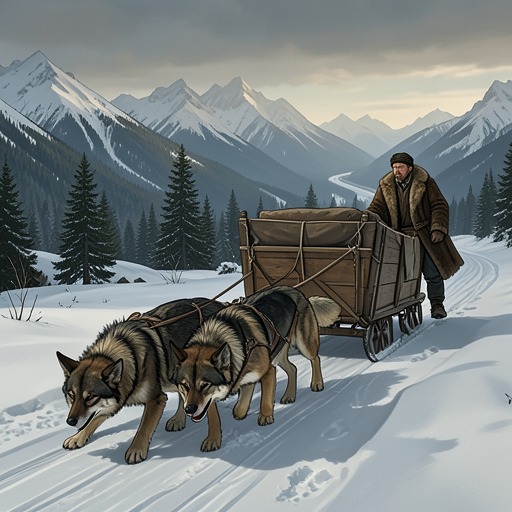
The first major run carried the team up the Canyon, through Sheep Camp, past the Scales and the timber line, across glaciers and deep snowdrifts, and over the formidable Chilkoot Divide between salt water and the North. They then moved quickly down the chain of lakes filling extinct volcanic craters and reached the great camp at the head of Lake Bennett late at night. Buck slept in a hole in the snow, but he was roused in the cold darkness and harnessed again before he had recovered from exhaustion.
The Northern Route and Its Physical Risks
The team covered forty miles on packed trail during one day, but subsequent days were slower and harder because the dogs had to break their own trail. Perrault usually traveled ahead in webbed shoes to pack the snow, while Francois guided the sled from the gee-pole when they exchanged places. Perrault’s urgency was matched by his knowledge of ice, a necessity where fall ice was thin and swift water left stretches entirely open.
The Thirty Mile River presented the journey’s most immediate danger. Its wild water remained open despite the frost, and ice held only in eddies and quiet places. Six days were needed to cover its thirty terrible miles, with every step threatening the lives of both dogs and men. Perrault repeatedly broke through ice bridges, surviving because the long pole he carried fell across each opening. With the thermometer at fifty below zero, every immersion required him to build a fire and dry his clothing before freezing overtook him.
The dogs faced the same hazards. The sled once broke through with Dave and Buck, leaving both half-frozen and nearly drowned before they could be dragged out. Their bodies became solidly coated with ice, and Perrault and Francois kept them running around a fire until they thawed, close enough to the flames to be singed. The route therefore tested not only speed but the practical intelligence, courage, and endurance of every participant in the transport system.
Buck’s Rise to Leadership
Buck’s rise became inseparable from the team’s conception of work. The pride of the traces animated Dave and Solleks, transformed the dogs at break of camp, and drove them through the day before leaving them gloomy and restless at night. It also made Spitz punish dogs that shirked or hid when harnessing began. Buck possessed the same pride, and because he wanted leadership by nature, the conflict between him and Spitz became inevitable.
When Buck took the lead, Francois was ordered to throw down the club. Buck trotted into position, his traces were fastened, and the team dashed onto the river trail. The change immediately exceeded the driver’s expectations. Buck assumed the duties of leadership and proved superior to Spitz wherever judgment, quick thinking, and rapid action were required.
His authority was practical rather than ceremonial. Dave and Solleks accepted the change because their concern was to toil powerfully in the traces, not to control the team’s hierarchy. The other dogs, however, had become unruly during Spitz’s absence, and Buck imposed order by force. He repeatedly shook Pike for loafing until Pike pulled harder than ever before. He subdued Joe, whom Spitz had never successfully disciplined, by overwhelming him with superior weight and continuing until the dog stopped snapping and begged for mercy. The team’s general tone immediately improved: its old solidarity returned, and the dogs again moved as one animal.
At Rink Rapids, two native huskies, Teek and Koona, were added. Buck broke them in so quickly that Francois was astonished. Perrault, who had already valued Buck highly, now recognized that he had underestimated him. Francois declared Buck worth one thousand dollars, while Perrault agreed; the valuation captures both the economic world of the mail route and the concrete labor value Buck had earned through skill, authority, and speed.
The Record Pace to Skaguay
The return journey was favored by an excellent, hard-packed trail, little new snow, and moderate cold, although the temperature remained at fifty below zero throughout the trip. Perrault and Francois alternated between riding and running, while the dogs were kept moving with only infrequent stops. On the Thirty Mile River, conditions had changed enough for the team to cover in one day what had taken ten days on the inward journey.
The team made a sixty-mile dash from the foot of Lake Le Barge to White Horse Rapids. It then raced across seventy miles of lakes—Marsh, Tagish, and Bennett—so quickly that the man assigned to run sometimes towed himself behind the sled by a rope. On the last night of the second week, the dogs topped White Pass and descended the sea slope with the lights of Skaguay and its shipping spread below them.
The achievement was formally measurable: for fourteen days the team averaged forty miles each day. Perrault and Francois spent three days throwing chests up and down the main street of Skaguay and receiving invitations to drink, while the team drew a constant crowd of dogbusters and mushers. The public spectacle turned the dogs into objects of admiration, but the attention soon shifted when several western bad men attempted to take over the town and were killed. The record therefore became part of the unstable economy of northern fame, where working animals could briefly become the center of public worship before another crisis supplied a new idol.
Separation and the Cost of the Mail Service
The triumph ended with official orders. Francois called Buck to him, embraced him, and wept over him; then Perrault and Francois passed permanently out of Buck’s life. A Scotch half-breed took charge of Buck and the other dogs, and the team began the return journey to Dawson as part of the mail train.
The mail route was no longer a light, record-breaking run. It carried a heavy load and moved with the monotonous regularity of industrial labor: fires and breakfast in the morning, harnessing and departure before daylight, camp at night, and repeated work by both men and dogs. Buck did not like the routine, but he endured it well and took pride in the labor after the manner of Dave and Solleks, ensuring that his mates did their fair share. Even among more than a hundred other dogs, he established mastery after three fights with the fiercest animals, so that his raised hackles and bared teeth were enough to make them give way.
The long service also exposes the cost hidden beneath the record. Dave became so weak by Cassiar Bar that he repeatedly fell in the traces. When he was removed and Solleks was fastened into his position, Dave resisted the substitution, attacked Solleks, and struggled through the soft snow to return to his place. He eventually bit through both of Solleks’s traces and stood directly before the sled, pleading with his eyes to be harnessed again. The men believed that a dog could die from being denied the work that had defined him, and they returned Dave to the traces. He pulled proudly despite his internal injury, collapsed repeatedly, and was finally killed after he could no longer travel.
Thirty days after leaving Dawson, the Salt Water Mail reached Skaguay with Buck and his companions in a wretched condition. Buck had fallen from one hundred and forty pounds to one hundred and fifteen; the other dogs had lost even more proportionately. The team was footsore, injured, and depleted after twenty-five hundred miles in less than five months, including eighteen hundred miles with only five days of rest. They could barely keep the traces taut and had no reserve strength left. Thus the record run’s glory stands beside the later mail service’s exhaustion: the same pride that makes the dogs magnificent also makes them vulnerable to a system that consumes their final strength.