The Toil of Trace and Trail
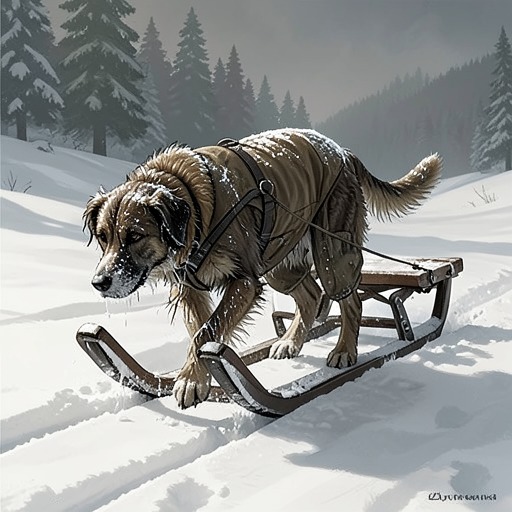
The Call of the WildThe Toil of Trace and Trail is the book’s governing concept for sled-dog labor: the repeated work of pulling a sled through snow, ice, darkness, hunger, and fatigue, together with the pride that makes the work meaningful to the dogs themselves. It transforms Buck from a stolen Southland pet into an efficient working animal and eventually awakens instincts older than civilization. The labor is coercive, but it is not portrayed as mere mechanical suffering. In the traces, the dogs acquire skill, rivalry, solidarity, status, and a dangerous satisfaction in exertion; when that work is denied, the loss can be as devastating as the work itself.
Definition and Conditions
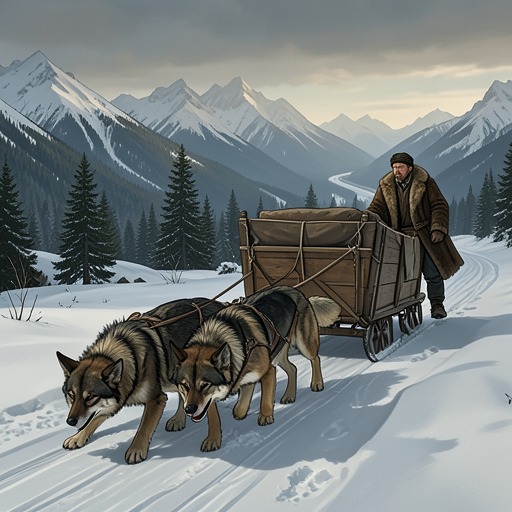
The toil begins when Francois fastens Buck into a harness and sets him to hauling a sled to the forest and returning with firewood. Buck’s dignity is injured by being made a draught animal, yet he is too wise to rebel. Under Francois’s stern commands and whip, and under the corrections of Dave, Solleks, and Spitz, he learns to stop at “ho,” move at “mush,” swing wide on bends, and avoid the wheeler when a loaded sled rushes downhill behind him. His position in the team is deliberately instructional: Dave occupies the wheeler’s place, Buck pulls in front of him, Solleks follows Buck, and Spitz leads the single-file line.
The work is governed by constant alertness. Dave and Solleks, passive and unconcerned outside the harness, become active, watchful, and fiercely irritable once work begins. Delay and confusion offend them because the toil of the traces has become the supreme expression of their being. Buck absorbs this collective urgency. His teachers enforce their lessons with sharp teeth, while Francois’s whip makes error costly; after Buck tangles the traces during a halt and is soundly punished by his mates, he keeps the lines clear and quickly masters the trade.
Daily Labor and Physical Cost
The routine is severe and nearly unbroken. The team breaks camp in darkness, reaches the trail at dawn, travels through the day, eats a small ration of fish after nightfall, and crawls into snow to sleep. Buck receives a pound and a half of sundried salmon each day, yet remains perpetually hungry; the smaller dogs receive only a pound and somehow maintain their condition. Hunger strips away his old fastidiousness. He eats faster to prevent his mates from stealing his unfinished ration, then learns to steal secretly by observing Pike, while Dub is punished for Buck’s undetected theft.
The discipline of the trail changes Buck’s body and judgment at the same time. He learns that survival depends on speed, concealment, and adaptation rather than on the moral habits of his former life. The club of the man in the red sweater has taught him a primitive law: he no longer risks himself to defend property or principle when evasion will preserve his life. The harness therefore produces more than obedience. It creates a practical intelligence shaped by hunger, punishment, snow, and the need to keep pace with the team.
The accumulated physical cost is enormous. On the mail route back toward Skaguay, the work becomes monotonous and machine-like, but Buck still takes pride in it and makes sure his mates do their fair share. In less than five months the dogs travel twenty-five hundred miles, with only five days of rest during the final eighteen hundred. By the time they arrive, Buck has fallen from one hundred and forty pounds to one hundred and fifteen. His companions are limping, footsore, and weakened; their feet strike the trail without spring, every muscle and fiber exhausted by months of slow strength-drain rather than by a single burst of effort.
Pride, Hierarchy, and Conflict
The toil carries a paradoxical emotional force. It is exhausting, yet the dogs take pride in performing it well. That pride animates Dave as wheeler and Solleks as a powerful puller, and it transforms them at the daily breaking of camp from sullen brutes into eager, ambitious workers. It also sustains Spitz’s authority. As lead dog, Spitz thrashes dogs that shirk, blunder, or hide when harnesses are being prepared. His leadership is therefore both social dominance and functional competence within the labor system.
Buck discovers that he shares this pride. He wants the lead position not simply because it offers power, but because the trail has awakened in him a nameless pride in trace and harness. The work holds dogs to their task until the last gasp, draws them joyfully toward death in the traces, and leaves them broken-hearted when they are removed from it. Buck deliberately interferes with Spitz’s discipline, shielding shirking companions and provoking tangles and fights while continuing to work faithfully enough to avoid being caught. His revolt is not a refusal of labor; it is a demand to direct it.
When Francois tries to restore Solleks to a position Buck considers his own, Buck remembers the club and retreats beyond its reach. He does not flee the team or abandon the camp. Instead, he circles, dodges thrown clubs, snarls, and makes clear that he will return once his demand for leadership is met. The scene distinguishes fear of punishment from rejection of the labor order: Buck accepts the work and claims that, because he has earned mastery, he should occupy its highest place.
Labor, Injury, and Death
Dave provides the starkest evidence that the pride of trace and trail can become inseparable from identity. When illness makes him fall repeatedly in the traces, the driver removes him and places Solleks in his position. Dave resists with grief and rage. He attacks Solleks, struggles to get between the replacement dog and the sled, ignores the whip, and chooses the difficult soft snow rather than run quietly behind the team. Even when exhausted, he returns to his own sled and bites through both of Solleks’s traces so that he can stand again in his proper place.
The men understand that denying Dave his work may break his heart. Although he is already dying, they consider it a mercy to let him die in the traces, where he can be content. Reharnessed, he pulls proudly despite the inward pain, falls several times, is dragged by the sled, and is injured when the sled runs over him. At the next morning’s harnessing he crawls toward his mates, yearning to join them, until his strength fails. A revolver shot behind the river timber confirms his death, while the team continues along the trail with snapping whips, tinkling bells, and churned snow.
Dave’s death reveals the labor system’s cruelty and its emotional complexity. The dogs are exploited as transport, yet their work is also a field of skill and selfhood that human observers only partly understand. The men recognize that removal from the traces can destroy a dog, but their solution is to return the dying animal to the very labor that has consumed him. The scene makes exhaustion, attachment, and dignity inseparable.
From Harness to Wildness
The toil also opens a passage from trained labor to older forms of animal life. During a chase after a snowshoe hare, Buck leads a pack of roughly sixty dogs and pursues living meat through moonlight. The excitement is not merely appetite. He experiences the chase as an ecstatic release in which every muscle, joint, and sinew expresses life through movement. The harness has trained his body to run with others, but the pursuit redirects that disciplined energy toward hunting and the recovery of primordial instinct.
Later, Buck meets a wild wolf and refuses to attack, instead circling him with threatening yet friendly advances until the wolf accepts him. They run together across the creek bed, gorge, and divide, and Buck recognizes the experience as an answer to the call. The trail’s discipline has prepared him for endurance and coordinated movement, while the wild journey reveals what those capacities can become outside human command.
After John Thornton’s death, the last human bond no longer restrains Buck. When the wolf pack enters his valley, Buck faces it alone, kills the first attacker by breaking its neck, drives back three more, and withstands the entire pack from a protected angle by the pool. At last he touches noses with the wild brother who had once guided him. The Toil of Trace and Trail thus forms a decisive middle state in Buck’s transformation: it subjects him to human purposes, teaches him the body and pride of collective work, and ultimately supplies the strength, intelligence, and instinct through which he passes beyond the human world into the wolf pack.