The Yeehat Attack and John Thornton's Death
The Call of the WildThe Yeehat Attack and John Thornton's Death is the decisive rupture in Buck's life: an assault on the mining camp kills John Thornton and his companions, provokes Buck's most devastating act of violence, and leaves him free to answer the wild call that had been gathering within him. The event joins personal bereavement to territorial conflict, turning the destruction of a human camp into the threshold of Buck's final transformation from devoted sled dog into the legendary Ghost Dog.
Causes and Background
The attack follows months of wandering undertaken by John Thornton, Pete, Hans, Buck, and other dogs in search of a legendary lost mine. They traveled seventy miles up the Yukon, turned into the Stewart River, passed the Mayo and McQuestion, and continued eastward through an unknown wilderness. Their expedition ultimately found not the Lost Cabin but a shallow placer in a broad valley, where gold lay visibly across the bottom of the washing pan. The party worked every day, filling moosehide bags with fifty pounds of gold dust and nuggets apiece and piling them outside the spruce-bough lodge like firewood.
This prosperity also made the camp a concentrated store of extractable wealth in a contested landscape. The journey had followed routes shaped by government dispatches, police provisions, sled transport, hunting, and mining, while the gold was removed from the valley and accumulated beside the lodge. The surrounding wilderness is therefore presented both as a place of freedom and as a space entered, mapped, traveled, and mined by outsiders. The Yeehats appear at the moment when that fragile settlement is exposed to armed resistance and the camp's presumed security collapses.
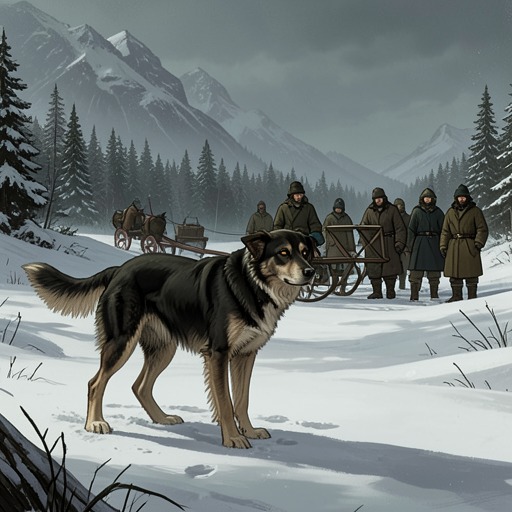
The attack itself is discovered through Buck's return from a moose hunt. After pulling the moose down, Buck remains by the kill for a day and a night, then turns toward camp with renewed strength. He follows the tangled route without losing his way, moving homeward with a certainty that surpasses that of a man and his magnetic needle. As he approaches, the land gives warning: birds have vanished, squirrels are hidden, and a fresh trail leads straight toward the camp. The trail creates suspense by revealing that violence has already passed through the forest while withholding its final meaning from Buck and the reader.
The Attack and Buck's Revenge
Buck first finds Nig lying dead beside the trail, an arrow protruding through his body. A hundred yards farther on, another sled dog is still caught in a death struggle. At the edge of the clearing, Hans lies face down, feathered with arrows, while the spruce-bough lodge has been wrecked. The evidence of the attack is not presented as a single explanation but as a sequence of bodies, tracks, silence, and ruined shelter, allowing Buck's senses to reconstruct the catastrophe before he fully sees its center.
The sight releases an overpowering rage. Buck abandons the cunning and reason that ordinarily govern his fighting because his love for John Thornton overwhelms them. The Yeehats are dancing around the wreckage when they hear a terrifying roar and see Buck charge them. He attacks the chief first, ripping open his throat, then tears the throat of a second man on his next bound. His speed makes him almost impossible to resist: he moves through the group in continuous motion, while the Yeehats' own arrows strike one another because they are tangled together in panic.
The violence becomes grotesquely self-defeating for the attackers. A young hunter throws a spear at Buck in mid-air but drives it through another hunter's chest, with the point breaking through the victim's back. The Yeehats flee into the woods, proclaiming Buck the Evil Spirit. He pursues them like deer, dragging them down as they run, until the surviving Yeehats scatter across the country. A week later, the survivors gather in a lower valley to count their losses. Buck's revenge is therefore not merely an isolated defense of the camp; it becomes a collective memory that changes how the Yeehats understand the territory and the creature who now dominates it.
Thornton's Death and Buck's Grief
When Buck returns to the desolated camp, he finds Pete dead in his blankets, killed in the first moment of surprise. The marks of John Thornton's desperate struggle remain visible on the earth and lead to the edge of a deep pool. Skeet lies there with her head and fore feet in the water, faithful to the end. The pool is muddy and discolored by the sluice boxes, and it conceals John Thornton's body. Buck follows Thornton's trace into the water, but no trace leads away.
The obscured body makes the death physically incomplete while leaving its meaning unmistakable. Buck understands death as the cessation of movement and recognizes that John Thornton is gone. He spends the day brooding beside the pool or moving restlessly around the camp. His grief is compared to hunger: it creates a vast aching emptiness, but food cannot fill it. The comparison preserves the bodily intensity of bereavement while distinguishing this loss from ordinary deprivation. Buck has known starvation and battle, yet Thornton's absence produces a void of another order.
The carcasses of the Yeehats briefly interrupt the pain. Looking at them, Buck feels pride in having killed human beings, whom he regards as the noblest game, under the law of club and fang. He concludes that men are no match for him without arrows, spears, or clubs; a husky dog is harder to kill than a man. This pride does not cancel grief. Instead, the two responses coexist: vengeance confirms Buck's power, while the empty pool confirms the loss of the one human relationship that mattered most to him.
The Broken Bond and the Call
Night brings the next stage of the event. Under the full moon, Buck hears distant yelps that grow closer and recognizes them as sounds from the other world that has persisted in his memory. The call reaches him more clearly and compellingly than ever before. John Thornton's death has broken the last tie binding him to human society, so he is ready to obey the summons of the forest. The transition is not a sudden discovery of an entirely new identity; it is the release of an ancestral life that earlier memories, hunts, battles, and the huskies' old song had already awakened.
A wolf pack advances and forces Buck backward into a creek bed and against a high gravel bank. Protected on three sides, he faces the wolves from the remaining opening. For half an hour he holds them off with quickness and agility, pivoting, snapping, and gashing until the exhausted pack withdraws. His survival preserves the hierarchy he has established through repeated combat, but the scene changes from a contest for dominance into a test of possible belonging.
A long, lean gray wolf approaches in a friendly manner, and Buck recognizes the wild brother with whom he once ran for a night and a day. They touch noses. An old, battle-scarred wolf then comes forward; after Buck cautiously sniffs noses with him, the elder raises his muzzle to the moon and begins the long wolf howl. The pack joins him, and Buck answers. When the leaders move into the woods, Buck follows beside the wild brother, running and yelping with the pack. His departure is thus marked by reciprocal recognition rather than simple submission: the call receives an answer, and the solitary survivor acquires a new community.
Aftermath and Legendary Transformation
The immediate aftermath converts the attack into an enduring tribal legend. The Yeehats later observe a change in the breed of timber wolves, including animals with brown splashes on the head and muzzle and a white rift down the chest. More remarkable still is the report of a Ghost Dog running at the head of the pack. The Ghost Dog steals from camps during severe winters, robs traps, kills dogs, and defies the bravest hunters, possessing a cunning greater than that of the people who fear him.
The legend grows through repeated disappearances and mutilated bodies. Hunters fail to return, while others are found with throats cruelly slashed and wolf prints around them that are larger than those of any ordinary wolf. Each fall, when the Yeehats follow the moose, they avoid a particular valley. Women become sad when the story is told around the fire of the Evil Spirit who chose that valley as his abiding place. The attack therefore reorganizes the geography of fear: the valley where gold was found and human labor accumulated wealth becomes a forbidden domain associated with Buck's presence.
Yet the final image complicates the legend's violence. In summer, an unknown visitor enters the valley: a great, gloriously coated wolf, alone, crosses from the smiling timberland into the open space among the trees. Yellow water from rotted moosehide sacks sinks into the ground, grasses and vegetable mold overrun the treasure, and the wolf pauses before howling once, long and mournfully, then departs. Buck's return to the abandoned camp preserves the memory of John Thornton even after Buck has joined the wolf pack. The event thus ends not with a clean replacement of love by savagery, but with a double inheritance: Buck becomes the feared Ghost Dog of the wild, while the ruined mining site remains a place of solitary remembrance.