
The False Messages And Public Trust
The CallerThis flow traces how lies work by borrowing the authority of ordinary public systems and why trust becomes both their strength and their danger.
increasing Bearing strength in each event
 decreasing
Bearing strength in each eventdecreasingA Notice That Looks Official
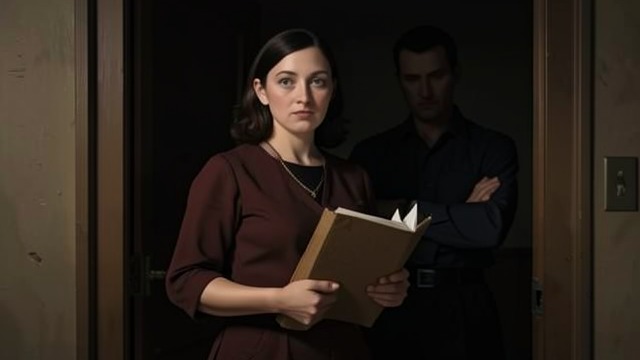
A Notice That Looks Official
Familiar print lends authority
Gunilla sees a complete obituary in the newspaper, including accurate personal details and a formal funeral announcement. The notice’s familiar format makes its claim difficult to dismiss immediately.
A living person confronts a public death
Gunilla checks the text, sees that it identifies her correctly, and fears that the world has become unhinged. Her children must explain that the announcement is fabricated.
The lie depends on a trusted format. The newspaper’s credibility becomes part of the mechanism of terror.
Trust At The Funeral Home

Trust At The Funeral Home
A caller claims authority
A caller presents himself as a doctor and reports Helge’s death to the funeral home. The staff receive a name and address and arrange a pickup.
A routine safeguard is absent
The representative explains that funeral homes require a death certificate before beginning their work, but he was told the certificate would be sent later. The mistake allows the hearse to arrive before the claim is verified.
The deception exploits professional cooperation while exposing a weak point in procedure. Courtesy and trust are necessary to daily life, but they can be abused.
An Emergency By Telephone

An Emergency By Telephone
A caller directs a mother
Evelyn is told that Frances has been in a serious accident and that she must come to the hospital. She believes the voice and drives there quickly.
Verification arrives too late
The information desk discovers that Frances is not a patient and helps Evelyn call her daughter. The safe result depends on checking the claim after fear has already taken hold.
The hoax succeeds because it mimics how an urgent hospital call might sound. Trust is not foolishness; the attacker turns a reasonable response into a weapon.
A Pattern Becomes Visible

A Pattern Becomes Visible
Institutions share a weakness
Newspapers, hospitals, and funeral services each rely on accurate names and confident communication. Johnny’s false messages exploit their separate procedures to produce believable emergencies.
Investigators compare cases
Sejer and Skarre look for recurring methods, including the use of newspaper profiles and public notices to select victims. The cases begin to look connected despite their different settings.
The pattern is less about a single technical trick than about understanding how people cooperate. Each lie works because someone follows the ordinary rules of a trusted institution.
Trust Rebuilt Slowly

Trust Rebuilt Slowly
Victims question ordinary routines
Gunilla jumps at the doorbell, Evelyn fears Frances riding her scooter, and the Landmarks have death forced into their home. Each incident makes routine information feel less dependable.
Explanation is not restoration
Police explain how the hoaxes may have worked, but victims cannot simply return to their previous confidence. The same telephone, newspaper, or visitor may now carry the memory of a false emergency.
The emotional aftermath reveals what the campaign attacks most effectively: the expectation that familiar systems can be trusted without constant suspicion.
the morning Gunilla finds the obituary
the afternoon the hearse reaches the Landmark house
the day Frances rides her scooter
after the first several hoaxes
during the follow-up visits to victims
