
Punishment And The Limits Of Law
The CallerThis flow traces the conflict between formal justice and the desire for immediate retribution after attacks, hoaxes, and Theo’s death.
increasing Bearing strength in each event
 decreasing
Bearing strength in each eventdecreasingA Father Wants Immediate Revenge

A Father Wants Immediate Revenge
A violent promise
Karsten says that he will tear apart the person who harmed his family. He views the unknown attacker as undeserving of sympathy or patience.
A system appears too slow
The police investigate carefully, but Karsten’s sense of urgency is personal and absolute. He wants a direct connection between the crime and punishment.
The conflict begins before the suspect is known. Karsten’s demand reveals how legal delay can feel unbearable to someone whose safety has been violated.
The Police Choose Method

The Police Choose Method
Calm over spectacle
Sejer tells reporters that the police are taking the attack seriously but resists offering dramatic speculation. He worries that publicity may give the offender exactly the audience he wants.
Investigation as restraint
Rather than promising immediate capture, Sejer asks victims to record details and seeks to examine the scene. His method values evidence and patience over public declarations.
The approach contrasts with Karsten’s desire for instant retaliation. It is slower, but it avoids presenting suspicion as a verdict.
Karsten’s Dog Analogy

Karsten’s Dog Analogy
A case for speed
Karsten argues that a dog must be punished immediately or it will not connect action with consequence. He extends the example to criminal justice and rejects delays and appeals.
Lily defends human judgment
Lily argues that people are not dogs and that legal consequences can remain meaningful. Their disagreement reveals how fear pushes Karsten toward an increasingly simple account of punishment.
The analogy is powerful but troubling. It offers certainty by reducing justice to control and leaves little room for evidence, proportionality, or error.
The Call For The Dogs’ Death
The Call For The Dogs’ Death
A demand for a strong statement
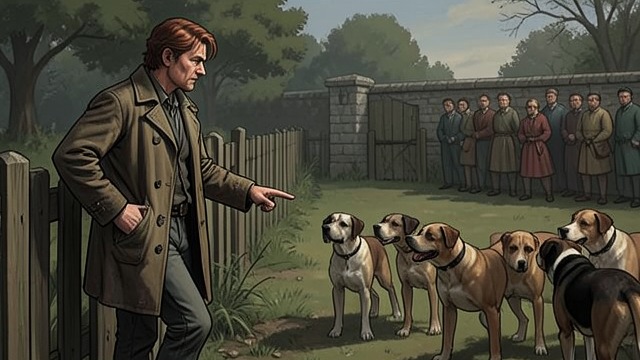
Holthemann asks whether the dogs should be killed as a response to Theo’s death. The proposal is partly about preventing danger and partly about showing sympathy to the bereaved family.
Sejer refuses a symbolic execution
Sejer says that taking the animals to a veterinarian is sufficient and considers the burden on the person who would have to kill them. He recognizes the horror without endorsing punishment merely for spectacle.
The conversation asks whether grief should dictate a public act of retribution. Sejer’s answer insists that compassion and responsibility can coexist with restraint.
A Trial Without Certainty
A Trial Without Certainty
Procedure continues
Schillinger’s trial is expected in January, and he hopes the court will find reasonable doubt. The community still debates whether the kennel was deliberately opened.
Punishment cannot restore the child
Even a definitive verdict could assign legal responsibility but could not undo Theo’s death. The uncertainty also leaves room for vigilante anger to persist.
The legal process is slow, but the novel does not present speed as a substitute for truth. Justice must contend with evidence that cannot supply the certainty grief demands.
after the first attack on Margrete
during Sejer’s first press statements
during an argument with Lily
the night after Theo’s attack
after Johnny’s death, before Schillinger’s trial
