Astrid Landmark
The CallerAstrid Landmark is the wife and daily caregiver of Helge Landmark, whose progressive paralysis has left him dependent on a wheelchair and help with basic tasks. Their life is organized around his worsening illness and the future they can barely bring themselves to discuss. When a hearse arrives at their home after a prank call, Astrid must manage both the immediate confusion and the painful reality the prank invokes: death is already present in their household, even when they try not to name it.
Identity and Home
Astrid has recently turned fifty-three; Helge is fifty-nine, though illness makes him seem much older. They live at Sandbergveien 15, where they sit outdoors when the weather allows. Their garden has old apple trees, flowers, berry bushes, and a wooden patio set beneath a large white parasol. The scene of their home is also a scene of exposure: from outside, passersby can see how their life has changed.
Their son lives in Dubai, is unmarried, and comes home only at Christmas for a couple of weeks. Astrid tells the investigating officer that few people visit apart from those selling things or asking directions. The couple manage on their own, at least as far as they have been able. This limited support helps explain the intensity of the work that falls to Astrid and the privacy in which the two of them face Helge’s decline.
Care and the Unspoken Future
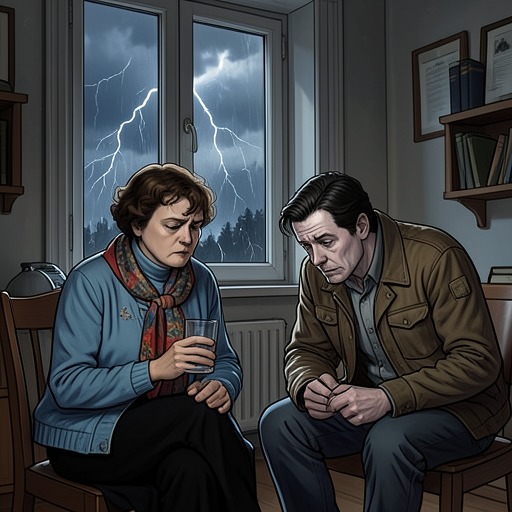
Helge’s paralysis is advancing through his body. Astrid understands that he will lose the ability to swallow, speak, and breathe, and that there is little uncertainty about what lies ahead. The certainty does not make it easier to face. Fear of death has taken hold of Helge, while Astrid struggles to look him in the eye and does not know what to say. Almost everything about the future has become difficult to discuss: even ordinary references to spring, Christmas, or another time feel impossible because they may not have one.
The practical questions are unavoidable. They ought to discuss death and burial, and decide what to do with the cabin at Blefjell, which Helge named El Dorado despite its expense. Astrid also wonders whether she can maintain their house, start the lawnmower, operate the snowblower in winter, stain the drying exterior, or prune the fruit trees. These are not abstract concerns about bereavement; they are the concrete tasks that will remain when Helge cannot do them and she is left to manage alone.
In the meantime, Astrid keeps busy. She irons shirts that have already come out smooth from the dryer, does laundry, and makes plans to knead bread dough, wash the front-door window, and sweep the kitchen floor. The work gives her something to do and helps hold the truth at a distance. It also offers a temporary refuge from the helplessness of watching Helge sit in his wheelchair. Her care is practical and continuous, but it cannot repair the illness or supply an easy language for what both of them know.
The False Funeral Pickup
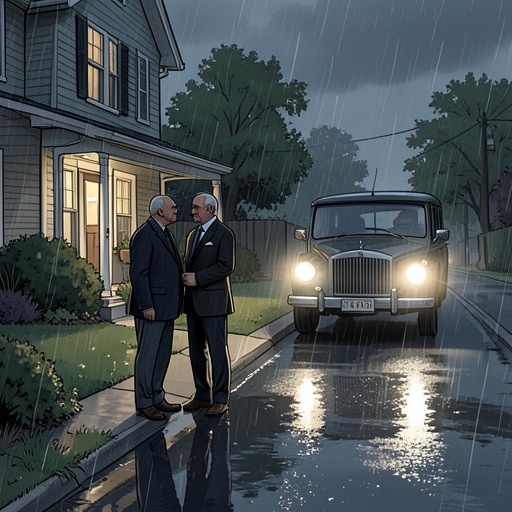
The prank turns that unspoken knowledge into an event at the door. Astrid hears a car moving unusually slowly, stopping at the gate before backing into the driveway. Its cross-marked roof identifies it as a hearse. A man in a dark suit gets out, approaches the house, and offers his condolences. Astrid is bewildered and panicked; her first thought is to keep Helge from seeing the car. He is unsettled by visitors and does not want anyone to see him in his condition, but he senses that she is concealing something and wants to know what is happening.
The hearse belongs to Memento, and its arrival is based on a false call. Astrid tells the men that the situation is difficult and asks them to come inside because Helge wants to speak to them. They hesitate, then enter and face him in his wheelchair. The prank does not remain a mistaken delivery that can simply be waved away: Helge asks what the car is, and later says he supposes he could have gone with them, as though the difference between his present life and death has become almost impossible to measure.
That response exposes what Astrid has been trying to shield from view, including from herself. She knows she still needs the man she met when she was nineteen, the tall, broad-shouldered aeroplane mechanic she married. Yet the care equipment has become part of every room: a commode chair in the bathroom, a bedpan in the bedroom, a pill organiser in the kitchen, and the wheelchair’s large grey wheel in her field of vision. The false funeral does not create their fear of death, but it gives that fear a public, physical form in their driveway.
Aftermath and Narrative Significance
Astrid explains that someone called the funeral home as a prank and says they will report it. She connects the incident to other recent acts of intimidation: fake newspaper obituaries and the episode involving the baby in Bjerketun. She suspects the same people may be responsible, perhaps boys treating their actions as a joke. Her explanation shows that the couple’s private ordeal belongs to a wider campaign of pranks, while also making clear how differently the same act lands in a home already shaped by illness and anticipated loss.
When questioned, Astrid describes the couple’s ordinary routine and can recall no unusual calls, mail, or visitors in the preceding days. Her account is composed of small domestic details and the limits of what she can remember, set against an intrusion that has made the home feel less secure. The investigating officer sees the apple trees, flowers, bushes, and patio furniture; Astrid’s description supplies the quiet routine behind that view, a life that is usually private and rarely interrupted.
Astrid’s role gives the false funeral its emotional weight. She is not only the person who sees the hearse and speaks to its attendants; she is also the caregiver who has been keeping daily life moving while both spouses live with a future they cannot easily discuss. Her industriousness, her concern for Helge’s dignity, and her moment of panic belong to the same strained situation. The prank forces the subject they have avoided into the house, but it cannot resolve the questions waiting there: how to care for Helge, how to speak about his death, and how Astrid will carry on when the work and the marriage are changed by his absence.