Bjørn Schillinger
The CallerBjørn Schillinger is introduced as a man whose comfortable domestic world depends on his command of familiar routines and places. When the seven dogs in his kennel are gone, that sense of control breaks: the animals are later implicated in the fatal attack on a boy near Glenna.
Identity and Home
Schillinger lives at Sagatoppen in a spacious red house with fifty square metres of outbuildings. Dense forest rises behind it, and he knows its trails: one leads to Saga, another to Glassverket, and a third reaches Snellevann and Svarttjern. He has run those paths since childhood, first as a boy and later as an adult trying to keep in shape. In front of the house, a broad garden and a table and two benches he made for himself offer a place to sit outdoors.
On the September day when the dogs disappear, Schillinger is returning from the sixth birthday party of his daughter, June. He loves her more than anyone else in the world and has good contact with her. His wife, Evy, has recently left him, but he remains optimistic about bachelor life despite tight finances; he values being master of his own days. The ease of that return, with its games, chocolate cake, and red fizzy drinks, makes the scene at home all the more abrupt.
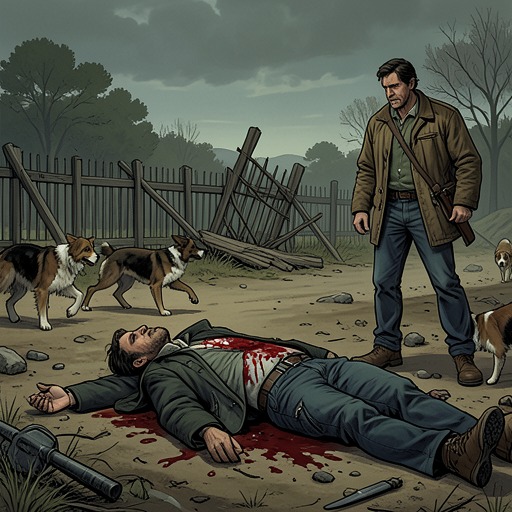
His yellow Land Cruiser stops so sharply that gravel spits from its tyres. The kennel doors are wide open, and all seven dogs are missing. Schillinger knows the kennel is secure and keeps a close eye on its doors; he cannot believe the dogs could have let themselves out. Near the house, however, Lazy is licking its paws, with blood and grime around its mouth. Schillinger’s concern turns to the prey the dogs may have killed. He approaches carefully, then rushes at Lazy, pins the dog down, and forces its jaw open. Blood and scraps of skin cling to its teeth. Hoping the dogs took a sheep, he thinks he can placate Sverre Skarning and pay for the loss.
The News of the Boy’s Death
When Konrad Sejer tells Schillinger that a little boy has been found near Skillet, down by Glenna, and was probably attacked by dogs, Schillinger turns deathly pale. Picking at a splinter in his hand, he tears at it as he asks whether the child is badly hurt. Sejer answers that the boy is dead, then confirms Schillinger’s other fear: he will lose the dogs. The exchange makes Schillinger’s immediate concern legible without settling what he knew or intended; the vanished animals have become not merely a breach of his control but the center of a fatal consequence.
Ownership and Control
Schillinger’s encounter with the missing dogs exposes the difference between taking responsibility for animals and being able to command them. He has treated the kennel doors as secure and watched them closely because he knows the dogs are powerful; yet once they are loose, his authority proves uncertain even inside the territory he knows so well. Lazy no longer recognizes him as pack leader, and the blood on the dog’s mouth points beyond his household to whatever the pack has encountered. The boy’s death gives that failure of control a human cost. The evidence establishes Schillinger’s concern for what the dogs may have killed and his awareness of his obligations, but it does not establish that he released them or knew where they had gone.
Confidence Before the Discovery
On the steep drive home, Schillinger hums a simple melody beneath the low September sun, which makes the day seem beautiful, hot, and golden. His optimism is not abstract: after his daughter June’s sixth-birthday party, he remembers the singing games, chocolate cakes, and red fizzy drinks, and the red dress with white polka dots that prompted him to tease her by comparing her to a poisonous toadstool. He thinks of children as bold and cheerful, and of the importance of what other people think. These small, ordinary details give the empty kennel its force: the shock interrupts a day Schillinger had experienced as secure and good.