Bjørn Schillinger’s kennel and gate
The CallerBjørn Schillinger’s kennel and gate are both the practical barrier meant to contain his seven dogs and the center of his confidence that he has always handled them responsibly. When the dogs disappear, the open enclosure turns an ordinary, repeated safeguard into an alarming question: how could the gate have been left unsecured?
A Routine Built Around the Gate
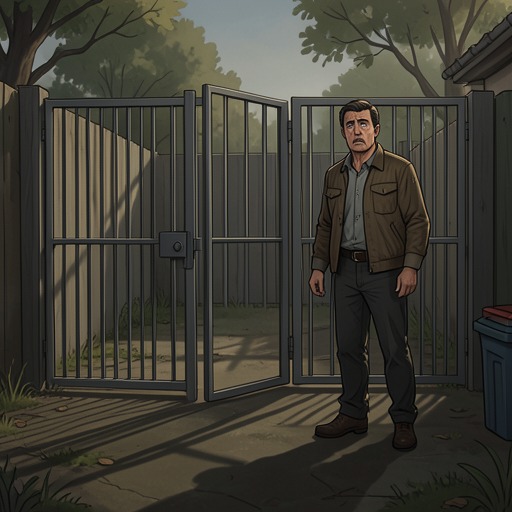
Schillinger’s kennel is enclosed by chain link and secured by an aluminium gate. Its bolt and latch are not incidental fittings in his account of dog care: he describes closing the gate, pushing the bolt into place, and flipping down the latch as a practiced sequence he performs whenever he enters to feed the dogs, check their paws, or trim their claws. The movements have become reflexive, and he says he listens for the iron bolt to screech and the hook to click. His insistence that the procedure is ingrained makes the gate a measure of his responsibility as an owner as well as a physical barrier.
That routine is tested when Schillinger returns to find the kennel empty and its doors wide open. He believes the dogs could not have escaped the secure enclosure by themselves, and initially treats the open gate as evidence that someone must have come to the property. Yet when he examines it, the aluminium gate is intact: none of its bars has been cut, and the bolt and other fittings appear to be in place. The intact hardware offers no clear explanation for the dogs’ absence, leaving Schillinger caught between what he sees and his certainty that he could not have forgotten to secure the entrance.
The Escape and Its Immediate Aftermath
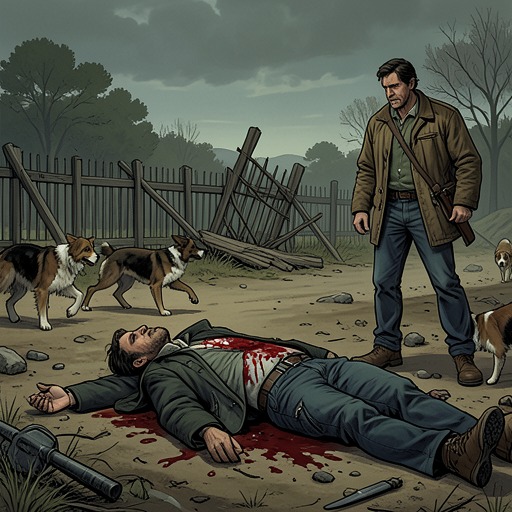
The open kennel becomes more than an unexplained gap in the enclosure when Schillinger finds the dogs returning from the woods. Lazy sits near the house, bloodied around the mouth; then Ajax and Marathon emerge, also with blood on their jaws, followed by the rest of the pack. Schillinger sees patches of skin caught on Lazy’s teeth. The evidence suggests the dogs have attacked prey, but he cannot tell what they killed. His first fear is that it may have been a pet, or even another dog; he settles on a sheep as the likeliest explanation and thinks of paying Sverre Skarning for the loss.
The escape also unsettles the familiar relationship between owner and animals. When Lazy growls and bares its teeth, Schillinger recognizes that the dog is no longer treating him as pack leader. He rushes forward, forces Lazy to the ground, and holds its jaw open to inspect its teeth. As more dogs come out of the woods, he has to gather them individually: he coaxes some into the kennel and drives others with a stick, then shuts the gate, pushes the bolt, and drops the latch. The animals that return seem changed to him, no longer companions but powerful beasts whose behavior he cannot confidently control.
Schillinger hoses the dogs down with ice-cold water, first dragging the hose to the kennel and turning on the water in the cellar. He keeps watch for approaching cars and people as he washes blood from their mouths and bodies, fearing that anyone who learns of the attack will demand that the dogs be destroyed. Afterward he checks the gate, bolt, and latch again, pulling at the gate twice. The physical ritual is restored, but it cannot explain how the enclosure was opened or undo what the dogs may have done.
When Konrad Sejer and Jacob Skarre later arrive, the kennel offers a starkly different picture: behind the chain link, the dogs are lively and playful, making friendly barks. Their ordinary behavior does not resolve the question of what happened outside the enclosure. Sejer tells Schillinger the dogs will be confiscated and tested for DNA, while the police investigate the scene to determine how they got out. The gate thus becomes both a practical point in the inquiry and the material center of Schillinger’s claim that he followed the procedure he had repeated for years.
The Gate as Evidence and Accusation
When Konrad Sejer and Jacob Skarre question Schillinger, the kennel’s open gate becomes a point where his account of himself meets the evidence of the attack. Schillinger paces, avoids their eyes, and says that he puts a lock on when he leaves, adding that this time he had been away for only an hour. He insists the kennel was empty when he returned, but the empty enclosure does not answer how the dogs escaped. His description makes the gate’s failure seem both impossible and consequential: a lapse would connect his daily care directly to the danger the dogs posed beyond the fence.
The officers notice that the dogs are wet. Schillinger answers quickly that they were hot and that their thick fur made them overheat; he says he only wanted to cool them down. The explanation sits beside his repeated denial that he forgot to close the entrance. Earlier, he had washed blood from the returning dogs because he feared what people would think and what they might demand. Now the water on their coats is visible to the investigators, while its cause is disputed. The kennel’s barriers can be inspected, but the dogs’ altered appearance records an encounter that the washing was meant to erase.
Schillinger frames the gate not only as equipment but as proof of a thirty-year identity. In the dark room, photographs cover the walls, with each dog’s name written beneath it and separate walls for females and males. He tells Sejer that he has always run a responsible team, that people can be asked whether his dogs have caused trouble, and that the sequence of shutting the door, securing the bolt, and lowering the hook is ingrained in him. His devotion is genuine in the scene, but it cannot settle the question of responsibility. Sejer says the dogs will be confiscated for DNA testing and that investigators will examine the scene to establish how they got out; Schillinger’s assurance must now be tested against physical evidence.
The possible consequences make his defense increasingly personal. Schillinger says he was at a birthday party for his six-year-old daughter when the dogs escaped, and fears that the community will drive him out and that he will lose the right to keep dogs. He speaks of the animals as his life and recalls their everyday companionship, but the boy mauled by dogs is Hannes Bosch and Wilma Bosch’s son. Sejer answers that punishment belongs to the justice system while a dog owner remains responsible for keeping the animals secured. Schillinger rejects blame and suggests sabotage: someone, he says, may have opened the gate, just as someone let Sverre Skarning’s sheep out. He points to the season’s hoaxes and prank calls as grounds for suspicion, not proof. The enclosure therefore holds two unresolved claims at once: Schillinger’s insistence that his familiar safeguards could not have failed, and the investigation’s need to determine how seven dogs came to be loose.
A Suspect Ruled Out
Schillinger’s first attempt to explain the open kennel had included the possibility that another dog owner’s animals were responsible; he had remembered a man nearby with four huskies and wondered whether he might be able to shift suspicion. Sejer later tells him that the owner had taken those dogs to Finnmark and had been away for four weeks. The alternative could not account for the seven dogs’ escape. The open gate remains unexplained, but the investigation has removed one imagined route by which Schillinger hoped to distance his own pack from the attack.