Bjerkås
The CallerBjerkås is a town of about five thousand residents, and its connected neighborhoods, lakefront, and paths give the novel’s episodes a shared local geography. It is both a place where residents’ routines make them visible to one another and a network of routes and boundaries through which a prankster can approach, observe, and escape. The contrast between well-kept homes, aging estates, and closing businesses makes the town’s physical layout part of the story’s account of security, familiarity, and suspicion.
Town and housing estates
Bjerkås lies at the center of a small cluster of places and routes. Bjerketun, a housing estate built in the early 1990s, is four kilometres from the town center and contains sixty homes. Its houses are well maintained, with gardens, double garages, and broad verandas. Some residents nearest the woods have extended their homes, but Lily Sundelin and Karsten Sundelin chose not to build an extension: they wanted to preserve the garden as a place where their daughter, Margrete, might later play, swim in a small pool, or bounce on a trampoline. Their plans give the garden a domestic, future-facing significance before the attack on their baby makes the family’s sense of safety precarious.
The wooded grove behind the Sundelins’ house separates Bjerketun from Askeland, a larger estate of seventy-four homes. Built in the 1960s, Askeland is described through its square, faded buildings and a growing sense of decline. A third of the homes were allocated by the local authority to welfare recipients, a fact the narration connects to the estate’s deterioration. The sharp difference between Bjerketun’s tended gardens and Askeland’s worn appearance marks social division within a compact area; the grove between them is at once a physical boundary and a concealed passage.
Lakefront and local life
Sejer’s journey into Bjerkås brings the town’s natural and commercial edges into view. He drives twenty-five kilometres to reach it and follows directions to flags by the water. A narrow asphalt path descends to a beach that proves uninviting: rather than sand, it has large, sharp stones, and boats pulled onto shore lie partly overturned. The difficult swimming conditions help explain why a Spar supermarket operates there. The lake itself is calm during Sejer’s visit. Sitting on an overturned boat, he watches ducks while Frank growls at the water’s edge; Sejer tells the dog to leave them alone, and rings spread behind the birds.
The shoreline also holds traces of the town’s past and civic life. Sejer sees the old red-brick dairy he passed on his way down to the water. Across the lake stands a large white former cloister, whose small chapel hosts concerts and readings. These landmarks place a former local industry and a continuing cultural venue beside the quiet shore, rather than presenting Bjerkås as only a backdrop to crime.
Its commercial life is contracting. A resident explains that Askeland once had a Joker shop, but it closed, so residents now use Spar; some travel to Kirkeby for a better selection. Bjerkås formerly had a bakery, hairdresser, café, and bank, but these businesses have closed one after another. The remaining grocery store, petrol station, and small bar make the Spar more than a shopping stop: it is one of the few surviving everyday centers in a town where familiar services have receded.
Routes, observation, and investigation
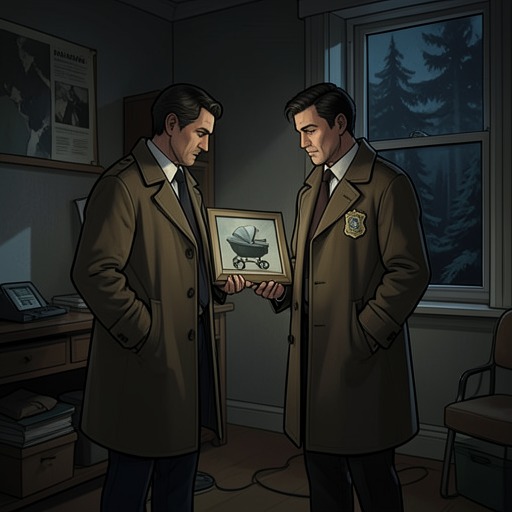
The layout gives Sejer a way to turn a frightening event into a testable spatial hypothesis. Studying a map, he traces the main road from Bjerkås through Bjerketun toward Askeland and reasons that the person who drenched Margrete’s pram in blood may have come from Askeland. A route through the grove could allow someone to carry a container under a jacket, watch the pram from behind a tree, and return unseen. Sejer does not treat this as established fact: he considers possible containers and sources of blood, including the possibility of blood obtained from an abattoir, and waits for laboratory analysis. The map makes the woods and estates investigable without resolving the perpetrator’s identity or exact route.
The search extends into Askeland. Sejer drives there but has difficulty locating the trail leading toward Bjerketun, then asks boys playing football whether they have heard about the incident with the baby. The episode makes the path’s obscurity consequential: proximity alone does not make a route easy to find, and local knowledge becomes part of the investigation. Elsewhere, the post-prank investigation returns to Spar. A cashier tells Skarre that a boy who bought frozen ox blood had left behind black motorcycle gloves with red skulls. The employee remembered the gloves, not the helmeted customer’s face, and expected their owner to come back for them. In this small-town setting, an ordinary purchase and an overlooked object can become a lead because staff and investigators can connect them to a shared place.
Repeated incidents and community consequences
Bjerkås and its surrounding neighborhoods also form the setting for a series of hoaxes that turn ordinary trust into a vulnerability. After a false funeral pickup at Helge Landmark’s home, people wonder how a caller could frighten and humiliate residents so easily. The deception worked partly because the voice sounded polite and Arnesen at Memento Funeral Home had no reason to doubt it. The incident raises questions about procedures involving death; for residents, the most disturbing part is that death seemed to have entered the home before it arrived in reality. Helge, who has ALS and is dying, had refused to speak to newspapers, but the news of his illness nevertheless circulated.
Other episodes give the local geography a more immediate, personal charge. In late summer, Johnny Beskow passes Hauger School while the band is rehearsing. He pushes his moped the final stretch so that Else Meiner will not hear him, then considers the Love Trail, a paved route behind a barrier bordered by thick bushes. He believes Else will ride it home after practice and plans to wait there to take revenge. The school, the route, the bushes, and the predictable end of band practice combine into an ambush plan grounded in routine rather than distance.
The town’s network of residents also shapes blame after the dogs attack Theo Bosch. Bjørn Schillinger insists that someone must have opened the kennel gate, and invokes earlier hoaxes and the release of Sverre Skarning’s sheep as grounds for suspecting sabotage. Sejer reminds him that dog owners are responsible for securing their animals. Nihmet Skarning says the sought prankster has been blamed for many strange incidents, while Sverre defends Schillinger’s long experience, care for his dogs, and habits on Glenna Trail. Bjerkås thus becomes more than a map of possible movements: each new incident alters how neighbors interpret one another, and the familiar places that once connected the community also become channels for suspicion.