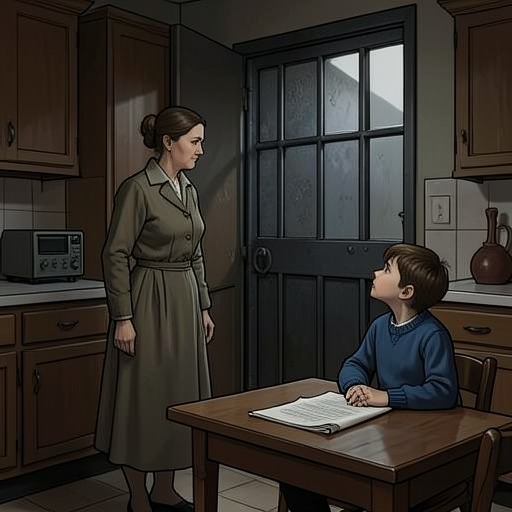
Evelyn Mold—Frances Mold
The CallerEvelyn Mold and Frances Mold are close enough that everyday conversation, tenderness, and laughter usually come easily between them. A hoax that sends Evelyn to the hospital believing Frances may have been hurt exposes how much that bond rests on ordinary trust—and how quickly fear can unsettle it. Frances helps her mother through the immediate panic, but the experience changes the way Evelyn imagines her daughter leaving home on her scooter.
A Close and Familiar Bond
Before the false alarm, Evelyn and Frances share an unforced domestic intimacy. Their conversations flow without restraint, and their home life is associated with familiar routines: sunlight in the windows, birds behind the house, television in the corner, and the ease of talking together. The prank does not create distance from nothing; it intrudes upon a relationship whose comfort has been part of their daily life.
Evelyn thinks of herself as strong, determined, down-to-earth, and realistic. She has rafted down the Sjoa River and run the Oslo Marathon twice, and she has not considered herself someone who takes life for granted. Those qualities help explain why the deception catches her so unprepared: she has assumed that being practical means she can withstand a crisis, but the thought of Frances being in danger reaches her in a more intimate place than her self-image can protect.
The Scooter and an Existing Fear
The scooter is the specific point around which Evelyn’s anxiety gathers. When Frances got it, Evelyn had already imagined the possibility that her daughter might be hit by a car. She dismissed the thought as unhelpful and told herself that she was rational, not someone who looked ahead for trouble. The fear therefore precedes the hoax, although she had kept it at a distance from everyday life.
Frances’s appearance in a local newspaper gives the prankster information with which to make the false emergency credible. Fourteen days before the hospital episode, she had answered questions at a dealership while a Council for Road Safety representative was writing about traffic safety. He took her photograph. The article described her as newly fifteen, said the scooter was a gift from her father, who lived abroad, and noted that she had bought the most expensive helmet and promised not to ride recklessly. When Frances later points to the saved article, Evelyn and the investigators can see how a public account of a routine milestone could be turned into a means of frightening her family.
The False Hospital Summons
Evelyn arrives at the hospital expecting help for Frances, not an explanation of a deception. She insists that someone called and asked her to come, and grows increasingly distressed when no one is waiting to meet her. She identifies her daughter by name and says that Frances rides a scooter. Asked for Frances’s full name and age, she gives both: Frances Emilie Mold, born in 1994, fifteen years old. As she waits for the answer, the uncertainty leaves her feeling suspended and without a firm footing.
The hospital’s routine checks expose that something is wrong. When staff contact the University Hospital, the suspicion that the situation does not fit a genuine emergency is confirmed. Evelyn is asked whether Frances has a mobile phone; she calls her daughter, who is safe. The hoax exploits the very habits that normally make family life dependable: a call that sounds like an urgent message, a parent’s willingness to respond, and the expectation that an institution will know why she has been summoned.
Home After the Panic
Evelyn and Frances arrive home at about the same time, and Evelyn sees the scooter as she drives into the driveway. They have returned to the familiar setting, but not immediately to their former ease. Their usual conversations no longer flow; both seem awkward, as if they have been put in a strange room and must find their way back to what they know. The change is especially painful because the relationship had been marked by tenderness, love, and laughter.
Inside, Evelyn locks the door and walks into the lounge before losing control of her breathing. She braces herself against a table and gasps for air. Frances follows, awkward but present, trying to reassure her that she is there and that they need not keep thinking about what happened. Evelyn associates the intensity of her bodily reaction with Frances’s birth fifteen years earlier, when painful labour threatened to overwhelm her. The comparison connects the fear of losing her daughter with the memory of bringing her into the world, without suggesting that the two events are otherwise alike.
When Evelyn falls back on asking what they should eat for dinner, Frances pulls her away from the pressure to resume practical tasks at once. She asks them simply to sit together and watch television. They huddle on the sofa in silence. Evelyn eventually says that the episode is over and that she must calm down and forget it, but she cannot restore the old sense of certainty by declaring the danger past. She admits that everything feels changed and wonders what it will be like when Frances leaves the house on the scooter.
Frances bows her head and asks whether Evelyn wants her to sell it. The question makes the cost of the deception concrete: a false report has reached into a real decision about Frances’s independence and her mother’s sense of safety. Evelyn does not ask her to sell it. Instead, she points to the car Frances will be able to drive in two years as the safer prospect. Their conversation ends not with a return to effortless normality, but with the two of them together, trying to make room for the fear without allowing it to erase their closeness.