Frank
The CallerFrank, Konrad Sejer’s Chinese Shar Pei, is both a steady presence in the detective’s solitary home and a vivid counterpoint to Sejer’s ideas about loyalty, vulnerability, and survival. His small rituals—following his master from room to room, waiting at the bedroom door, and returning to his mat—give their companionship a quiet constancy. Yet Sejer’s late reflections on what Frank might do to survive expose a limit to that intimacy: affection does not abolish animal nature.
Appearance and Temperament
Frank is described in close physical detail. His ears are tiny and closed, leaving him with poor hearing; his grey skin hangs in deep wrinkles, and his black, intelligent eyes sit far back in them, limiting his vision. The narration compares his wrinkled appearance to a chamois cloth. His body makes him distinctive, but the account also stresses an inward quality: he is dignified, patient, and difficult to approach.
That reserve echoes Sejer’s own deliberate manner. The comparison does not make Frank a miniature human; instead, it establishes a recognizable likeness between the two companions while preserving the dog’s separate physical limits and habits. Frank’s attentiveness is expressed through watchfulness and movement, not speech or human reasoning. His presence is often quiet, but it is never merely decorative.
Sejer’s Companion at Home
Frank follows Sejer from room to room as the detective prepares for bed. When the flat is dark, the dog settles on his mat in the bedroom and remains there through the night, guarding his master. At the sound of the doorbell he rushes into the hallway, sits by the front door, and whines. Sejer’s first concern is for his daughter, Ingrid, and grandson, Matteus, but Frank’s immediate response gives the moment its own small alarm: the dog is already at his post.
The relationship is built into Sejer’s daily decisions as well as these moments of vigilance. When Ingrid invites him to stay or have dinner, she predicts that he will refuse because he needs to get home to Frank. Sejer confirms that the dog has been alone since seven that morning and leaves. The exchange presents care as a practical obligation: Frank depends on Sejer’s return, and that dependence shapes how the widower arranges his time. Ingrid’s teasing recollection of the tantrums she threw as a child adds warmth to the scene, but Frank remains the immediate reason Sejer cannot stay.
Out in the World
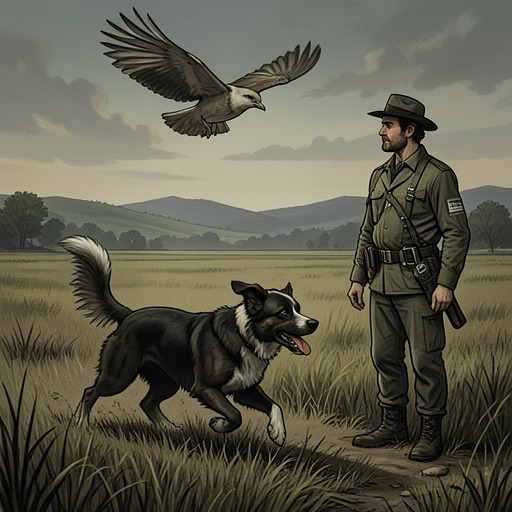
On an early-morning drive to Bjerkås, Sejer brings Frank with him. At the lakeshore he lets the dog off the leash because no one else is around. Frank trots awkwardly past the large stones, tests the water, and comes straight back. Sejer jokes that it is too cold for him; nearby, Frank stands growling at the water, his ears drawn back and a wrinkle gathered on his snout. The still lake and the dog’s wary posture make this more than a simple excursion: Frank experiences the place bodily, moving toward it and then withdrawing.
Frank also accompanies Sejer through the city. He pauses to sniff a half-eaten bun, then urinates on a rusty gate before continuing beside his master. The scene gives him ordinary animal business within Sejer’s more troubled inward life. When a dizzy spell makes the street and back alleys seem to sail away, Sejer moves to a wall, closes his eyes, and waits. Frank stops too and looks up at him. The dog does not diagnose or explain the spell; he stays beside Sejer while it passes, an uncomplicated form of attention that recurs throughout their life together.
Care, Irritation, and Vulnerability
Frank’s dependence is not presented as effortless sentiment. After Sejer has learned the horrifying details of Theo Bosch’s fatal dog attack, he returns home exhausted and distressed. In the bathroom Frank craves attention at his feet, but Sejer pushes him away and kicks at him angrily, dismissing him as only a dog and questioning whether dogs can be trusted. The episode marks a breach in their usual pattern of care. The violence of the case has entered the home, and Frank—another dog, physically close to Sejer—becomes the object of a displaced reaction.
Later, Sejer lies awake while Frank sleeps on the mat beside his bed. The peaceful sight of the small, wrinkled animal turns his thoughts toward life and death and the raw force of nature. Sejer imagines the two of them trapped without food or water, with himself dead and Frank left alone with his body. He concludes that hunger would drive the dog to eat him. This is Sejer’s imagined test, not an event that happens to Frank; its force lies in the possibility that survival could overrule their bond. The thought does not cancel their affection. It makes that affection more complex by recognizing Frank as an animal with needs and instincts not governed by human promises.
Narrative Significance
Frank’s role gathers meaning through recurrence rather than through a separate plot of his own. He guards Sejer at night, accompanies him outside, responds when his master falters, and offers a peaceful presence after violence. At the same time, his limited hearing and vision, his bodily habits, and Sejer’s final speculation about hunger keep him from becoming simply a human companion in a dog’s shape. He is close to Sejer but not reducible to Sejer’s comfort.
That distinction sharpens the novel’s meditation on the boundary between human and animal life. Frank can be patient and loyal, and Sejer can love him; neither fact removes the force of survival. The dog is therefore both companion and independent creature in Sejer’s imagination: a familiar figure on a mat beside the bed, and a life that would continue according to its own nature if the circumstances became desperate.