Gorilla mask
The CallerThe Gorilla mask is the disguise Johnny Beskow wears when he ambushes Else Meiner on the Love Trail. It lends the attack a grotesque theatricality, but does not turn it into a game for its victim: Else resists fiercely, and the mask’s strong, sweet smell becomes one of the few clues she can give investigators afterward.
The Mask in the Attack
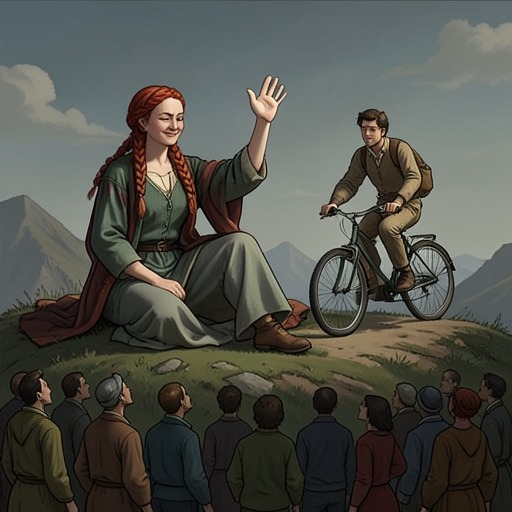
Johnny waits in the undergrowth as Else rides alone along the Love Trail, humming to herself. He has planned to startle her from behind, counting on the shock to paralyse her with fear. Wearing the Gorilla mask, he rises from the brush and lunges at her bicycle. The trumpet case on its rack crashes to the path as he grabs the bike and wraps an arm around her throat.
The mask makes the attacker’s face into an animal image, but Else does not behave as the helpless figure Johnny expects. She thrashes and kicks, and when she turns her head, she looks directly at him. Through the holes in the mask, he sees her freckles. Her resistance threatens his control of the encounter: she bites his forearm hard enough to bring tears to his eyes and nearly loosen his grip. He responds by forcing her down, straddling her back, and cutting off her red plait with his army knife. The mask accompanies a planned act of intimidation, but it cannot make the assault orderly or one-sided; Else’s physical struggle alters its course and leaves Johnny injured.
Afterward, Else tells the police that the Gorilla mask had a strong odour like sweets and seemed to have come straight from a shop. The detail is strikingly ordinary beside the violence: beneath the animal disguise is a recently purchased object with a recognisable smell. Asked whether she could tell how old the attacker was, Else answers that guessing the age of a gorilla is difficult. The mask thus frustrates the investigators’ effort to identify its wearer by appearance, while its smell gives Else a more useful observation. She also reports that he disappeared into the bushes and that she heard no engine, only his heavy breathing.
Disguise, Performance, and the “Game”
The Gorilla mask belongs to a more specific episode than Johnny Beskow’s wider campaign of intimidation: the evidence places it on his face during the assault on Else Meiner, not as a general uniform for every prank. That distinction matters. Johnny had already taken pleasure in becoming a subject of public talk, relishing the nicknames circulating among newspaper staff and the general public and imagining that he had finally forced others to acknowledge him. The mask gives one violent encounter an animal guise, while his pursuit of attention elsewhere depends on people discussing the unseen prankster. Together, the episodes show different sides of his performance: concealment at the point of attack, notoriety at a distance.
Johnny later reduces his frightening pranks to a game and says he never meant to hurt anyone. The Gorilla mask makes that account harder to sustain as a description of what he did to Else: his disguise accompanies a deliberate ambush that ends with her braid cut off and his threat of further harm. Its theatrical appearance cannot make the assault harmless, any more than Johnny’s playful framing can undo its consequences. The object therefore marks a boundary between the prankster’s imagined game and the physical violence enacted against a person who fights back.
Anonymity and Misidentification
The mask conceals the attacker’s age and face, leaving Else with the incongruous task of estimating a person through a gorilla disguise. When investigators ask whether the assailant seemed to be a man or a boy, she answers that one tries to guess the age of a gorilla. The response captures a practical limit of the evidence: the mask has replaced ordinary identifying features with an animal image, making the wearer difficult to classify even for the person he attacked.
That uncertainty also leaves room for suspicion to settle on the wrong person. During the police questioning, Else’s father calls the attacker a gypsy and urges her to help catch him; Else softly objects that he probably was not one. The contrast matters to the mask’s role in the scene: it hides Johnny Beskow’s identity, while the visible disguise encourages others to fill the gap with assumptions. Else’s correction resists turning an unknown, masked assailant into a ready-made social category, even as the Gorilla mask makes the attacker’s actual identity unavailable to her at the time.
Animal Image and the Observer’s Gaze
Before the assault, Johnny Beskow rides through late-summer streets studying people in their gardens as if they were exotic animals. Their ordinary routines—children on trampolines, washing on the line, men painting fences—are precisely the vulnerable domestic life he says he wants to destroy. The Gorilla mask makes that predatory outlook visible in the attack on Else Meiner: the observer who has reduced other people to creatures for his scrutiny takes on an animal image himself. The disguise does not explain or excuse his violence; it gives a grotesque outward form to the distance he tries to place between himself and his victim.