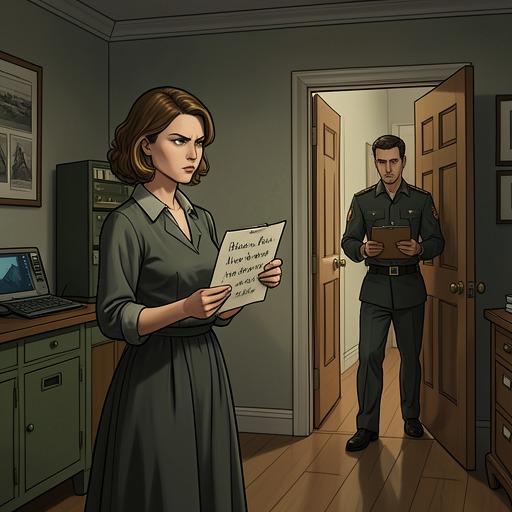
Gunilla Mørk's birthday notice
The CallerGunilla Mørk's birthday notice is a newspaper announcement celebrating her seventieth birthday, but its public details make it more than a family keepsake: Johnny Beskow uses the printed information to find and target her. Later, the notice becomes a tangible clue for the investigators, who explain how an ordinary greeting could supply the means for a seemingly personal act of intimidation.
The announcement and its details
The notice reports that Erik and Ellinor Mørk, from Kirkeby, send warm greetings to their mother on her seventieth birthday. It looks forward to celebrating with her, thanks her for many happy years, and wishes her well in the years ahead. Its language is affectionate and conventional, placing Gunilla within a recognizable family relationship and marking a specific milestone. Gunilla later tells the police that she had just turned seventy and that her children had placed the announcement; she had been touched by the gesture.
That ordinary function is important. The notice was not written as a warning, nor did its family message imply that Gunilla had been singled out by someone who knew her personally. It was published so relatives could acknowledge her birthday, but it also made several identifying facts accessible to a stranger: her name, her connection to Kirkeby, her age and birthday, and the names of her children. The details that express family warmth are the same details that allow an outsider to identify a household and manufacture the appearance of personal knowledge.
From clipping to lead
Johnny has a small notice torn from a newspaper in his bedside-table drawer. He studies it, checks the date on the front page, and reads the announcement again. Later, after seeing his mother watching television, he slips out to his Suzuki and takes a box of rat poison from beneath the seat. The scene places the clipped notice in the same sequence as his deliberate preparations, though the notice itself is not the poison and the two objects have distinct roles: one supplies information, while the other is a material item Johnny retrieves.
When investigators speak with Gunilla, Skarre asks whether she still has the notice. She goes into the living room, searches a basket, and quickly returns with the paper. Skarre reads it and identifies the likely chain of discovery: Johnny could have seen the announcement, learned that Gunilla lived in Kirkeby, and taken her age and her children’s names from the printed information. The notice, previously a record of a family celebration, now allows the investigation to reconstruct how a target may have been found.
Skarre’s explanation changes the apparent meaning of Gunilla’s experience. He tells her that the announcement probably led Johnny to her and that she was selected at random, rather than because he held a special grievance against her. In this account, the notice does not reveal a hidden feud or establish that Johnny knew the family. It points instead to a method of opportunistic selection: information printed for public consumption could be enough to make a stranger identifiable and to give an attack the unsettling appearance of being directed at her personally.
A paper trail of attention
The notice also sits within a wider pattern in which Johnny turns other people’s visibility into an instrument. After his actions attract public attention, he hears people giving him increasingly audacious nicknames and takes their recognition as proof that he has finally made something of himself. He rides around on his red Suzuki, watching people in their gardens and imagining that he can push them out of their sense of safety. The birthday notice belongs to the quieter side of that pattern: before the public notices him, he reads what the public has printed about others.
The distinction between the announcement and Gunilla’s later forged obituary is essential. They are separate newspaper items. The birthday notice is a genuine message from her children, preserved by Gunilla and produced when Skarre asks for it. The fabricated obituary is a different piece of paper, and Gunilla later cuts it out and places it in a little silver frame on her kitchen wall. Each changes the force of print in a different way: the birthday notice discloses usable identifying information, while the false obituary announces a death that has not occurred. Gunilla’s daily glance at the framed fabrication becomes a reminder that she is still alive, giving the prank’s newspaper form an afterlife quite different from the family greeting that helped expose its mechanism.
Significance in the investigation
As evidence, the notice is modest but unusually revealing. It does not name Johnny or prove by itself every step by which he found Gunilla. Its importance comes from the concrete information it contains and from the fact that Gunilla retained it: Skarre can compare the public announcement with the target’s account and explain why the choice need not have been personal. The paper helps separate what the attack seemed to mean to its recipient from what the available evidence suggests about the attacker’s selection.
The notice therefore marks a conversion of ordinary publicity into vulnerability. A brief expression of gratitude and affection becomes a map of sorts—not a complete address or an account of Gunilla’s private life, but enough public detail to narrow a stranger’s search. In the investigation, the same sheet moves from birthday keepsake to explanatory clue. Its significance rests precisely in that reversal: the family message remains sincere, yet its circulation also exposes Gunilla to an act of intimidation that can imitate personal knowledge without requiring it.