Gunilla Mørk’s Fabricated Death Notice
The CallerGunilla Mørk’s Fabricated Death Notice is a false obituary that makes death feel at once public, official, and immediate. Printed with Gunilla’s correct identifying details and a funeral announcement, it confronts her with a version of her own death while she is alive, transforming the familiar newspaper ritual of reading the obituaries into an act of intimidation.
The Notice and Its Details
Gunilla encounters the notice in the local newspaper while reading the obituaries, a habit she follows carefully because she sometimes recognizes the deceased. She also notes their birth years, comparing them with her own as she senses that her allotted time is passing quickly. The false notice exploits that ordinary practice: it does not merely report a death, but presents one in the recognizable, detailed form of a family announcement.
It identifies Gunilla as born on 17 July 1939 and says she has died peacefully in her sleep on 25 July. It describes her as a kind and caring mother, mother-in-law, and sister, names Erik and Ellinor alongside friends and other relatives, and announces a funeral service at the small chapel of Eastern Crematorium on 1 August at 10:30. A verse about rest after years of toil and the consolation of grief gives the item the conventions of a sincere farewell. The invented death is therefore furnished with the dates, kinship roles, and ceremony that make an obituary look like a family’s real public announcement.
Gunilla’s Encounter with Her Printed Death
The notice arrives against the particular anxieties of Gunilla’s life. She has recently celebrated her seventieth birthday with her children, friends, and neighbors. Although she is active, agile, and clear-headed, the birthday has prompted her to wonder whether she will reach eighty. On the morning she finds the obituary, she looks at her wrinkled hand and is briefly frightened by the physical evidence of age. She tries to reassure herself that she is warm and well, and turns back to the kitchen, sunlight, and strong coffee as proof of the life still around her.
Then her own name stops that reassurance short. At first she considers whether the notice is a mistake or refers to another woman with the same name. The correct birth date and year remove that escape: the details match her. She looks around at the familiar cups and bowls, as if the ordinary kitchen might establish that she has not lost hold of reality. Instead, the newspaper insists that she is dead. She lowers her head onto the table and knocks over her coffee cup. The small domestic accident makes the shock visible without diminishing its cause: a printed account of her death has invaded the place where she was reading, thinking, and alive.
Family Response and the Notice’s Afterlife
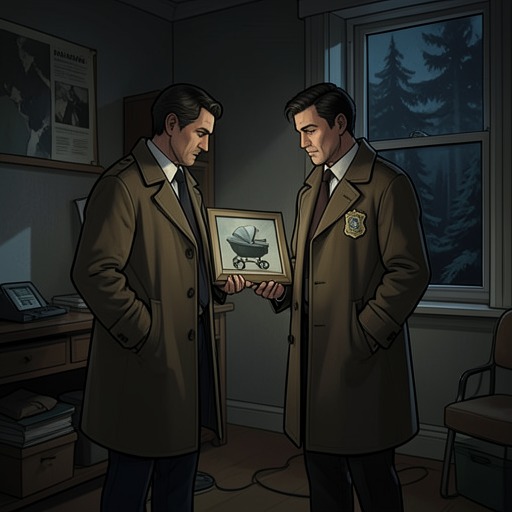
Gunilla’s children take the obituary to the police station together. Erik, the elder, is already grey at the temples; Ellinor is considerably younger. Their closeness is apparent in the way they present themselves as a united, furious pair on their mother’s behalf. Erik stresses that Gunilla has only just turned seventy and has always been quite healthy. He calls the notice offensive and demands that the police find out what is happening. The newspaper clipping thus becomes more than the instrument of Gunilla’s private terror: it is also evidence her family can bring to the authorities and a cause of collective anger.
The object’s meaning changes again when Gunilla keeps the clipping. She cuts it from the newspaper and hangs it in a little silver frame on the wall. Each morning, she reads it and reminds herself that she is not dead yet; the ritual gives her a measure of satisfaction. This response does not make the original shock unreal. Rather, the notice that first imposed a false ending becomes a material reminder of her survival, fixed in a frame and returned to on her own terms.
Meaning in the Wider Story
Gunilla does not accept Bjørn Schillinger’s claims of sabotage, and she dislikes his bitterness, hostility, and lack of humility about what has happened. Yet she thinks the prankster who has made sport of the community is sophisticated, imaginative, and stylish. Her response registers the disturbing double quality of the notice: it is cruel in its effect, but crafted to resemble an ordinary, credible social form. Its apparent respectability is part of its menace.
The false obituary also sits beside the story’s more immediate encounters with mortality. Astrid Landmark faces her husband Helge’s progressive paralysis and the prospect that he will soon be unable to swallow, speak, or breathe; the couple struggle to discuss death, burial, and the practical future of their home. When Helge sees a funeral car, he asks whether a reservation is possible. Against such real end-of-life fears and preparations, Gunilla’s notice is a counterfeit announcement, but not an inconsequential one. It borrows the language and procedures of death to unsettle a living woman, then remains in her kitchen as a daily, unsettling proof that the announcement was false.