Hannes Bosch
The CallerHannes Bosch is a husband and father whose vision of an independent family life in the Norwegian woods is bound up with his hopes for his son Theo. He encourages Theo’s wilderness fantasies and shares his delight in an orange sheep, but when Theo goes hiking alone, Hannes arrives at a cordoned-off scene looking for him. There, the ordinary confidence of a father who expects to share the woods with his son gives way to the possibility of loss.
Identity and Home
Hannes and Wilma Bosch have lived in Norway for fifteen years and built a large log cabin on the road to Saga. Set at some distance from other people, the house and its surroundings feel to them like their own small country. Hannes values the evergreens, the woods, and the clean air; from the doorway, he looks at Wilma in the kitchen and Theo in a hammock and imagines the place as a natural setting for his son’s future.
That vision is specific: Hannes pictures Theo growing up among the trees, wandering through the woods and swimming in cold water. The cabin is not merely shelter in this picture, but the foundation of a life apart from the closeness of other people. The line of tree stumps behind the house, standing like soldiers, gives the cleared ground a visible edge between the family’s home and the forest they prize.
Fatherhood and Theo’s Imagination
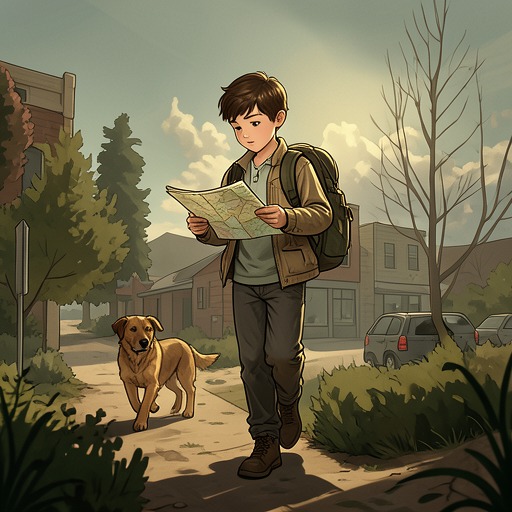
Theo, who has just turned eight, admires both Optimus Prime and the explorer Lars Monsen. His interest in the latter fills his bedroom and his daydreams: he has Lars Monsen on DVD, on a poster, on his bookshelf, and even as a life-sized cardboard cut-out. Theo imagines paddling, camping, fishing, and crossing icy lakes, although for now he is a thin child swinging safely among the hammock’s pillows. Hannes’s hopes for his son meet Theo’s own wilderness ideal in the woods around their home.
At dinner, Hannes calls Theo in from the hammock and offers to take him into the woods afterward. Theo eagerly repeats the prospect of going with his father, adding Optimus Prime to the imagined outing. The small exchange makes their closeness concrete: Hannes proposes an activity they can share, while Theo folds his favorite hero into it. The invitation belongs to the ordinary life Hannes wants for his son, in which the forest is both a place to explore and a setting for time together.
A later glimpse of the household shows Theo still absorbed in Lars Monsen’s adventures on television. After watching two episodes, he goes looking for Wilma; Hannes tells him that she is resting with a headache and makes a general remark about women needing a room of their own. The moment offers a brief, matter-of-fact instance of Hannes explaining Wilma’s absence to their son, against the earlier scene in which the family is gathered around a meal.
The Orange Sheep
On an outing near Snellevann, Theo spots an orange sheep among white ones. Hannes takes the binoculars and sees that Theo is right: the sheep is plainly orange, yet moves among the others as if unaware of its unusual appearance. Hannes and Theo take turns looking through the binoculars, and Theo becomes so excited that he jumps from the rock and runs about waving his arms. Hannes, amused but watchful, worries that the expensive Zeiss binoculars might be smashed on the rocks.
Hannes then searches his pocket for his mobile phone because he wants to tell the local newspaper about the discovery. He gives the reporter his name, says that he and his son are in the woods by Snellevann, and insists that a photographer bring colour film so the sheep’s defining peculiarity will be visible. The call turns the pair’s private amusement into a potential public story. Hannes’s pleasure lies both in sharing the strange sight with Theo and in making sure others can see what they have found.
The Search and Its Ending
When Theo is out on a hike and does not answer their calls, Hannes and Wilma go looking for him to be on the safe side. They reach a road where Konrad Sejer is keeping people back after an accident. Hannes explains that they live down the road and are searching for their boy; when he sees the green tarpaulin, alarm comes over his face. Wilma tries to cross the road, but Sejer holds her back.
After being told that the boy they have found is dead, Hannes still hopes the identification is wrong. There are other people in the forest, he reasons, so they cannot be certain. He takes the mobile phone from his shirt pocket and presses a button, looking toward Jacob Skarre, who is holding Theo’s mobile. A thin melody begins: “Joy to the World, the Lord is come. Let earth receive her King.” The sound links the search to Theo’s phone and sharpens the scene’s uncertainty, while Hannes’s remaining hope rests on the possibility that the body beneath the tarpaulin is not his son.
Narrative Role
Hannes’s hopes for Theo give the forest two sharply opposed meanings. At home and on the outing by Snellevann, it is a landscape of freedom, shared discovery, and a future imagined by a father for his child. During the search, the same wooded setting becomes a place where Theo cannot be reached and where Hannes must confront the possibility of his death. The change is not a rejection of Hannes’s earlier love of the woods; it is the rupture of the confidence with which he had pictured his son growing up there.