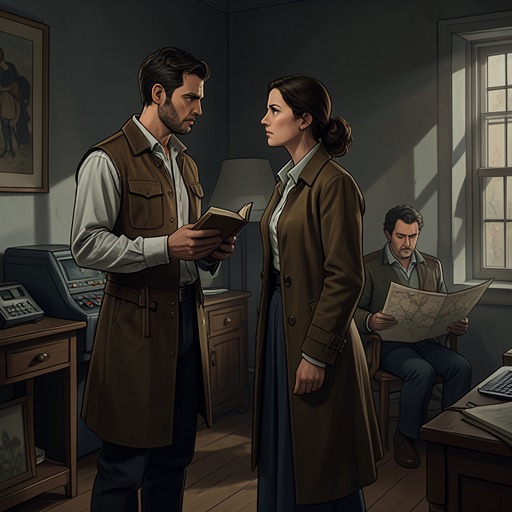
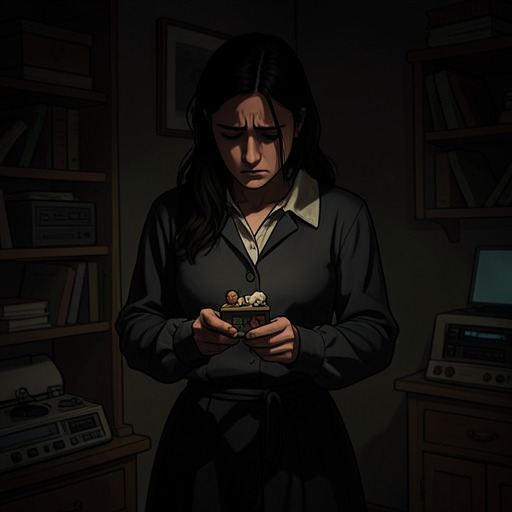
Hannes Bosch—Wilma Bosch
The CallerHannes Bosch and Wilma Bosch are Theo Bosch’s parents, and the decision to let their eight-year-old son hike alone to Snellevann exposes a difference in how they understand both his independence and his safety. Hannes sees the woods as a place where Theo can explore; Wilma imagines the dangers he might face. When Theo is killed by dogs, their disagreement is overtaken by a loss neither can undo, though each parent’s grief takes a different form.
A decision made between two parents
Hannes weighs the outing carefully rather than treating it as a trivial errand. He calculates that the walk to Snellevann will take about an hour, expects Theo to spend twenty minutes at the water, and estimates the whole absence at two hours and twenty minutes. He notes that it is early, the weather is fine, and nightfall is distant. Farmers and landowners will be out tending livestock and checking fences, while hikers, cyclists, and berry pickers may also be on the route. Against these considerations stands Theo’s age: he is only eight.
Hannes nevertheless relies on a shared understanding that the woods are safer than almost anywhere else. He has also watched Theo’s enthusiasm: his son wants to explore, carry his own lunch, and pack a rucksack with his father’s help. Hannes’s permission therefore expresses confidence in Theo as well as confidence in the landscape. But that permission is not jointly given. Hannes quietly acknowledges that Wilma would probably say no, and Theo proposes that they not ask her. Their secret agreement makes the hike a small alliance between father and son, while leaving Wilma outside a decision that directly concerns her child.
Wilma’s fear and Hannes’s reassurance
Wilma does not share Hannes’s confidence. She asks how Theo will cope if something happens, and Hannes answers by imagining the woods as benign: acorns and hares, not danger. He presses her to identify what she is really afraid of, but his reassurance does not dissolve her concern. She moves to a window facing the road, although she cannot see Theo from there. The gesture brings her closer to the route in feeling, if not in sight, and makes visible the distance between Hannes’s decision and Wilma’s need to keep watch.
Hannes’s argument is that danger cannot be eliminated simply by refusing a child permission to go out. He points to ordinary vulnerability, including the possibility that an adult might slip on rocks and suffer a grave injury. Wilma, however, is not persuaded by a list of hypothetical risks. She sinks heavily into a chair and remarks that the influence of wilderness-adventure television may have gone too far. The exchange reveals a genuine disagreement over the meaning of courage and protection: Hannes treats fear as something Theo may encounter and manage, while Wilma focuses on the possibility that an encounter could become irreversible.
Even after Theo has set out, Hannes tries to make the separation manageable. He calls the boy and puts the phone on speaker so Wilma can hear, turning a private check-in into an effort to reassure both parents. The call gives their worry a practical outlet, but it cannot guarantee safety. Later, when they go looking for Theo, Hannes tells the police that they tried to call him without getting an answer. What had been a measure of reassurance becomes part of the sequence by which they realize the outing has gone terribly wrong.
The news that changes their relationship
At the scene, Hannes identifies himself as Theo’s father and explains why he and Wilma have come looking. When he sees the green tarpaulin, alarm replaces the ordinary purpose of their search. The police officer tells them that the boy they have found is dead. Wilma pulls away from Hannes and tries to cross the road; the officer restrains her, and she crumples, repeatedly trying to rise as her knees buckle. In this moment, their earlier disagreement no longer separates them over a choice. They face the same devastating fact, though the shock is expressed differently in each of them.
The explanation that Theo was attacked by several dogs, possibly a whole pack, takes Wilma into acute grief. She is taken to Central Hospital for shock, and her anguish is described as bodily and overwhelming; after being given strong calming medicine, she wakes and continues to scream. The account gives no reconciliation scene between the parents and does not suggest that Wilma’s earlier fears could have predicted this particular attack. Instead, the tragedy sharpens the emotional consequence of their difference: Hannes had permitted a journey he considered reasonable, while Wilma had feared an unnamed catastrophe, and the catastrophe arrives in a form neither could control.
Shared bereavement, different burdens
Theo’s remains are taken to the Institute of Forensic Medicine, and both parents are strongly advised not to see him. Hannes initially insists, but eventually gives up, consumed by shame. His response is bound to the permission he gave and to the fact that he had believed the woods were safe; he turns the loss inward as blame. The account does not establish that Wilma assigns him responsibility, and her grief should not be reduced to a verdict on his decision. What it does show is that the decision remains part of how Hannes experiences the aftermath.
The parents’ suffering is therefore shared but not identical. Wilma’s immediate response is so intense that she must be taken to hospital, while Hannes is left alone with guilt and the inability to carry out a simple action that Theo once performed with ease. The death does not resolve their earlier conflict by proving one parent right in every respect. Rather, it reveals how a private disagreement over care can become inseparable from bereavement, even when the danger that materializes is not one either parent could have known in advance.
Narrative significance
Their relationship gives Theo’s hike a family context beyond the question of whether a child should be allowed independence. Hannes’s belief in the woods and his confidence in Theo meet Wilma’s instinctive caution; the fact that he and Theo keep the plan from her makes that contrast part of the action itself. The call from the road briefly offers a bridge between their positions, but the unanswered attempt to reach Theo cannot restore the security they thought they had.
After Theo’s death, the narrative shifts from an argument about permission to the unequal, inescapable labor of grief. Wilma’s collapse and Hannes’s shame are distinct responses to the same loss, not evidence that one loved their son more or that one could have prevented his fate. Their bond is defined, finally, by parenthood under pressure: first by the difficulty of making a decision together, and then by the fact that no decision can protect them from the consequences of losing Theo.