Henry Beskow
The CallerHenry Beskow, Johnny Beskow’s grandfather, is an elderly man whose home in Bjørnstad becomes one of the few places where Johnny feels attached to another person. Frail and increasingly dependent on care, Henry nevertheless gives Johnny affection, food, attention, and a sense of being valued. His death leaves that bond abruptly without its ordinary rituals: the chair, the footstool, a sandwich, and the next visit.
Identity and Home
Henry lives in the last house on Rolandsgata, which is also the oldest house on the street. The location establishes a contrast between the settled, familiar interior of his home and the hostile encounters Johnny has outside it. On the way to visit, Johnny passes Else Meiner, a girl who regularly watches the street and taunts him; Henry’s house lies at the end of that route, a destination associated instead with welcome and recognition.
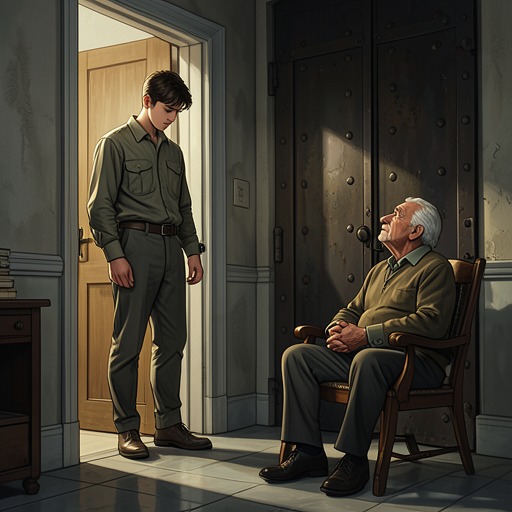
Henry’s age and illness are visible in how he occupies the room. He sits in a wing chair with his feet raised on a footstool, wrapped in a woollen blanket. His legs are bad, and arthritis has twisted his fingers into stiff, clawlike shapes. His eyes water and have burst blood vessels. Later, he is described sleeping in a frayed chair, mouth open, with a few worn teeth showing. These details establish not a passing discomfort but a life increasingly constrained by the ordinary tasks his body can manage.
The house also holds the record of Johnny’s childhood. During a visit, Johnny looks at photographs of himself as a small boy and at a picture of his grandmother, whom he never knew. Henry’s bridge trophies and a mounted grouse are among the objects in the room. The trophies suggest a life with interests and accomplishments beyond his illness, while the bird recalls Johnny’s childhood fear. For Johnny, however, the room’s strongest meaning lies in the person who still sits there and receives him.
A Refuge for Johnny
Henry’s relationship with Johnny is expressed through repeated, unceremonious care. Johnny sits at his grandfather’s feet and asks whether he has eaten; the visit is not merely a conversation but part of a familiar pattern of looking after one another. Henry welcomes him warmly, and Johnny responds with the intimacy of calling him Grandpa. Their closeness matters especially because Johnny recalls little comfort at home: the memories that come readily are of slammed doors and his mother moving through the house in anger and despair.
Henry offers Johnny an affirming account of himself. When Johnny speaks about having had a difficult time, Henry says that he at least knows how to treat other people and condemns the person responsible for hurting him. Johnny answers that the offender’s fingers could be broken. Henry agrees that they could. The exchange joins tenderness to retaliatory talk: Henry’s sympathy is genuine, but he does not redirect Johnny away from violence. His response gives the boy the sense of having an ally, even as their shared language of punishment echoes the anger Johnny carries elsewhere.
That alliance appears again when Johnny tells Henry about Else’s insults. He reports that she has called him a codface, adding to the earlier taunt about his red helmet. Henry’s home is therefore not wholly sealed off from Johnny’s conflicts. Johnny brings the humiliations inside and tells his grandfather about them; Henry listens, making himself a witness to grievances that might otherwise remain part of Johnny’s private resentment.
Money, Care, and Dependence
Henry has accumulated substantial savings through years of monthly deposits. When Johnny reads the account statement, the balance is 973,000 kroner. Henry is pleased that he can leave money behind, but immediately worries that Johnny’s mother will spend it on vodka rather than allow it to benefit Johnny. He asks how she might be disinherited. Johnny considers the question and replies that she cannot be disinherited before she dies. The exchange shows Henry trying to protect his grandson materially, while also revealing how concern about Johnny’s future is entangled with fear about his daughter’s drinking and the destination of his savings.
His own care arrangements are also partly hidden. Mai Sinok bathes him, and Henry says she comes on Sundays as well as on the other days she visits. He tells Johnny that social services do not know she is there every day because he pays her a little under the table; he asks Johnny not to tell, fearing she might lose her job. The arrangement exposes Henry’s dependence on assistance and his effort to preserve it, even by circumventing the rules. He is not simply a passive recipient of care: he negotiates how it is provided and tries to protect the person helping him.
Henry also describes a recent visit from two council workers, whom he identifies by their dark skin and guesses may be Tamil. They have brought a large box. He jokes to Johnny that black muscles are as good as white ones, perhaps better, then urges his young grandson to come closer. He calls the change a miracle and remarks that it is not too late for an old bag of bones. The evidence does not identify what the box contains, but Henry’s excitement makes clear that he regards the council visit as a meaningful change in his circumstances. His humor briefly sets his frailty against the possibility of renewed help.
Death and Narrative Significance
Johnny’s attachment to Henry becomes starkest when he sits beside him asleep. Johnny thinks of himself as insignificant and disconnected, without goals or reasons to live, yet recognizes a bond with the old man. He imagines the small acts that give their relationship its shape: making Henry a sandwich, swatting a fly, fetching the post, and chatting. His question about where he will go when Henry is gone frames the grandfather not only as family but as Johnny’s principal place of belonging and clarity.
Henry’s death is discovered in his house by Mai Sinok, who points the arriving investigators toward the lounge. Sejer and Skarre find him slumped over the armrest of his chair, one foot on the footstool and the other on the floor. They consider that he may have tried to stand or escape, but cannot establish that from his position. Blood is visible around his mouth and chest, with some on the floor. He wears an old green cardigan, and his oversized trousers are held up by a narrow belt altered with an extra hole, a small sign of his physical decline. A crime-scene officer supplies gloves, and Sejer carefully opens Henry’s mouth; the examination notes that he has a full set of teeth. The discovery presents a violent end inside the domestic space associated with Johnny’s safety, without by itself specifying the cause.
Henry’s narrative importance rests on the sharp difference between Johnny’s broad indifference to consequences and his particular devotion to his grandfather. The ordinary acts of visiting and helping are among the few meaningful purposes Johnny can name. Henry’s age and dependence do not erase his agency: he comforts Johnny, takes his complaints seriously, worries over money, manages care, and responds with humor to a possible improvement in his condition. His death therefore removes more than an elderly relative. It closes the daily refuge on which Johnny’s fragile sense of connection depends.