Jacob Skarre
The CallerJacob Skarre is a police officer and Konrad Sejer’s younger colleague. He helps investigate the attacks and hoaxes that unsettle the community, but his significance is not limited to procedure: he reads the campaign as a deliberate cruelty, imagines what it would mean to become its target, and is shaken when the investigation reaches a child’s remains. His characterization joins a playful manner to a moral seriousness that grows unmistakable as the pranks’ consequences become harder to contain.
Identity and Character
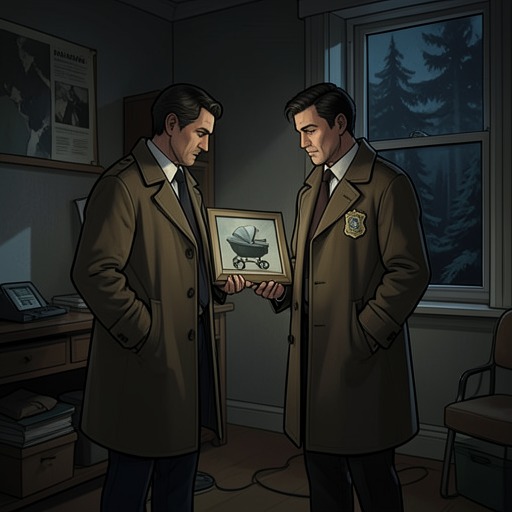
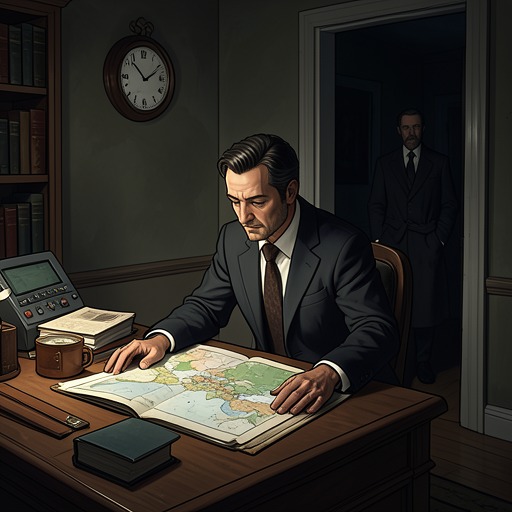
Skarre is introduced alongside Sejer when the two officers arrive at the Sundelins’ home after the attack on their baby, Margrete. The contrast between the men is visible in their appearance: Sejer is tall and grey-haired, while Skarre is young and curly-haired. The narration supplies a fuller portrait as Skarre studies the map. His father was a vicar, and he was raised to be fair, trustworthy, and demanding. That serious upbringing did not extinguish a boyish playfulness, a quality that draws people to him, especially women. He is unmarried and has no children that he knows of.
The narration also places him in relation to Margrete and her mother, Lily. He has noticed the baby’s chubby cheeks and the way she lies in Lily’s embrace, and recognizes the smell of milk and soap. This attention to the intimacy of ordinary care sits beside his professional appraisal of the crime. When he considers that the perpetrator may have watched the household’s routines and waited to see Lily’s reaction, he calls the act pure evil and says he is almost speechless. His response is not a lack of investigative thought; it is a judgment about the deliberate use of a mother’s fear.
Investigative Judgment and Empathy
Skarre’s work depends on reconstructing what an offender could have observed. At the map, he considers how the perpetrator might have approached the Sundelins’ house, watched when Margrete slept, and chosen a moment when Lily would be likely to discover the attack. He sees the planning not as a harmless trick but as the means by which the prankster turns knowledge of a family’s routine into an instrument of distress. His indignation gives moral weight to details that might otherwise sound merely tactical.
His empathy also appears in the way he responds to a hypothetical victim. When Sejer asks how he would react to seeing his own obituary in the newspaper, Skarre first opens his mouth, then falls silent to think. He imagines encountering a notice of his death during breakfast, in several possible formulations, rather than answering quickly. The pause makes the question personal without making him the victim: he tests the emotional force of the prank by picturing its effect on himself. The scene links investigative understanding to an act of imaginative attention.
The Prankster and Public Attention
As Johnny Beskow’s pranks attract attention, Skarre becomes a point of reference for thinking through their effects. Johnny rides his red Suzuki moped through the neighborhood and watches people in their gardens, taking pleasure in the busy details of their everyday lives even as he wants to destroy their sense of safety. Meanwhile, the public and newspaper staff begin giving Johnny nicknames. The narration records Johnny’s delight at finally making himself impossible to ignore and his intention to continue the game. These details belong to Johnny’s experience, not to Skarre’s, but they frame the investigation in which Skarre works: public attention can turn a prankster into a spectacle even as the targets bear the fear.
Sejer brings the problem back to Skarre by asking him to consider the obituary as if it were his own. Skarre’s silence is important against Johnny’s appetite for recognition. Where Johnny takes pleasure in being discussed, Skarre considers the imagined cost of being declared dead. The contrast does not make him a simple opposite to the prankster; it shows what Johnny’s performance leaves out—the private shock of the person who believes, even briefly, that a public notice has erased them.
Private Life and the Glenna Discovery
A quieter glimpse of Skarre comes after a shift. He returns to his flat with shopping bags packed with food, but the kitchen worktop is crowded. Against the wall sit a food processor, coffee maker, coffee grinder, sandwich maker, toaster, and a plastic salad spinner that will not fit in the cupboards. As he is about to put the groceries away, his mobile rings. The scene gives him a concrete domestic setting alongside the work and moral strain of the investigation; the caller is Britt, though this moment does not explain their relationship.
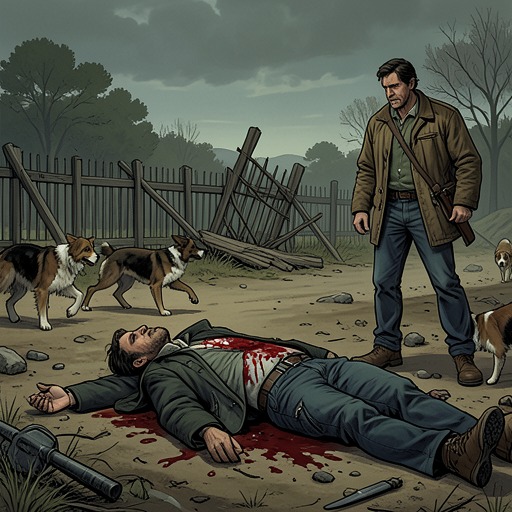
Later, Skarre is so agitated that he can barely speak when he calls Sejer and insists that he come at once. He has seen people floating in lakes and hanging from beams, and he and his colleagues have learned ways to remain calm around tragedies. This discovery, he says, is different and hideous. When Sejer reaches Glenna, officers and investigators are gathered near the fork in the road; one officer is sobbing, and a green tarpaulin covers a very small body. Skarre is there as Sejer approaches and tells him to take a deep breath. The controlled instruction carries the effort of composure, but it cannot make the scene ordinary. Skarre’s agitation marks a limit in the professional habits that have helped him face other deaths.
Narrative Role and Significance
Skarre serves as both an investigative partner to Sejer and a measure of the human damage hidden inside the word prank. His map-based reasoning follows how an offender could exploit a household’s routines, while his response to the obituary question makes him imagine the fear from the target’s side. At Glenna, the scale of the violence overwhelms the calm he has learned in police work. Across these moments, his defining combination remains intact: the fair and demanding officer can condemn calculated cruelty, while the playful, attentive man is still vulnerable to what he sees. The novel uses that combination to distinguish understanding a perpetrator’s methods from excusing what those methods do to other people.